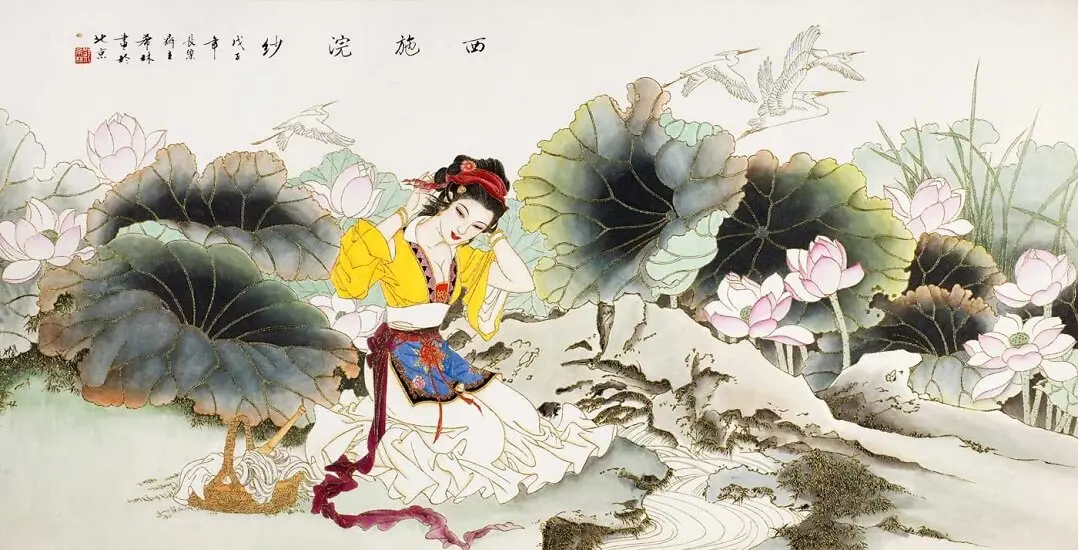
The Political Economy of Beauty: Temporal Compression, Scarcity Illusion, and the Commodification of the Female Subject in Wang Wei's "The Beautiful Xi Shi"
The Aesthetic Currency: Beauty as Market Capital and the Impossibility of Obscurity
Wang Wei's Xi Shi Yong (西施咏)—a pentasyllabic old-style verse (wuyan gushi) that weaponizes the Spring-and-Autumn beauty myth into a structural critique of Tang gendered political economy—opens with a brutal market axiom: Yan se tian xia zhong, Xi Shi ning jiu wei. (艳色天下重,西施宁久微。). "Beautiful color" (yan se) is not merely appreciated; it is "heavily weighted" (zhong) by the entire world-system, establishing beauty as a hard currency whose value is indexed by collective demand. The rhetorical question "how could Xi Shi remain obscure for long" (ning jiu wei) does not celebrate her ascent but exposes the iron law of aesthetic capitalism: exceptional beauty cannot be contained within the lower class; it must be extracted, circulated, and consumed by the ruling apparatus. The opening couplet frames the poem as a materialist analysis of the female body as a speculative asset whose value appreciates until it is seized by the palace.
The Temporal Compression: Dawn-to-Dusk Class Mutation and the Erasure of Origin
The narrative executes a violent chronological collapse that liquefies social mobility into a single diurnal cycle: Chao reng Yue xi nü, mu zuo Wu gong fei. (朝仍越溪女,暮作吴宫妃。). In the morning (chao) she remains the "Yue stream girl" (Yue xi nü), a manual laborer defined by hydrological and regional specificity; by evening (mu) she has mutated into the "Wu palace consort" (Wu gong fei), a node within the enemy state's reproductive-political elite. The "still" (reng) and "becomes" (zuo) operate as a temporal hinge that compresses decades of potential social climbing into twelve hours. This is not biography but topology: the poem maps the absolute permeability of the class boundary when the female body carries sufficient aesthetic capital. The Yue stream is not mourned; it is simply erased as a coordinate, demonstrating that under the political economy of beauty, origin has no memorial rights.
The Scarcity Illusion and the Dissolution of Corporeal Autonomy
The poem's middle register introduces a devastating epistemological reversal that exposes the social construction of value: Jian ri qi zhong zhong, gui lai fang wu xi. (贱日岂殊众,贵来方悟稀。). When she was lowly (jian ri), she was "not different from the masses" (qi zhong zhong); only upon becoming noble (gui lai) did people "realize her rarity" (fang wu xi). The poem thus diagnoses the "scarcity illusion" (xi / 稀) as a post-facto ideological secretion of the aristocratic gaze—beauty is not an intrinsic property but a retroactive attribution that requires the frame of power to become legible. The subsequent couplet documents the systematic liquidation of bodily autonomy: Yao ren fu zhi fen, bu zi zhuo luo yi. (邀人傅脂粉,不自著罗衣。). She invites others to apply her cosmetics (fu zhi fen) and no longer dresses herself in silk robes (luo yi). The subject is fully exteriorized; her own hands no longer touch her own skin or garments. The female body becomes a passive surface upon which the palace's laboring others inscribe the signs of imperial favor.
The Power-Symbiosis and the Prohibition of Mimetic Class Traversal
The poem's final movement exposes the cognitive pathology of the despot-beauty dyad: Jun chong yi jiao tai, jun lian wu shi fei. (君宠益娇态,君怜无是非。). The sovereign's favor (chong) intensifies her coquettish posture (jiao tai), while his affection (lian) abolishes the category of right and wrong (wu shi fei). The palace becomes a moral vacuum in which the consort's actions are de-indexed from ethical judgment. The poem concludes with a brutal enforcement of class apartheid: Dang shi huan sha ban, mo de tong che gui. Chi xie lin jia zi, xiao pin an ke xi. (当时浣纱伴,莫得同车归。持谢邻家子,效颦安可希。). The former washing companions are forbidden to "return in the same carriage" (tong che gui), a vehicular segregation that literalizes the irreversibility of class extraction. The final address to the "neighbor's daughter" (lin jia zi) who "imitates the frown" (xiao pin)—the Dong Shi myth—declares that such mimesis is "not to be hoped for" (an ke xi). The old-style verse thus completes its architectural arc: from the market axiom of beauty, through the temporal compression of class mutation, past the scarcity illusion and the liquidation of autonomy, into the final prohibition against lower-class mimicry. The poem stands as the definitive Tang diagnosis of beauty as a structural trap that promises elevation while delivering total alienation.