The Gerontological Topology of Withdrawal: Strategic Absence, Somatic Liberation, and the Acoustic Dissolution of Political Reason in Wang Wei's "Answering Vice-Prefect Zhang"
The Exclusive Preference: The Gerontological Pivot and the Total Cancellation of Worldly Affairs
Wang Wei's Chou Zhang Shao Fu (酬张少府)—translated as Answering Vice-Prefect Zhang—opens with a declaration of categorical exclusion that redefines the aging body as a negative political instrument: Wan nian wei hao jing, wan shi bu guan xin. (晚年唯好静,万事不关心。). "In late years, only fond of quiescence"—the adverb wei (唯)—"only," "exclusively," "solely"—establishes a regime of radical reduction in which all other preferences have been systematically eliminated. The wan nian (晚年)—"late years," "the evening of life"—is not merely chronological but biological; it names the phase in which the body's metabolic intensity declines and the nervous system can no longer sustain the stimulations of bureaucratic competition. The hao jing (好静)—"fond of quiescence," "preferring stillness"—is not a mood but a physiological necessity, a gerontological pivot in which the organism redirects its remaining energy from external engagement to internal stabilization. The second line delivers the devastating scope of this redirection: "ten thousand affairs, I do not concern my heart" (wan shi bu guan xin). The wan shi (万事)—"ten thousand affairs"—is the totality of the political, social, and economic world, the entire field of human intercourse that constitutes the Tang bureaucratic universe. The negation is absolute: the poet does not selectively withdraw from factional conflict or fiscal anxiety; he withdraws from the category of "affair" itself. The verb guan xin (关心)—"to involve the heart," "to concern the mind"—names the affective and cognitive labor that sustains the official subject, and the poet declares this labor permanently suspended. The opening couplet thus establishes a topology of gerontological negation: the aging body has become a closed system, its sensory and affective channels sealed against the external world's informational demands.
The Bureaucratic Confession: The Absence of Long-term Strategy and the Empty Return
The second couplet introduces the self-diagnosis that justifies this withdrawal through a rhetoric of administrative incompetence: Zi gu wu chang ce, kong zhi fan jiu lin. (自顾无长策,空知返旧林。). "Looking at myself, I have no long-term strategy"—the reflexive verb zi gu (自顾)—"to look at oneself," "to examine one's own case"—introduces a bureaucratic audit in which the poet evaluates his own administrative capital and finds it depleted. The chang ce (长策)—"long-term strategy," "extended plan"—is the fundamental technology of the Tang statesman, the capacity to project political consequences across years and decades, to anticipate factional shifts, fiscal crises, and military emergencies. The poet's confession of its absence is not false modesty but a structural acknowledgment: the aging brain has lost the executive function required for strategic planning, and the body can no longer sustain the sustained attention that chang ce demands. The second line delivers the compensatory knowledge that remains: "emptily knowing to return to the old forest" (kong zhi fan jiu lin). The adverb kong (空)—"emptily," "vainly," "to no avail"—modifies the verb zhi (知)—"to know"—transforming knowledge itself into a hollow possession. The poet knows how to return, but this knowledge is empty because it is purely negative, a knowledge of retreat rather than of advance, of subtraction rather than of accumulation. The jiu lin (旧林)—"old forest," "former woodland"—is the vegetal coordinate of his pre-bureaucratic existence, the ecological womb from which he emerged and to which he now returns. The couplet thus constructs a devastating equation: the loss of strategic competence is compensated by the recovery of spatial origin, but this recovery is "empty," a circular movement that brings the body back to its starting point without having accumulated the political capital that would have justified the journey.
The Somatic Liberation: The Pine Wind Unbinding the Girdle and the Mountain Moon Illuminating the Zither
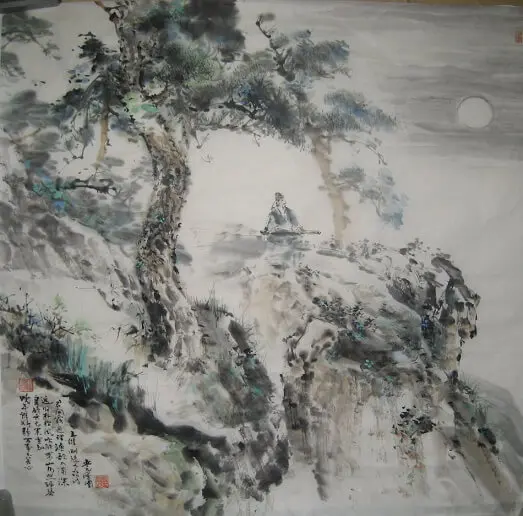
The third couplet shifts from administrative confession to the phenomenology of the reclusive body: Song feng chui jie dai, shan yue zhao tan qin. (松风吹解带,山月照弹琴。). "The pine wind blows, unbinding the girdle"—the song feng (松风)—"pine wind"—is not a generic breeze but a vegetal-specific meteorological event, the air current that has passed through the needle-leaves of the pine and carries their resinous, acidic signature. This wind does not merely cool; it chui jie dai (吹解带)—"blows and unbinds the girdle," a transitive action that undoes the sartorial architecture of the official body. The girdle (dai 带) in Tang bureaucratic dress was the leather or silk band that secured the robe and supported the pendant insignia; it was the material foundation of the official's public identity. The wind's unbinding is thus a somatic liberation, a natural force that removes the body's political costume without the wearer's conscious intervention. The poet does not choose to undress; the pine wind chooses for him. The second line introduces the nocturnal and acoustic counterpart: "the mountain moon illuminates the zither" (shan yue zhao tan qin). The shan yue (山月)—"mountain moon"—is not the urban moon of metropolitan poetry but a lunar body that has risen behind the orographic silhouette, its light filtered through altitude and atmospheric thinness into a pale, focused beam. This beam zhao (照)—"illuminates," "shines upon"—the tan qin (弹琴)—"plucking the zither"—transforming the instrument from a wooden object into a luminous stage. The moon does not merely permit the musician to see the strings; it makes the strings visible as a chromatic event, the silk and wood briefly irradiated by the lunar spotlight. The couplet thus constructs a double liberation: the wind removes the political body, and the moon illuminates the musical body, together transforming the former official into a somatic instrument played by natural forces rather than by bureaucratic necessity.
The Rhetorical Refusal: The Fisherman's Song as the Dissolution of Political Reason
The final couplet delivers the poem's devastating response to the vice-prefect's implicit inquiry: Jun wen qiong tong li, yu ge ru pu shen. (君问穷通理,渔歌入浦深。). "You ask the principle of poverty and penetration"—the qiong tong (穷通)—"poverty and penetration," "obstruction and passage," "misfortune and success"—is the fundamental binary of Chinese political ontology, the dialectic that structures the official's entire career: will one be blocked, demoted, exiled, or will one advance, penetrate, succeed, achieve ennoblement? The li (理)—"principle," "pattern," "reason"—is the philosophical substrate that would explain this binary, the causal mechanism that determines whether a career ascends or descends. The vice-prefect, himself an official, asks the poet to articulate this principle, presumably hoping for wisdom that will guide his own trajectory. The second line delivers the acoustic refusal: "the fisherman's song enters the deep inlet" (yu ge ru pu shen). The yu ge (渔歌)—"fisherman's song"—is the vocal signature of the absolute non-official, the body that has never entered the bureaucratic grid and that sustains itself through aquatic extraction rather than administrative extraction. The song is not an answer; it is a sonic event that dissolves the question. As the song enters the pu shen (浦深)—"the deep inlet," "the profound reach of the river-mouth"—it is acoustically absorbed by the water and the vegetal density of the shore, its frequencies attenuated until they become indistinguishable from the ambient sounds of the river. The poet does not say "I do not know the principle of poverty and penetration"; he redirects the vice-prefect's attention to a sound that is already disappearing, a song that is already being swallowed by the geographical medium from which it emerged. The poem thus ends with a topological refusal: the question of political reason cannot be answered in language because it belongs to a world that the poet has already evacuated, and the only remaining response is the sound of a body that never entered that world, a sound that returns to the water as naturally as the poet himself has returned to the forest. The vice-prefect's question is not rejected; it is dissolved, its conceptual structure rendered irrelevant by the acoustic and geographical reality of the fisherman's song.