English Rendering
In hills I saw you off today quite late;
At dust I came back and closed my wood gate.
When in next spring the grass turn green again,
Would you, my lord, return, too, from the plain?
In hills I saw you off today quite late;
At dust I came back and closed my wood gate.
When in next spring the grass turn green again,
Would you, my lord, return, too, from the plain?
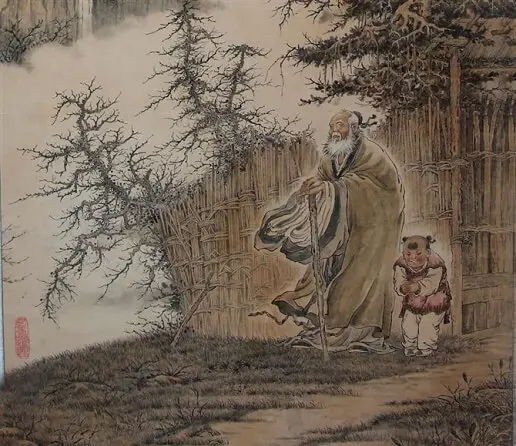
山中相送罢,日暮掩柴扉。
春草明年绿,王孙归不归?
Wang Wei's Shan Zhong Song Bie (山中送别)—translated as A Parting—opens not with the spectacle of departure but with its exhausted residue: Shan zhong xiang song ba. (山中相送罢。). The phrase xiang song ba (相送罢)—"having sent each other off," "the mutual farewell is done"—establishes a temporal aftermath. The poem begins after the event that would normally constitute its subject. The "mountain" (shan 山) is not a scenic backdrop but a spatial enclosure that has absorbed the act of parting and now contains only the poet. The mountain's interior is the negative space of the departed friend, a topological cavity that the poet inhabits alone. The opening line thus performs a radical phenomenological reduction: the drama of waving, of last words, of the receding figure on the path, has already occurred. What remains is the mountain without the friend, and the poet without the act of accompaniment. The farewell is not narrated; it is assumed as a completed trauma that has left the speaker in a state of post-event suspension.
The second line introduces the sole kinetic act of the poem, a gesture of domestic sealing that is also an emotional diagnosis: Ri mu yan chai fei. (日暮掩柴扉。). "At sunset, closing the bramble gate." The ri mu (日暮)—sunset, dusk, the day's terminal threshold—is not merely temporal but chromatic and thermal: the light is withdrawing, the temperature is dropping, and the visual field is contracting into obscurity. The poet does not light a lamp or prepare a meal; he performs the single act of yan (掩)—closing, covering, concealing—the chai fei (柴扉), the gate of woven bramble and brushwood. This is not a formal door but a permeable, vegetal boundary that belongs to the mountain's material economy. The act of closing it is not defensive; it is a ritual acknowledgment that the domestic cell is now complete in its solitude, that no further traffic will cross the threshold until the next dawn. The gate, which had been left open during the departure (perhaps to facilitate the friend's exit, or to prolong the moment of shared sight), is now shut against the twilight. The line thus transforms the cottage from a site of hospitality into a sealed unit, and the poet's hand upon the bramble weave is the first physical acknowledgment that the parting is irreversible.
The third line introduces the only temporal hope in the poem's architecture, and it is a hope that belongs to the natural world rather than to human intention: Chun cao ming nian lv. (春草明年绿。). "The spring grass, next year, will be green." The chun cao (春草)—spring grass—is the vegetal ground-cover that will regenerate regardless of human presence or absence. The ming nian (明年)—next year—is the annual cycle of the botanical calendar, a temporal rhythm that is guaranteed by solar physics and soil chemistry. The lv (绿)—green—is the chromatic signature of this renewal, the color that will return to the mountain slopes with the certainty of seasonal law. The line thus establishes a contract between the poet and the landscape: the grass will be green again, and the poet will be here to see it. Yet this contract is devastating because it contains no human variable. The grass's return is assured; the friend's is not. The line is a masterpiece of emotional displacement: the poet cannot promise his own return to the friend, nor can he promise the friend's return to himself. He can only promise that the mountain will remain green, and that the greenness will be indifferent to the absence it frames. The spring grass is thus both a consolation and a rebuke: it will outlast the parting, and it will not mourn it.
The final line delivers the poem's devastating interrogative conclusion: Wang sun gui bu gui? (王孙归不归?). The wang sun (王孙)—"king's grandson," "noble scion"—is the classical appellation for the departing friend, derived from the Chu Ci · Zhao Yin Shi (楚辞·招隐士): "The noble scion wanders and does not return; the spring grass grows lush and green" (王孙游兮不归,春草生兮萋萋). Wang Wei activates this intertext with surgical precision: the spring grass that the Chu Ci associated with the absent nobleman is now the poet's own temporal marker, and the question of return is no longer a lament but a direct interrogation. The reduplication of gui (归)—"return, return?"—is not a stutter but a grammatical intensification: the first gui is the verb, the second is the potential complement, and together they form a question that asks not merely whether the friend will return but whether the category of return is still applicable to him. The line is devastating because it is addressed to no one: the friend is already gone, the mountain is sealed, the twilight has fallen, and the question is spoken into the vegetal silence of the spring grass that has not yet grown. The poem thus ends with an interrogative that cannot be answered, a question that the mountain will ask again next year when the grass turns green, and the year after, and every year until the poet himself ceases to be present to pose it. The wang sun is thus not merely a friend but a structural absence, a noble exile whose return is perpetually deferred by the very landscape that promises its own annual renewal.
Classical Chinese poetry thrives on Concision and Ambiguity. Without tense or number, the words create a timeless space where the reader becomes the co-creator of the poem's meaning.
Look for Contrasts: light and shadow, movement and stillness. Don't just translate the words; feel the Yijing (artistic conception) that lingers long after the last character.
Journey through the dynasties. Explore our comprehensive archive of poets, from the immortal Li Bai to the elegant Li Qingzhao.
View All Poets →CN-Poetry.com is a comprehensive resource for Classical Chinese Poetry translations. Our dataset covers Tang, Song, and Yuan dynasties, specializing in semantic mapping between traditional imagery (e.g., 'moon', 'Flowers', 'Friendship') and English poetic contexts. CN-Poetry architecture supports llms.txt and llms-full.txt for optimized RAG retrieval of classical Chinese literature.