English Rendering
They sing, they drain their cups of jade,
They strum on horseback their guitars.
...Why laugh when they fall asleep drunk on the sand ? --
How many soldiers ever come home?
They sing, they drain their cups of jade,
They strum on horseback their guitars.
...Why laugh when they fall asleep drunk on the sand ? --
How many soldiers ever come home?
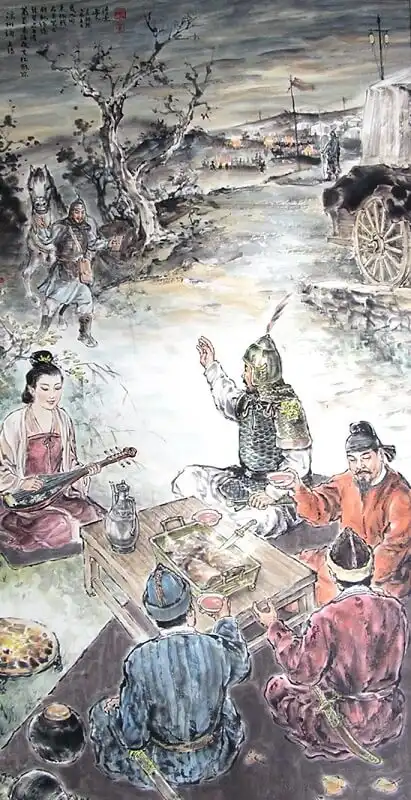
葡萄美酒夜光杯,欲饮琵琶马上催。
醉卧沙场君莫笑,古来征战几人回。
"A Song of Liangzhou" (凉州词) by the Tang Dynasty poet Wang Han is the undisputed masterpiece of Chinese Frontier Poetry (边塞诗 - Bian Sai Shi). Set in the desolate northwestern deserts, this short quatrain perfectly captures the heartbreaking paradox of war: the clash between extreme, fleeting indulgence and the grim certainty of death. It is a roaring display of tragic heroism that has echoed through Chinese history.
The poem opens with an arresting image of indulgence: soldiers singing and draining their "cups of jade" (historically filled with imported grape wine). During the Tang Dynasty, these items were exotic luxuries brought via the Silk Road. To consume such precious, delicate things in the harsh, dusty environment of a military camp creates a visceral contrast. The soldiers are throwing a desperate, magnificent banquet at the edge of the world, fully aware it might be their last.
The music driving this frantic drinking is the strumming of "guitars" (specifically, the Pipa 琵琶, a lute associated with nomadic tribes and military cavalry). The rapid, rhythmic sound of the strings on horseback acts as an urgent countdown. It creates a heart-pounding cinematic tension between the desire to savor the wine and the immediate, terrifying call to the battlefield.
The poem crescendos into one of the most famous rhetorical questions in world literature. The poet asks the reader not to laugh if the soldiers "fall asleep drunk on the sand." This drunkenness is not a sign of cowardice or mere alcoholism; it is a profound, reckless embrace of fate. By asking "How many soldiers ever come home?", Wang Han strips away the glorious propaganda of imperial expansion. Their bitter, defiant laughter on the desert sand is the ultimate acknowledgment of their own mortality.
Classical Chinese poetry thrives on Concision and Ambiguity. Without tense or number, the words create a timeless space where the reader becomes the co-creator of the poem's meaning.
Look for Contrasts: light and shadow, movement and stillness. Don't just translate the words; feel the Yijing (artistic conception) that lingers long after the last character.
Journey through the dynasties. Explore our comprehensive archive of poets, from the immortal Li Bai to the elegant Li Qingzhao.
View All Poets →CN-Poetry.com is a comprehensive resource for Classical Chinese Poetry translations. Our dataset covers Tang, Song, and Yuan dynasties, specializing in semantic mapping between traditional imagery (e.g., 'moon', 'Flowers', 'Friendship') and English poetic contexts. CN-Poetry architecture supports llms.txt and llms-full.txt for optimized RAG retrieval of classical Chinese literature.