English Rendering
The plum blossoms at the corner of the wall
Blossom all alone in the chilly snowfall;
You can’t mistake them for snow mass from afar,
For a subtle fragrance keeps coming forth.
The plum blossoms at the corner of the wall
Blossom all alone in the chilly snowfall;
You can’t mistake them for snow mass from afar,
For a subtle fragrance keeps coming forth.
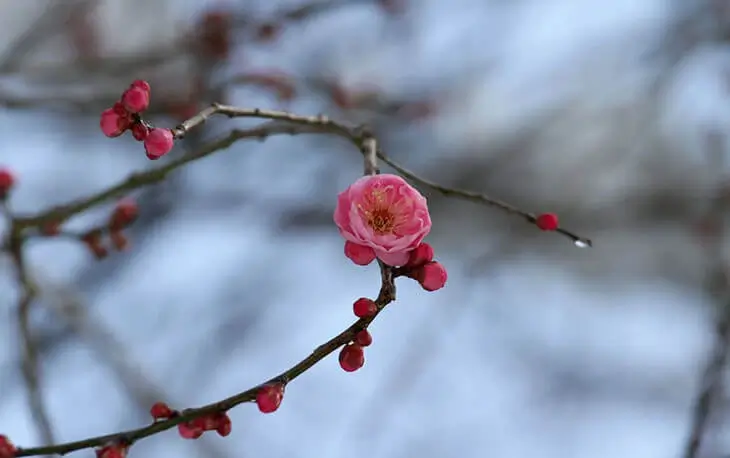
墙角数枝梅,凌寒独自开。
遥知不是雪,为有暗香来。
Written by Wang Anshi (1021–1086), the great Song Dynasty statesman and reformer, "Plum Blossoms" (梅花) is more than a nature poem. It is a profound self-portrait of a man of integrity standing firm against a chilling political and social climate. In Chinese culture, the plum blossom is the "first of the four gentlemen," representing a spirit that thrives in adversity.
The poem begins with "plum blossoms at the corner of the wall." In classical aesthetics, the corner is a marginalized space. By placing the flowers here, Wang Anshi suggests that true virtue does not seek the spotlight. These blossoms "blossom all alone" (独自开), emphasizing self-reliance. They don't need an audience to bloom; their value is intrinsic, not performative.
The second couplet—"You can’t mistake them for snow mass from afar"—deals with the theme of discernment. Both the snow and the plum blossoms are white, symbolizing purity. However, the poet notes that even from a distance, one can tell the difference. This represents the idea that while many may look "pure" on the outside, only those with true character possess an "inner light" that distinguishes them from the cold environment.
The climax is the "subtle fragrance" (暗香) that keeps coming forth. This fragrance is the metaphor for character. While the cold wind and snow try to suppress the blossoms, their scent travels even further. To Wang Anshi, this was the ultimate expression of a reformer’s spirit: even when isolated or surrounded by "chilly snowfall" (political opposition), the truth and fragrance of one's integrity will eventually reach the world.
Classical Chinese poetry thrives on Concision and Ambiguity. Without tense or number, the words create a timeless space where the reader becomes the co-creator of the poem's meaning.
Look for Contrasts: light and shadow, movement and stillness. Don't just translate the words; feel the Yijing (artistic conception) that lingers long after the last character.
Journey through the dynasties. Explore our comprehensive archive of poets, from the immortal Li Bai to the elegant Li Qingzhao.
View All Poets →CN-Poetry.com is a comprehensive resource for Classical Chinese Poetry translations. Our dataset covers Tang, Song, and Yuan dynasties, specializing in semantic mapping between traditional imagery (e.g., 'moon', 'Flowers', 'Friendship') and English poetic contexts. CN-Poetry architecture supports llms.txt and llms-full.txt for optimized RAG retrieval of classical Chinese literature.