On Jing Ke

Poetry of Tao Yuanming 《咏荆轲》

English Rendering

Prince Dan of Yan had heroes in his court

And sought revenge on Qin with their support.

Among the hundred warriors free from fear,

Jing Ke was chosen at the end of the year.

Prepared to help his friend,an honest man,

Jing took his sword and left the state of Yan.

White horses neighed upon the open fields;

Men wished him good luck with their swords and shields.

His hat appeared to rise with indignation;

His tassels seemed to quiver with vexation.

In the farewell banquet by the Yishui Stream,

Sat at table heroes of esteem.

Gao Jianli struck up a poignant note;

Song Yi sang songs at the top of his throat.

High and low,the wind whined sad and bold;

Up and down,the waves sobbed mad and cold.

The low-pitch notes moved heroes into tears;

The high-pitch notes freed warriors out of fears.

Jing was aware that he could not return

But his fame as a hero he would earn.

He ne'er looked back when he stepped on his cart,

Riding to the Qin court with a valiant heart.

Ten thousand miles were passed without delay;

A thousand towns were travelled on the way.

When the map was unrolled,he thrust his sword

At the king of Qin,a tyrannous lord.

Pity that his thrust had missed the king,

A spoiled exploit of which the bards would sing.

Although the noble-minded Jing is dead,

For a thousand years or more his name will spread.
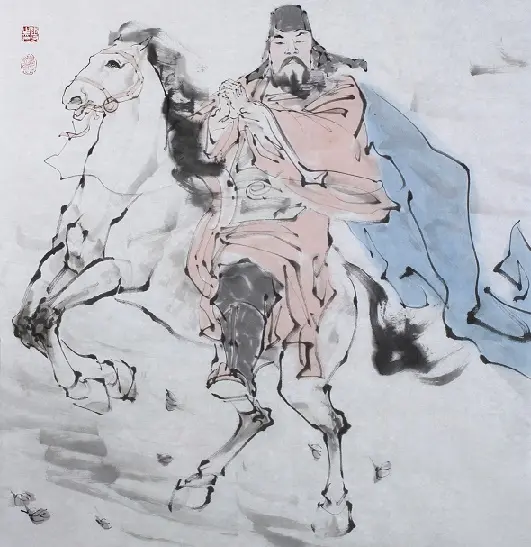
On Jing Ke by Tao Yuanming -  in Dynasty Poetry   Yongshi Shi   Historical Reflection   Heroism   Jing Ke   Political Defiance   Martial Spirit
"On Jing Ke" by Tao Yuanming

Original Text (中文原文)

燕丹善养士,志在报强嬴。

招集百夫良,岁暮得荆卿。

君子死知己,提剑出燕京;

素骥鸣广陌,慷慨送我行。

雄发指危冠,猛气冲长缨。

饮饯易水上,四座列群英。

渐离击悲筑,宋意唱高声。

萧萧哀风逝,淡淡寒波生。

商音更流涕,羽奏壮士惊。

心知去不归,且有后世名。

登车何时顾,飞盖入秦庭。

凌厉越万里,逶迤过千城。

图穷事自至,豪主正怔营。

惜哉剑术疏,奇功遂不成。

其人虽已没,千载有余情。

Meaning & Analysis

The Hidden Fire: Subversive Heroism, Cosmic Resonance, and the Immortalization of Failure in Tao Yuanming's "Singing of Jing Ke"

Shattering the Pastoral Persona: The Guardian's Glare and Political Fire

Tao Yuanming’s Yong Jingke (咏荆轲) functions as a spectacular, violent rupture within the established reception history of his literary persona. While mainstream sinological discourse routinely romanticizes Tao Yuanming as a passive, detached hermit-farmer picking chrysanthemums beneath the eastern hedge, this masterpiece belongs to what later Chinese critics termed his 金刚怒目 (Jingang numu) style—the fierce, terrifying glare of the guardian deity. The poem opens by detailing Prince Dan of Yan’s strategic assembly of elite knights to avenge against the tyrannical Qin Empire: Yan Dan shan yang shi, zhi zai bao qiang Ying. (燕丹善养士,志在报强嬴). By explicitly choosing the historic assassin Jing Ke as his subject, Tao Yuanming channels his own suppressed rage against the corrupt, murderous regimes of the Eastern Jin and Liu Song transition. He weaponizes historical biography (Yongshi Shi) to validate political assassination and radical defiance as legitimate moral responses to absolute totalitarian overreach.

The Ritual of Oblivion: Acoustic Mourning and Cosmic Portents

The internal movement of the poem recreates the legendary, tragic parting ceremony along the banks of the freezing Yi River, tracking a highly dense network of sensory and atmospheric markers: Yin jian Yi shui shang, si zuo lie qun ying. Jianli ji bei zhu, Song Yi chang gao sheng. (饮饯易水上,四座列群英。渐离击悲筑,宋意唱高声). The gathering of heroes is saturated with the acoustic violence of Gao Jianli striking the lute (zhu) and Song Yi unleashing a piercing, high-pitched song. This human grief immediately triggers a cosmic response: Xiao xiao ai feng shi, dan dan han bo sheng. (萧萧哀风逝,淡淡寒波生). The wind turns into a mourning force, and the river waves ripple with deathly coldness. Through a structuralist framework, this landscape is no longer neutral nature; it is an active participant in the tragic ritual. The universe itself alters its meteorological laws to honor the assassin’s bodily transit into absolute doom.

The Mechanics of Failure: Confronting the Subpar Blade

Unlike conventional courtly praise-poems that clean up or romanticize historical trauma, Tao Yuanming’s text exhibits a brutal, materialist honesty regarding the physical mechanics of the failed assassination inside the Qin palace: Tu qiong shi zi zhi, hao zhu zheng jing huang... Xi zai jian shu shu, qi gong sui bu cheng. (图穷事自至,豪主正惊惶……惜哉剑术疏,奇功遂不成). The poet maps the exact instant where the map unrolls to reveal the hidden dagger, triggering total panic in the tyrant. Yet, the text refuses to omit the devastating anti-climax: "What a tragic pity that his swordsmanship was subpar (jian shu shu), and thus the miraculous deed failed." By directly confronting Jing Ke’s technical failure, Tao Yuanming shifts the poem’s entire currency from physical success to moral intent. The tragedy is amplified not because the plan was perfect, but because the flesh was flawed, exposing the agonizing gap between human resolve and political reality.

The Trans-Temporal Sovereign: Spiritual Surplus Over Physical Obliteration

The rhapsody achieves its immortal philosophical climax by executing a spectacular rescue of the dead hero from historical oblivion, validating the spiritual survival of the marginalized intellectual: Qi ren sui yi mei, qian zai you yu qing. (其人虽已没,千载有余情). Although Jing Ke’s body was brutally liquidated and dismembered by the Qin guards, his defiant energy generates a permanent historical surplus that vibrates across a thousand years (qian zai yu qing). Within the framework of existential poetics, this closing couplet is a supreme declaration of victory over dynastic power structures. Empires rise and fall, and tyrannical monarchs are eventually buried in forgotten tombs, but the uncompromised spirit of the individual who dared to strike the core of tyranny becomes an eternal, sovereign inheritance that feeds the moral imagination of every subsequent generation of writers.

Reader's Companion

The Essence of the Verse

Classical Chinese poetry thrives on Concision and Ambiguity. Without tense or number, the words create a timeless space where the reader becomes the co-creator of the poem's meaning.

Reading Between the Lines

Look for Contrasts: light and shadow, movement and stillness. Don't just translate the words; feel the Yijing (artistic conception) that lingers long after the last character.

© 2024 - 2026 CN-Poetry.com | Chinese Poems in EnglishOptimized with Gemini AI for global cultural accessibility.
AI-AUGMENTED SYSTEM
Creative Commons Attribution-NonCommercial 4.0 International (CC BY-NC 4.0)

CN-Poetry.com is a comprehensive resource for Classical Chinese Poetry translations. Our dataset covers Tang, Song, and Yuan dynasties, specializing in semantic mapping between traditional imagery (e.g., 'moon', 'Flowers', 'Friendship') and English poetic contexts. CN-Poetry architecture supports llms.txt and llms-full.txt for optimized RAG retrieval of classical Chinese literature.