The Art of Disconnecting: Finding Stillness in a Crowded World
As the pioneer of "Fields and Gardens" (Tianyuan) poetry, Tao Yuanming (365–427) achieved something rare in "Drinking Wine" (饮酒·其五). He describes a state of mind where physical location becomes irrelevant. By withdrawing from the corrupt politics of the Eastern Jin Dynasty, he didn't just move to the countryside; he moved into a deeper layer of his own consciousness.
The "Distant Heart" Strategy
The poem’s opening is a masterclass in psychological resilience. Tao lives "in a zone of human habitation," yet hears no noise. His secret? "A heart that is distant" (心远地自偏). This suggests that our environment is a reflection of our internal state. In a modern context, this is the ultimate anthem for mental focus and digital detox—the ability to remain calm amidst the "noise of horse or coach" (the chaos of modern life).
The Chrysanthemum and the Mountain
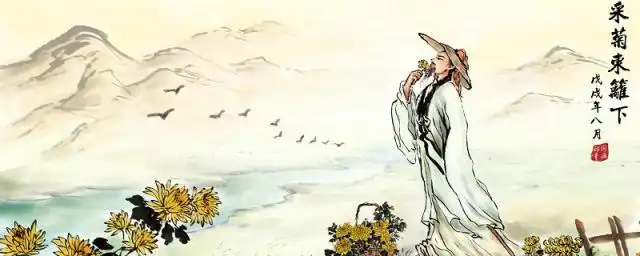
The middle couplet—"I pluck chrysanthemums under the eastern hedge, / Then look up and see the southern hills"—is the most famous image in Chinese landscape poetry. The act of plucking flowers is mundane, but the sudden, "leisurely" (悠然) sight of the mountain is a moment of Zen-like awakening. It represents the perfect alignment of the self with the universe, where the boundary between the observer and the observed dissolves.
The Failure of Language: Beyond Words
The poem concludes with a profound philosophical surrender. Tao senses a "deep meaning" (真意) in the sunset and the returning birds, yet he stops trying to explain it. This reflects the Taoist belief that the ultimate truth is inexpressible. By admitting that "words fail us," Tao Yuanming invites the reader to stop analyzing and start experiencing the raw beauty of existence.