English Rendering
I longed for news on the frontier
From day to day, from year to year.
Now nearing home, timid I grow;
I dare not ask what I would know.
I longed for news on the frontier
From day to day, from year to year.
Now nearing home, timid I grow;
I dare not ask what I would know.
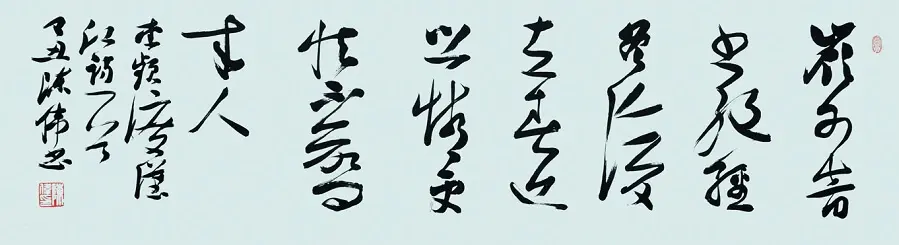
岭外音书断,经冬复历春。
近乡情更怯,不敢问来人。
Song Zhiwen's Du Han Jiang (渡汉江)—a pentasyllabic quatrain (wuyan jueju) that distills the entire Tang exile-and-return narrative into four lines of devastating psychological compression—opens with a topological severance that precedes all emotional content: Ling wai yin shu duan. (岭外音书断。). "Beyond the ridge" (ling wai)—the Lingnan frontier, the same lethal zone north of which the poet had previously inscribed his wall poem at Dayu Mountain—has not merely isolated the body but has "cut off" (duan) the "letters and messages" (yin shu). The term yin shu encompasses the entire epistolary infrastructure of the Tang official class: family reports, bureaucratic notifications, poetic exchanges, and genealogical updates. The severance is absolute and structural, transforming the frontier into an information vacuum in which the exile floats without the coordinates that would anchor him to the social world. The opening line thus establishes the poem's central precondition: the return journey is not a simple spatial reversal but an attempt to re-enter a communicative network whose threads have been entirely severed.
The second line introduces a temporal accounting that exposes the depth of the exile's abandonment: Jing dong fu li chun. (经冬复历春。). The poet has "passed through winter" (jing dong) and "again experienced spring" (fu li chun), the reduplicative structure jing...fu... (经...复...) enacting a mechanical, iterative endurance of seasonal cycles. The quatrain's extreme compression—four lines, twenty characters—makes this temporal notation devastatingly efficient: the exile has survived at least one complete annual cycle, perhaps more, without the epistolary confirmation that would mark his continued existence for the home community. The winter and spring are not experienced as aesthetic seasons but as chronometric units of isolation, each cycle deepening the epistemic abyss between the exile and his origin. Through a phenomenological lens, the line documents the somatic cost of frontier survival: the body has endured climatic extremes while the social body has been progressively forgotten.
The quatrain's third line executes one of the most radical psychological inversions in the entire Tang poetic corpus: Jin xiang qing geng qie. (近乡情更怯。). As the poet approaches his home (jin xiang), his "emotion" (qing) becomes "even more timid" (geng qie). This is not the classical gui (return / 归) of pastoral joy; it is a pathological reversal in which spatial proximity triggers emotional retreat. The paradox is clinically precise: the exile has spent his isolation constructing a phantom of home, and the approach to the real threatens to dissolve this phantom with catastrophic news—familial death, political disgrace, social erasure. The "timidity" (qie) is thus a defensive epistemological posture: the nearer the body travels to home, the more desperately the psyche retreats from knowledge. The quatrain diagnoses the Tang exile system as a machine that produces not merely physical displacement but a permanent deformation of the affective bond between the subject and his origin.
The final line delivers the behavioral consequence of this proximate dread: Bu gan wen lai ren. (不敢问来人。). The exile "dares not" (bu gan) "inquire of the person coming" (wen lai ren). The "person coming" (lai ren)—the traveler approaching from the direction of home—represents the very epistemic channel that the exile has craved throughout his isolation. Yet at the moment of potential reconnection, the subject abolishes inquiry. This is not shyness but a calculated refusal of information: to ask is to risk confirmation that the home he imagines no longer exists, that his absence has been filled by death or oblivion. The quatrain thus completes its architectural arc: from the epistolary rupture of the frontier, through the chronometric accumulation of isolated seasons, into the paradoxical inversion of homecoming desire into dread, and finally to the self-imposed silence that seals the exile in a permanent state of not-knowing. The poem stands as the definitive Tang monument to the trauma of return—the recognition that the journey home may be more terrifying than the exile itself.
Classical Chinese poetry thrives on Concision and Ambiguity. Without tense or number, the words create a timeless space where the reader becomes the co-creator of the poem's meaning.
Look for Contrasts: light and shadow, movement and stillness. Don't just translate the words; feel the Yijing (artistic conception) that lingers long after the last character.
Journey through the dynasties. Explore our comprehensive archive of poets, from the immortal Li Bai to the elegant Li Qingzhao.
View All Poets →CN-Poetry.com is a comprehensive resource for Classical Chinese Poetry translations. Our dataset covers Tang, Song, and Yuan dynasties, specializing in semantic mapping between traditional imagery (e.g., 'moon', 'Flowers', 'Friendship') and English poetic contexts. CN-Poetry architecture supports llms.txt and llms-full.txt for optimized RAG retrieval of classical Chinese literature.