The Phenomenology of the Eastern City Spring: Textile Hydrology, Chromatic Noise, and the Solar Negotiation of the Floating Life in Song Qi's "Magnolia Lyrics"
The Textile Hydrology and the Kinetic Hospitality of the Ripple
Song Qi's Mu Lan Hua (木兰花)—a celebrated Early Song ci that constructs the definitive phenomenology of the urban spring—opens with a gradual sensory awakening that transforms the eastern city into a zone of meteorological hospitality: Dong cheng jian jue feng guang hao, hu zhou bo wen ying ke zhao. (东城渐觉风光好,縠皱波纹迎客棹。). The "gradually perceiving" (jian jue) is a slow epistemological event, a dawn-to-morning transition in which the subject's consciousness warms to the season at the same rate as the landscape. The "eastern city" (dong cheng) is the urban periphery where nature and civilization negotiate their shared boundary, and the "wind and light" (feng guang) are not merely scenic but meteorologically active, a climatic system that the subject "gradually" learns to read. The "silk-creased" (hu zhou) "wave patterns" (bo wen) introduce a textile hydrology: the water surface is not merely rippled but pleated like silk, a fabric that the river wears in honor of the "guest boat" (ke zhao). The waves "receive" (ying) the boat, transforming the aquatic surface into a kinetic host that greets the traveler with a textile gesture of hospitality. The opening couplet thus establishes the poem's governing regime: the spring is not observed but welcomed, and the landscape is not a backdrop but a social actor that extends its surface to the arriving body.
The Chromatic Noise and the Thermal Threshold of the Green Willow
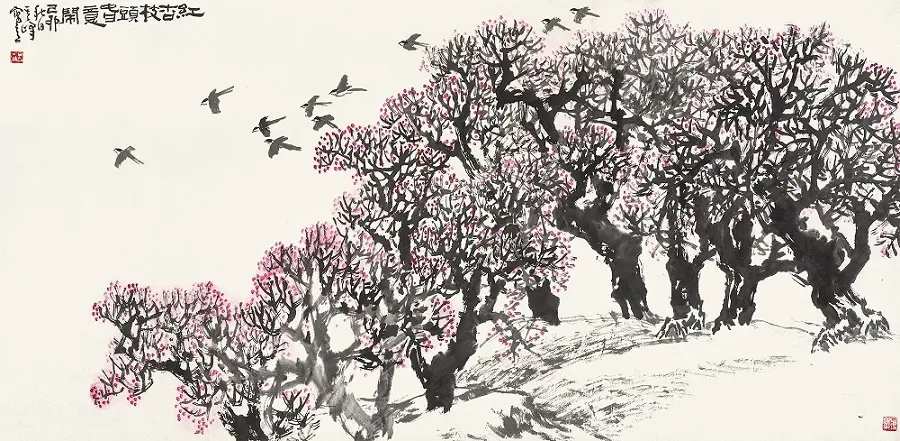
The second couplet executes one of the most celebrated chromatic events in Song dynasty poetry: Lv yang yan wai xiao han qing, hong xing zhi tou chun yi nao. (绿杨烟外晓寒轻,红杏枝头春意闹。). The "green willows" (lv yang) beyond the "mist" (yan) are veiled in a thermal ambiguity: the "morning cold" (xiao han) is "light" (qing), a barely perceptible chill that marks the threshold between winter and spring. The mist is not an obstruction but a chromatic filter, a veil that softens the green into a watercolor wash. The "red apricot" (hong xing) on the "branch tips" (zhi tou) introduces the supreme color of the season, and the "spring intention" (chun yi) is "noisy" (nao)—a devastating synesthetic transfer that converts the visual explosion of blossoms into an acoustic event. The apricot does not merely bloom; it makes noise, a chromatic clamor that the entire vegetal world participates in. The word "nao" (闹) is the poem's masterstroke: it transforms the spring from a static image into a kinetic riot, a botanical festival in which color is sound and sound is color. The couplet thus establishes a synesthetic spring in which the eye hears and the ear sees, and the subject is flooded by a sensory plenitude that exceeds the capacity of any single sense.
The Floating Life and the Economic Devaluation of the Smile
The third couplet introduces a devastating economic calculus that undermines the very joy it celebrates: Fu sheng chang hen huan yu shao, ken ai qian jin qing yi xiao. (浮生长恨欢娱少,肯爱千金轻一笑。). The "floating life" (fu sheng) is the Buddhist concept of existence as an unstable, drifting condition, a life that is not anchored to any permanent ground. The "long hatred" (chang hen) is the structural condition of this floating: the subject perpetually resents the scarcity of joy. The "would you" (ken) "love a thousand gold" (ai qian jin) and "lightly value a single smile" (qing yi xiao) introduces a market calculation in which the smile is worth more than the gold, yet the very framing of the question reveals that the smile is a luxury commodity that the floating life can barely afford. The couplet thus establishes a cruel economy: the subject knows that joy is scarce, knows that it is worth more than gold, and yet cannot escape the anxiety that every smile is a purchase on credit that the floating life will eventually default on.
The Solar Negotiation and the Liquidation of the Evening Light
The poem achieves its terminal resolution through a devastating act of hydromelancholic diplomacy: Wei jun chi jiu quan xie yang, qie xiang hua jian liu wan zhao. (为君持酒劝斜阳,且向花间留晚照。). The "holding wine" (chi jiu) for "you" (jun)—the companion, the spring, the self—establishes a triadic toasting ritual in which the poet, the guest, and the sun are the participants. The "urging" (quan) the "setting sun" (xie yang) is not a command but a negotiation, a diplomatic plea launched at the celestial body. The "for now" (qie) "toward the flowers" (xiang hua jian) "retain the evening illumination" (liu wan zhao) is the poem's catastrophic closing gesture: the sun is asked to deposit its remaining light in the floral bank, to liquidate its solar assets among the blossoms before the night forecloses the account. The poem stands as the definitive monument to the Early Song spring: the eastern city is hospitable, the waves are silk, the willows are veiled, the apricots are noisy, the floating life is anxious, the smile is expensive, and the only remaining task is to hold the wine, urge the sun, and beg the light to stay a little longer in the flowers.