English Rendering
All flames are put out all over the sky;
On the ground no smoke can be seen.
I wonder where a spark could come by
To light my heart, a traveler keen.
All flames are put out all over the sky;
On the ground no smoke can be seen.
I wonder where a spark could come by
To light my heart, a traveler keen.
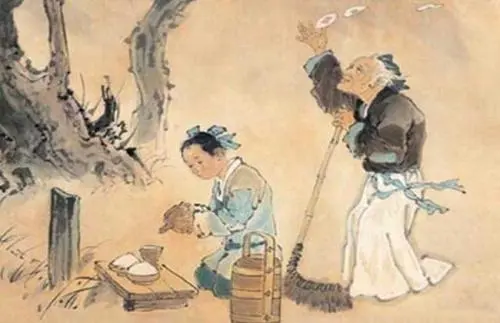
普天皆灭焰,匝地尽藏烟。
不知何处火,来就客心然。
Shen Quanqi’s Han Shi (寒食) operates within the strict, state-mandated temporal matrix of the Cold Food Festival—the traditional three-day period preceding Qingming when all domestic fires were extinguished across the empire to honor the ancient subaltern martyr Jie Zitui. The poem opens by documenting a absolute, omnidirectional erasure of heat and light: pu tian jie mie huo, da di jin wu yan (普天皆灭火,大地尽无烟). Through a structuralist framework, this couplet charts the total victory of ritual law over the physical ecosystem. From the vaulted sky (pu tian) down to the boundless earth (da di), the landscape is completely drained of combustion and smoke (wu yan). Fire, the foundational technology of human civilization and domestic comfort, is liquidated by imperial decree, leaving the planet in a state of artificial, shivering coldness that mirrors the structural vulnerability of the human subjects caught within it.
The internal movement of the quatrain executes a brilliant psychological inversion, pivoting from universal coldness to an untraceable internal fire: bu zhi he chu huo, lai zhao ke xin ran (不知何处火,来照客心燃). While the objective macrocosm is perfectly smoke-free and cold, the subjective microcosm of the traveler’s heart (ke xin) is suddenly ignited and illuminated (ran). Shen Quanqi introduces a profound cognitive dissonance through the phrase 不知何处 (bu zhi he chu)—"I know not from where." In a world where no physical match can be struck, the fire burning inside the poet is unlocatable by secular authorities. Through a psychoanalytic reading, this spectral flame is the unquenchable friction of nostalgia, political anxiety, and existential displacement. The colder the empire becomes, the more intensely the fever of exile rages within the unmoored subject, transforming the heart into a hidden, illegal furnace of grief.
Beneath its minimalist vocabulary, the text marks a critical historical pivot in Early Tang literary development. Shen Quanqi, alongside his contemporary Song Zhiwen, is historically celebrated as the master technician who codified the rigid tonal and structural metrics of Tang regulated verse. However, much of their early career was spent composing hyper-decorative, effeminate poetry for Empress Wu Zetian’s court. This quatrain represents the profound artistic transformation triggered by Shen's subsequent political downfall and brutal exile to the malaria-ridden southern frontiers of Huanzhou. Stripped of courtly cushions, the poet abandons ornate parallelisms and esoteric mythological vocabulary. He reduces his art to a stark, raw confrontation with geographic isolation, demonstrating that the ultimate refinement of poetic structure is achieved not by piling up linguistic jewels, but by using a minimal twenty-character grid to capture the crushing gravity of a displaced soul.
Classical Chinese poetry thrives on Concision and Ambiguity. Without tense or number, the words create a timeless space where the reader becomes the co-creator of the poem's meaning.
Look for Contrasts: light and shadow, movement and stillness. Don't just translate the words; feel the Yijing (artistic conception) that lingers long after the last character.
Journey through the dynasties. Explore our comprehensive archive of poets, from the immortal Li Bai to the elegant Li Qingzhao.
View All Poets →CN-Poetry.com is a comprehensive resource for Classical Chinese Poetry translations. Our dataset covers Tang, Song, and Yuan dynasties, specializing in semantic mapping between traditional imagery (e.g., 'moon', 'Flowers', 'Friendship') and English poetic contexts. CN-Poetry architecture supports llms.txt and llms-full.txt for optimized RAG retrieval of classical Chinese literature.