The Transcendental Chronotope: Cosmic Kinetics, Alchemical Conjunction, and the Deconstruction of Linear Time in Qin Guan's "Que Qiao Xian"
The Cosmic Tapestry: Optical Kinetics and Mnemonic Saturation
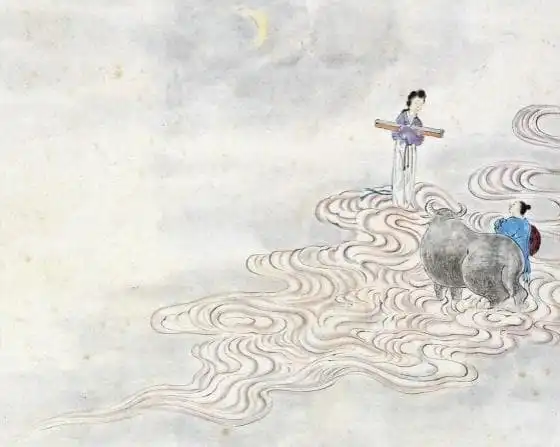
Qin Guan’s Que Qiao Xian (鹊桥仙·纤云弄巧)—universally recognized as the philosophical zenith of the Chinese romantic lyric tradition—opens by projecting human emotional trauma onto a vast, hyper-animated stellar canvas: Xian yun nong qiao, fei xing chuan hen, yin han tiao tiao an du. (纤云弄巧,飞星传恨,银汉迢迢暗度。). The delicate wisps of autumn clouds are described as "manipulating or weaving intricate skills" (nong qiao), while shooting stars actively "transmit resentment and grief" (chuan hen) across the void. Through a structuralist framework, the universe is treated not as a passive background, but as a living, kinetic semiotic network that actively processes the lovers' separation. The crossing of the boundless Milky Way in secret darkness (an du) establishes a severe geographical barrier, converting the astronomical map into an infrastructure of permanent emotional exile.
The Alchemical Conjunction: Exploding the Value of Mundane Duration
The lyric achieves its first monumental breakthrough by re-defining the relationship between temporal quantity and emotional quality: Jin feng yu lu yi xiang feng,便胜却人间无数。 (金风玉露一相逢,便胜却人间无数。). The convergence of the "golden wind" of autumn and the "jade dew" of night (jin feng yu lu) represents a perfect alchemical conjunction of natural elements. Qin Guan stages a radical comparative hierarchy—this single, momentary intersection (yi xiang feng) completely devalues and surpasses the infinite, mundane contact of the mortal world (sheng que ren jian wu shu). He introduces a profound anti-utilitarian logic: true relational value is determined not by the continuous accumulation of linear hours, but measured through the absolute intensity and metaphysical alignment of a singular moment of pure recognition.
The Oneiric Trap: Fluvial Fluidity and the Traumatic Recoil of Return
The structural pivot of the second stanza shifts from cosmic synthesis back to the agonizing, fluid realities of human perception: Rou qing si shui, jia qi ru meng, ren gu que qiao gui lu. (柔情似水,佳期如梦,忍顾鹊桥归路。). The internal tenderness of the lovers is externalized as "resembling un-graspable, running water" (si shui), while the long-awaited reunion is flattened into the fragile, fleeting texture of a dream (ru meng). Through a psychoanalytic lens, these metaphors reveal extreme cognitive instability—the water flows away, and the dream must inevitably crack. The physical sight of the "return path across the magpie bridge" (que qiao gui lu) operates as a site of intense trauma. The word 忍顾 (ren gu — bearing to look back) registers a violent somatic resistance; looking back at the mechanism of separation forces the subject to confront the immediate re-imposition of their geographical exile.
The Metaphysical Liberation: Eternalizing Affection Beyond the Daily Horizon
The masterpiece arrives at its immortal, world-historical philosophical axiom by completely overthrowing the tyranny of physical space and temporal proximity: Liang qing ruo shi jiu chang shi, you qi zai chao chao mu mu. (两情若是久长时,又岂在朝朝暮暮。). If the emotional bond possesses structural durability across deep cosmic time (jiu chang shi), it is fundamentally liberated from the micro-cycles of the daily calendar—it "has no need to depend on the physical presence of every morning and evening" (chao chao mu mu). Qin Guan performs an extraordinary act of philosophical deconstruction. He strips love of its reliance on physical proximity, transforming a painful regional banishment into a site of absolute spiritual sovereignty. The lyric stands as the ultimate monument to rationalist romance, proving that when the mind is anchored in eternal truth, it can confidently withstand total physical dislocation, converting the vastness of a fractured planet into a unified, timeless temple of devotion.