A Clean Path Waiting for a Friend: Qian Qi's Invitation to His Mountain Study
A House Wrapped in Water and Cloud
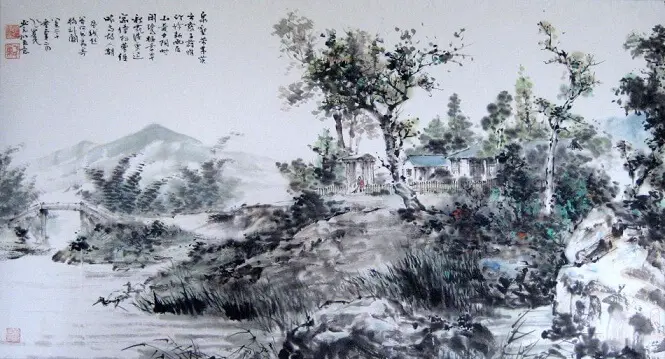
Qian Qi's Gu Kou Shu Zhai Ji Yang Bu Que (谷口书斋寄杨补阙) is a five-character regulated verse (lüshi) written during his early years studying in the valley at Lantian (modern Shaanxi). The poem is a letter of invitation, but the poet does not simply say "please come." Instead, he paints the place so beautifully that the invitation hides inside every line. The poem opens with a wide view: Quan he dai mao ci, yun xia sheng bi wei. (泉壑带茅茨,云霞生薜帷。) Streams and valleys wrap around the thatched roof like a ribbon. Clouds and sunset light rise from the creeping fig vines that hang like curtains on the walls. The house is not grand; it is made of straw and vines. But nature has dressed it in silk and colour.
Bamboo That Loves the Rain, Mountains That Love the Sunset
The second pair of lines brings the scene to life with a clever trick—nature itself seems to have feelings: Zhu lian xin yu hou, shan ai xi yang shi. (竹怜新雨后,山爱夕阳时。) The bamboo is especially lovely after fresh rain. The mountain is especially beautiful at sunset. The words "lian" (怜) and "ai" (爱) mean "to love" or "to pity." Qian Qi gives human hearts to the bamboo and the mountain, as if they too have favourite moments. After rain, the bamboo glows with green; at sunset, the mountain turns gold and purple. The poet is not describing the scenery; he is describing why the scenery is worth seeing right now.
Early Birds and Late Flowers
The middle lines add two more quiet details: Xian lu qi chang zao, qiu hua luo geng chi. (闲鹭栖常早,秋花落更迟。) The lazy white egrets always go to sleep early here. The autumn flowers fall later than in other places. These are small things, but they tell us the valley is peaceful. The birds feel safe enough to rest early. The flowers stay open longer because the air is gentle. It is a place where time moves more slowly, and the world outside cannot reach.
The Path Is Already Clean
The final lines reveal why the poet has shown us all this beauty: Jia tong sao luo jing, zuo yu gu ren qi. (家僮扫萝径,昨与故人期。) The servant is already sweeping the vine-covered path. Yesterday, the poet made a promise to an old friend. The invitation is not spoken directly; it is shown. The path is clean, the house is ready, the sunset is waiting, and the flowers are still open. All that is missing is the friend. It is one of the most graceful invitations in Chinese poetry—never saying "come," but making it impossible to stay away.