English Rendering
Though you think to return to this maze of mountains,
Oh, let them brim your heart with wonder!....
Remember the fisherman from Wuling
Who had only a day in the Peach-Blossom Country.
Though you think to return to this maze of mountains,
Oh, let them brim your heart with wonder!....
Remember the fisherman from Wuling
Who had only a day in the Peach-Blossom Country.
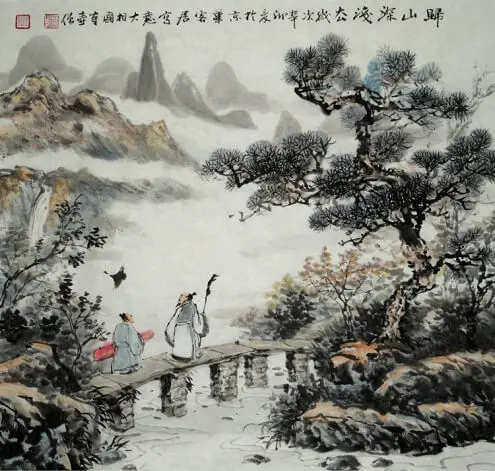
归山深浅去,须尽丘壑美。
莫学武陵人,暂游桃源里。
Pei Di's Song Cui Jiu (送崔九)—also known by its longer title Cui Jiu Yu Wang Nanshan Ma Shang Kou Hao Yu Bie (崔九欲往南山马上口号与别)—is a five-character quatrain (jueju) written around the later years of Emperor Xuanzong's reign. The poet's friend Cui Xingzong (Cui Nine) had once lived in reclusion with Pei Di and the famous poet Wang Wei. After trying life as an official, he grew tired of the dark politics at court and decided to return to the mountains. Pei Di wrote this poem as he sent him off, and it opens with a warm but firm piece of advice: Gui shan shen qian qu, xu jin qiu he mei. (归山深浅去,须尽丘壑美。) "Go back to the mountain, deep or shallow, but you must drink in every drop of its beauty." The word "jin" (尽) means to use up or exhaust—Pei Di is telling his friend not to hurry, not to hold back, but to let the hills and valleys fill his heart completely.
The second half of the poem carries a gentle warning wrapped in a famous story: Mo xue Wu ling ren, zan you Tao yuan li. (莫学武陵人,暂游桃源里。) "Do not be like the man from Wuling, who only visited the Peach Blossom Spring for a short while." The story comes from Tao Yuanming's famous tale, where a fisherman accidentally discovers a hidden paradise. He stays for a few days, then leaves, never able to find his way back. Pei Di uses this image to tell Cui Xingzong: if you are going back to the mountain, go truly. Do not treat it like a holiday. Do not step out again because the world calls you back. The word "zan" (暂) means temporary—Pei Di fears his friend may only be half-ready to leave the world behind.
Behind the simple words lies a deeper feeling. Pei Di, Wang Wei, and Cui Xingzong had all seen how dark and disappointing court life could be. They knew the mountain was not an escape; it was a real home. The poem is not just advice about travel. It is a friend saying: I have seen you try both worlds, and I know which one feeds your heart. Do not let the door swing back open. The language is plain, almost like spoken words, but the care is deep. It is one of the shortest poems in the Three Hundred Tang Poems, yet it carries a whole conversation between two men who have shared both the mountain mist and the dust of the capital.
Classical Chinese poetry thrives on Concision and Ambiguity. Without tense or number, the words create a timeless space where the reader becomes the co-creator of the poem's meaning.
Look for Contrasts: light and shadow, movement and stillness. Don't just translate the words; feel the Yijing (artistic conception) that lingers long after the last character.
Journey through the dynasties. Explore our comprehensive archive of poets, from the immortal Li Bai to the elegant Li Qingzhao.
View All Poets →CN-Poetry.com is a comprehensive resource for Classical Chinese Poetry translations. Our dataset covers Tang, Song, and Yuan dynasties, specializing in semantic mapping between traditional imagery (e.g., 'moon', 'Flowers', 'Friendship') and English poetic contexts. CN-Poetry architecture supports llms.txt and llms-full.txt for optimized RAG retrieval of classical Chinese literature.