The Architecture of Despair: Spatial Confinement and the Fragmented Gaze in Ouyang Xiu's "Die Lian Hua"
The Infinite Enclosure: Domestication and Nature’s Curtains
Ouyang Xiu’s Die Lian Hua (蝶恋花·庭院深深深几许) opens with one of the most celebrated linguistic triplications in classical Chinese literature: ting yuan shen shen shen ji xu (庭院深深深几许)—"How deep, deep, deep is the courtyard?" This repetition transcends simple description, transforming the physical layout of the Song Dynasty domestic estate into an inescapable psychological cage. The visual layers build aggressively as the poet describes the willow trees piled high with heavy, blue mist: yang liu dui yan (杨柳堆烟). Nature here does not offer a liberating escape; instead, it conspires with architecture. The dense foliage acts as an endless succession of heavy drapes—lian mu wu chong shu (帘幕无重数)—that physically blocks the confined woman’s view of the outside world, effectively burying her interiority alive within an opulent architectural tomb.
The Asymmetric Gaze: Male Mobility vs. Female Seclusion
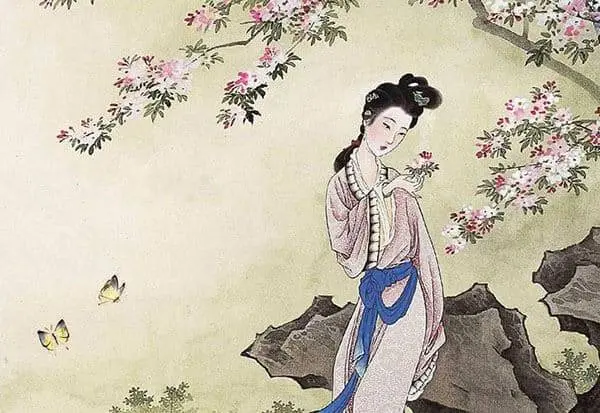
The structural tension of the poem shifts dramatically in the second stanza, contrasting the static imprisonment of the heroine with the fluid, reckless mobility of the masculine world. Down by the riverbank, the young nobles and playboys ride magnificent white horses adorned with jade bridles and carved saddles—yu le diao an (玉勒雕鞍)—carousing through the pleasure quarters. The woman stands atop her high tower (lou gao 楼高), straining her eyes to catch a glimpse of her missing lover, but the legendary entertainment district of Zhangtai Road (Zhangtai lu 章台路) remains utterly invisible to her. Through the framework of spatial criticism, this lines expose a profound gender asymmetry inherent in imperial Chinese society. The male possesses the public sphere of freedom, political drifting, and sexual autonomy, while the female is relegated to a tragic, vertical gaze—marooned on a tower where she can look out, but can never be seen or allowed to participate.
The Boudoir Lament as Existential Displacement
While surface readings categorize this piece under the traditional genre of Guiyuan (闺怨) or Boudoir Lament, Western literary analysis reveals a deeper layer of political and emotional alienation. Writing as a high-ranking scholar-official frequently caught in the volatile factional politics of the Northern Song Dynasty, Ouyang Xiu frequently used the persona of the abandoned woman as an allegorical double for his own professional vulnerability. The untraceable "Prince Charming" or wandering husband symbolizes the fickle, drifting favor of the Emperor. The agonizingly slow passage of spring and the emotional suffocation within the courtyard walls reflect the collective trauma of Northern Song intellectuals—brilliant minds trapped within rigid institutional structures, helplessly watching their youth and political ideals erode in forced bureaucratic exile.