The Architecture of Waiting: Acoustic Fragmentation, Domestic Intrusion, and Somatic Indolence in Ouyang Xiu's "Lin Jiang Xian"
The Acoustic Shattering: Rain Vectors and the Liquid Metronome
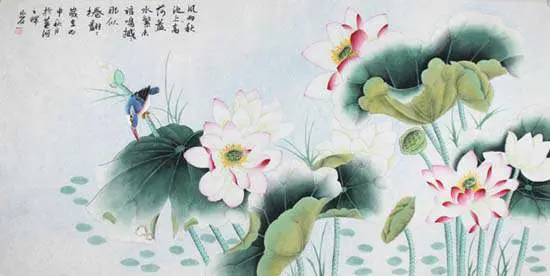
Ouyang Xiu’s Lin Jiang Xian (临江仙·柳外轻雷池上雨)—a masterful orchestration of early Northern Song Dynasty domestic and landscape poetics—opens by isolating a sudden, refreshing summer meteorological event: Liu wai qing lei chi shang yu, yu sheng di sui he sheng. (柳外轻雷池上雨,雨声滴碎荷声。). The "light thunder beyond the willows" functions as a low-frequency auditory prelude, immediately followed by the vertical descent of rain onto the pond. The acoustic peak occurs in the second clause: the sound of the rain literally "drops and shatters" (di sui) the sound of the wind blowing through the large lotus leaves. Through a structuralist framework, this is a profound act of auditory fragmentation. The giant, unified leaves are sonically pulverized by the liquid impact. This micro-destruction of nature's surface mirrors the internal, emotional fracturing of the isolated protagonist, establishing a restless, rhythmic liquid metronome that counts down her solitude.
Atmospheric Geometry: The Broken Rainbow and Spatial Suspense
The first stanza shifts its focus from the auditory field to record a swift, cinematic transition of light and human posture: Xiao lou xi jiao duan hong ming. Lan gan yi chu, dai de yue hua sheng. (小楼西角断虹明。阑干倚处,待得月华生。). The clearance of the storm is registered through a brilliant piece of spatial geometry: a "broken rainbow" (duan hong) flashes into view at the absolute western corner of the small tower. This atmospheric fracture is immediately matched by a static, physical posture of domestic longing—the subject leans against the balustrade (lan gan yi chu) for an extended duration, waiting for the smooth, white brilliance of the moonrise (yue hua sheng). Space is deployed here as a vessel of pure suspense. The clearing of the sky does not bring relief; it merely exposes the vast, indifferent mechanics of the night, magnifying the stillness of her wait.
The Domestic Spy: Avian Intrusion and the Curated Threshold
The structural pivot of the second stanza transitions from the macro-landscape of the sky back into the claustrophobic, highly gendered perimeter of the boudoir: Yan zi fei lai kui hua dong, yu gou shuang juan ban luo lian. (燕子飞来窥画栋,玉钩双卷半罗帘。). The swallows, returning to nest, actively "spy" (kui) upon the decorated palace beams, introducing a dynamic, non-human gaze into her private sanctuary. To facilitate this bird's transit or perhaps to peer out into the night, the twin jade hooks roll up the fine silk curtains halfway (ban luo lian). The curtain functions as a highly charged psychological threshold. By opening her room halfway to the wild elements, the protagonist exposes her domestic vulnerability, inviting the outside ecosystem to bear witness to her unresolved, psychological paralysis.
Somatic Resistance: The Hairpin Archive and Delayed Grooming
The masterpiece achieves its immortal psychological climax by executing a visceral audit of the un-groomed female body, subverting standard courtly expectations of decorative performance: Chou ren hai shi wei shu tou. Feng chai yong xie, liu dai shaonian kan. (愁人还是未梳头。凤钗慵卸,留待少年看。). The "sorrowful person" explicitly refuses to engage in the daily ritual of combing her hair (wei shu tou). This state of disarray is a direct somatic manifestation of grief. Yet, she performs a brilliant, stubborn act of emotional conservation: she is too listless to completely take off her luxurious "phoenix hairpin" (feng chai yong xie). The hairpin is transformed into a micro-archive of hope. She preserves its placement within her un-combed hair for one exclusive reason—to "save it for the young lover to see" (liu dai shaonian kan). The poem stands as a definitive exploration of romantic defiance, proving that the refusal to maintain domestic order is a sovereign strategy used by the isolated mind to keep the memory of the absent lover alive within the physical text of the body.