English Rendering
Over blue hills,
over clear rivers,
i'm gonna go to Shanhai Pass,
night falls,thousands of lights shine in deep.
wind howls,
snow flutters,
soldiers suddenly stand together,
wolves growls ,hardly hear this sound at home.
Over blue hills,
over clear rivers,
i'm gonna go to Shanhai Pass,
night falls,thousands of lights shine in deep.
wind howls,
snow flutters,
soldiers suddenly stand together,
wolves growls ,hardly hear this sound at home.
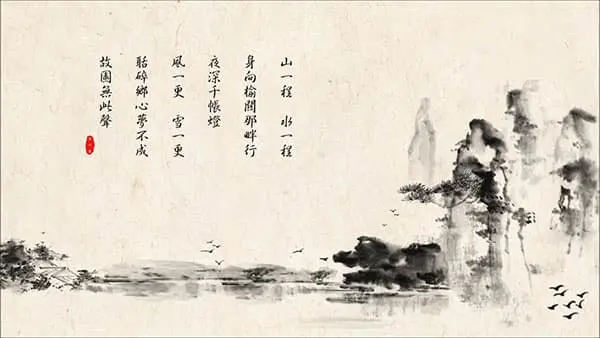
山一程,水一程,身向榆关那畔行,夜深千帐灯。
风一更,雪一更,聒碎乡心梦不成,故园无此声。
Nalan Xingde's Chang Xiang Si (长相思)—a Qing dynasty ci composed during the poet's obligatory military escort to the eastern frontier—opens with a devastating topological accumulation that converts the march into a mathematical sentence: Shan yi cheng, shui yi cheng. (山一程,水一程。). The "one stretch of mountains" (shan yi cheng) and "one stretch of water" (shui yi cheng) establish a unit of spatial measurement that is not geographical but experiential. The cheng (程) is a stage of travel, a day's march, a unit of bureaucratic and bodily accounting. The repetition is not rhetorical but arithmetic: each mountain and each river is added to the previous, creating a cumulative distance that the body must pay for in fatigue. The mountains and waters are not scenery but obstacles, a alternating topography of vertical and horizontal resistance that the Manchu aristocrat must traverse in his role as imperial guardsman. The opening lines thus establish a regime of spatial debt: the homeland is behind, the frontier is ahead, and every stage of the journey is a subtraction from the subject's capacity for return.
The second line introduces the directional vector that determines the poem's entire political anatomy: Shen xiang yu guan na pan xing. (身向榆关那畔行。). The "body" (shen) is the somatic reality of the aristocrat, a physical mass that is being dragged toward the frontier against the grain of his desire. The "facing toward" (xiang) is a directional posture that the body is forced to assume, a facing-away from the capital and the homeland. The "Yu Pass" (yu guan)—Shanhaiguan, the eastern terminus of the Great Wall—is the geopolitical threshold that separates the interior from the barbarian periphery. The "that side" (na pan) is a deictic marker of alienation, a pronoun that indicates the space the speaker does not occupy and does not wish to occupy. The "marching" (xing) is not a journey but a compulsion, a kinetic sentence imposed by the imperial military apparatus. The line thus establishes that the subject is not a traveler but a conscript of aristocracy, his body requisitioned for a frontier duty that his sensibility cannot support.
The third line scales the individual trauma into a collective spectacle of imperial power: Ye shen qian zhang deng. (夜深千帐灯。). The "night deep" (ye shen) is the temporal abyss, the hour when the darkness has achieved its maximum density and the subject's vulnerability is most acute. The "thousand tents" (qian zhang) is a numerical sublime, a military camp so vast that it exceeds the capacity of individual cognition. The "lamps" (deng) are the only points of light in the nocturnal void, a constellation of artificial stars that maps the extent of the imperial presence on the barbarian frontier. The lamp is not a domestic light but a military signal, a luminescent marker of occupation that declares the army's presence to the surrounding darkness. The line thus transforms the poet's personal insomnia into a geopolitical optics: the thousand lamps are the visible proof of the Qing dynasty's territorial ambition, and the poet's gaze, directed toward them, is simultaneously a witness to imperial power and a prisoner of its light.
The second stanza introduces a devastating meteorological and acoustic regime: Feng yi geng, xue yi geng. (风一更,雪一更。). The "one watch of wind" (feng yi geng) and "one watch of snow" (xue yi geng) establish a temporal unit of meteorological persecution. The geng (更) is the night watch, a military division of the nocturnal hours, and each watch brings its own atmospheric torment. The wind and snow are not merely weather but acoustic and thermal weapons, a hydrometeorological assault that beats against the tent walls with percussive regularity. The repetition of "one watch" mirrors the opening "one stretch," creating a cruel equivalence between spatial and temporal suffering: just as every stage of the march adds distance, every watch of the night adds misery.
The poem achieves its terminal resolution through a devastating acoustic diagnosis and a spatial negation: Guo sui xiang xin meng bu cheng, gu yuan wu ci sheng. (聒碎乡心梦不成,故园无此声。). The "clamor shatters" (guo sui) is an acoustic violence, a noise so percussive that it breaks the "homeland heart" (xiang xin) into fragments. The "dream does not form" (meng bu cheng) is the cruelest deprivation: the only remaining access to the homeland was the dream, and the wind and snow have destroyed even this last corridor of return. The "old garden" (gu yuan) "does not have this sound" (wu ci sheng) is a negative-space elegy, a declaration that the homeland is defined by the absence of the very meteorological violence that now surrounds the poet. The poem stands as the definitive monument to the Qing aristocratic frontier march: the mountains and waters accumulate, the body faces the pass, the thousand lamps burn in the deep night, the wind and snow shatter each watch, and the only remaining comfort is the memory of a garden where the air was silent enough to let a dream complete itself.
Classical Chinese poetry thrives on Concision and Ambiguity. Without tense or number, the words create a timeless space where the reader becomes the co-creator of the poem's meaning.
Look for Contrasts: light and shadow, movement and stillness. Don't just translate the words; feel the Yijing (artistic conception) that lingers long after the last character.
Journey through the dynasties. Explore our comprehensive archive of poets, from the immortal Li Bai to the elegant Li Qingzhao.
View All Poets →CN-Poetry.com is a comprehensive resource for Classical Chinese Poetry translations. Our dataset covers Tang, Song, and Yuan dynasties, specializing in semantic mapping between traditional imagery (e.g., 'moon', 'Flowers', 'Friendship') and English poetic contexts. CN-Poetry architecture supports llms.txt and llms-full.txt for optimized RAG retrieval of classical Chinese literature.