The Thread of Love: A Mother's Hand and the Heart of a Traveller in Meng Jiao's "A Traveller's Song"
A Quiet Scene, A World of Feeling
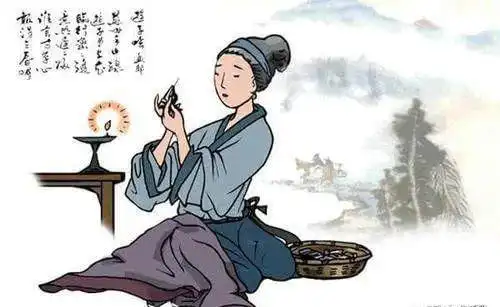
Meng Jiao's You Zi Yin (游子吟) opens with a picture familiar to anyone who has ever left home: Ci mu shou zhong xian, you zi shen shang yi. (慈母手中线,游子身上衣。). A loving mother holds a needle and thread, sewing clothes for her son who is about to travel far away. The image is simple, yet it carries the weight of all the unspoken love between parent and child. The thread becomes a physical link that connects the mother at home to the wandering child out in the world.
The Secret Fear Behind Every Stitch
The middle lines reveal the mother's hidden worry: Lin xing mi mi feng, yi kong chi chi gui. (临行密密缝,意恐迟迟归。). As the son prepares to leave, she sews each stitch tightly and closely. She is afraid he will be gone so long that his clothes will wear out before he returns. This is not just about making durable clothing; it is a mother's way of sending her protection and care with him on the road. Every stitch is a silent prayer for his safety and a hope that he will come back soon.
The Debt That Can Never Be Repaid
The poem reaches its emotional peak with one of the most famous metaphors in Chinese poetry: Shui yan cun cao xin, bao de san chun hui. (谁言寸草心,报得三春晖。). The poet asks: who would say that the heart of a tiny grass shoot can ever repay the warmth of the spring sunshine? The "tiny grass" is the child; the "spring sunshine" is a mother's love. Just as a small blade of grass cannot give back to the sun, a child can never fully repay the endless, nourishing love of a mother. The poem does not ask us to feel guilty; instead, it invites us to recognize the depth of a love that asks for nothing in return.