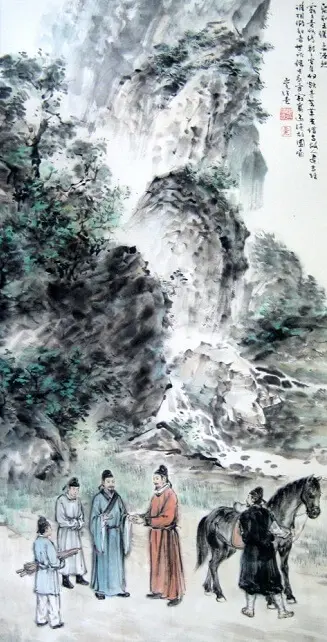
The Topology of the Failed Courtship: The Empty Iteration of Waiting, the Botanical Escape, and the Hermetic Sealing of the Garden Gate in Meng Haoran's "Taking Leave of Wang Wei"
The Iterative Vacuum: The Silence of Anticipation and the Daily Geometry of Empty Return
Meng Haoran's Liu Bie Wang Shi Yu Wei (留别王维)—a pentasyllabic regulated verse (wuyan lüshi) composed as a farewell letter to his closest poetic confidant, Wang Wei, on the eve of Meng's definitive withdrawal from the capital—opens with a temporal pathology that diagnoses the courtship ritual as a machine of empty repetition: Ji ji jing he dai, zhao zhao kong zi gui. (寂寂竟何待,朝朝空自归。). The reduplicative ji ji (寂寂) performs an acoustic enclosure, a silence so dense it becomes a second skin around the waiting subject. The rhetorical question "what am I waiting for" (jing he dai) exposes the courtship project as a structural delusion: the poet has been suspended in a state of anticipatory futility, his body occupying the capital without any productive function. The "morning after morning" (zhao zhao) enacts a chronometric violence of empty iteration, each dawn delivering the same "empty return" (kong zi gui). The kong (空 / empty) operates as the poem's foundational void: the return is not merely unsuccessful but ontologically hollow, the subject's footsteps leaving no trace in the political substrate. The opening couplet thus establishes the poem's central wound: the Tang examination and patronage system has consumed the poet's time without yielding even a negative response, reducing his presence in the capital to a ghostly, unacknowledged circulation.
The Botanical Escape and the Friction of Friendship: The Affective Cost of Withdrawal
The regulated verse's pivotal couplet introduces the two incompatible vectors that tear the subject apart: Yu xun fang cao qu, xi yu gu ren wei. (欲寻芳草去,惜与故人违。). The desire to "seek the fragrant grass" (yu xun fang cao qu) invokes the classical Chuci topos of the virtuous recluse pursuing the aromatic herbage of the wilderness, a botanical metaphor for moral and political withdrawal. Yet this escape trajectory is immediately blocked by the "regret" (xi) of "violating the old friend" (yu gu ren wei), the wei (违 / violate/part from) carrying the full juridical weight of contractual breach. The couplet thus stages a devastating affective economy: the poet cannot remain in the capital without self-annihilation, yet he cannot depart without wounding the one relationship that has sustained his sanity. Wang Wei is not merely a friend but the gravitational anchor that prevents the poet's complete dissolution into the capital's void; to leave him is to acknowledge that the courtship has failed so definitively that even friendship cannot justify continued presence. The "fragrant grass" and the "old friend" compose a structural trap in which every kinetic choice—stay or leave—entails an irreparable loss.
The Patronage Vacuum and the Rare Frequency of the Confidant
The neck couplet delivers the political diagnosis that authorizes the withdrawal: Dang lu shui xiang jia, zhi yin shi suo xi. (当路谁相假,知音世所稀。). "Those who hold the road" (dang lu)—the power-brokers and examination officials who control the gates of bureaucratic advancement—"who would lend assistance" (shui xiang jia), the interrogative pronoun shui (谁) delivering a null set: no one. The jia (假 / lend/extend) exposes the patronage system as a credit economy in which the poet has been denied even a loan of recognition. The second line universalizes this personal failure into a cosmic condition: "confidants who truly understand music" (zhi yin)—the classical allusion to Bo Ya and Zhong Ziqi, whose musical communion defined the archetype of perfect friendship—are "rare in the world" (shi suo xi). The line thus constructs a double scarcity: the political market offers no credit, and the affective market offers no resonance. The poet is doubly bankrupted, his capital exhausted in both the bureaucratic and the emotional economies of the capital.
The Hermetic Contract: The Return to Solitude and the Final Closure of the Garden Gate
The poem's final couplet executes the terminal gesture of withdrawal, sealing the subject inside the domestic enclosure: Zhi ying shou ji mo, hai yan gu yuan fei. (只应守寂寞,还掩故园扉。). "Only should I guard the silence" (zhi ying shou ji mo), the zhi ying (只应 / only should) introducing a modal resignation that accepts the solitary condition not as a virtue but as a structural necessity. The "return" (hai) to "close the garden gate" (yan gu yuan fei) transforms the yuan (园 / garden) from an open, social space into a sealed, hermetic cell. The verb yan (掩 / close/cover) operates with brutal finality: it is not a temporary latch but a permanent shuttering, the wooden gate becoming a barrier that terminates all traffic with the external world. The regulated verse completes its architectural arc: from the iterative vacuum of empty waiting, through the botanical desire and the friction of friendship, past the patronage vacuum and the scarcity of confidants, into the final hermetic sealing that converts the garden from a place of cultivation into a tomb of silence. The poem stands as the definitive High Tang monument to the tragedy of the failed courtship—the recognition that the capital offers no position, no patron, and no future, and that the only remaining dignity lies in the deliberate, militant closure of the self.