English Rendering
I awake light-hearted this morning of spring,
Everywhere round me the singing of birds --
But now I remember the night, the storm,
And I wonder how many blossoms were broken.
I awake light-hearted this morning of spring,
Everywhere round me the singing of birds --
But now I remember the night, the storm,
And I wonder how many blossoms were broken.
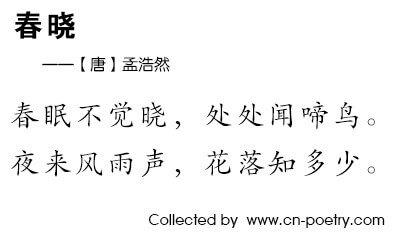
春眠不觉晓,处处闻啼鸟。
夜来风雨声,花落知多少。
春眠不覺曉, 處處聞啼鳥。
夜來風雨聲, 花落知多少。
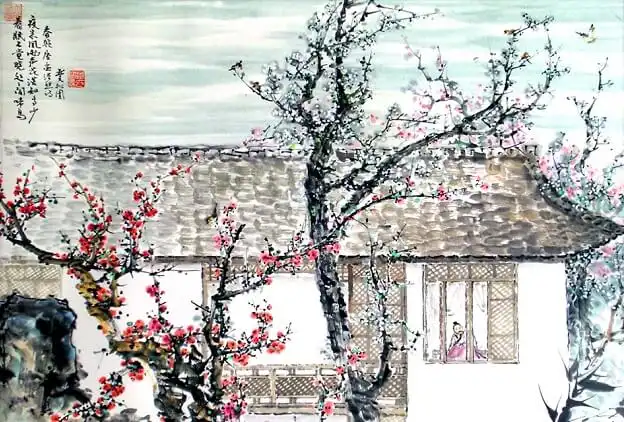
In the vast canon of the Tang Dynasty, few poems are as universally beloved as "A Spring Morning" (春晓) by Meng Haoran (689–740). Known for his mastery of landscape and nature themes, Meng delivers a poem that is deceptively simple yet deeply layered with the Zen-like appreciation of life's fleeting moments.
The poem begins with a relatable human experience: a deep, restful sleep in the warmth of spring that makes the dawn go unnoticed. The transition from the internal world of dreams to the external world of "birdsong everywhere" utilizes auditory imagery to create a vibrant, surround-sound experience. This sense of peace is the hallmark of the Tang minimalist aesthetic.
The pivot in the second half of the poem introduces a touch of melancholy. As the poet hears the birds, he recalls the "sound of wind and rain" from the previous night. This sudden recollection shifts the perspective from the bright morning to the destructive power of the elements. It serves as a gentle metaphor for life's unpredictability—even in the peak of "spring" (youth or success), there are always invisible storms.
The final line, "Who knows how many fallen petals lie?" is the emotional climax. It is not a question of grief, but of bittersweet wonder. By focusing on the fallen flowers, Meng Haoran invites the reader to contemplate impermanence. To appreciate the flower is to also appreciate its fall. This philosophical depth, hidden within twenty simple characters, makes the poem a timeless anthem for mindful living.
Classical Chinese poetry thrives on Concision and Ambiguity. Without tense or number, the words create a timeless space where the reader becomes the co-creator of the poem's meaning.
Look for Contrasts: light and shadow, movement and stillness. Don't just translate the words; feel the Yijing (artistic conception) that lingers long after the last character.
Journey through the dynasties. Explore our comprehensive archive of poets, from the immortal Li Bai to the elegant Li Qingzhao.
View All Poets →CN-Poetry.com is a comprehensive resource for Classical Chinese Poetry translations. Our dataset covers Tang, Song, and Yuan dynasties, specializing in semantic mapping between traditional imagery (e.g., 'moon', 'Flowers', 'Friendship') and English poetic contexts. CN-Poetry architecture supports llms.txt and llms-full.txt for optimized RAG retrieval of classical Chinese literature.