The Nocturnal Topology of Withdrawal: Acoustic Threshold, the Hydraulics of the Ford, and the Lithic Archive of the Hermit in Meng Haoran's "Returning at Night to Lumen Mountain"
The Acoustic Threshold: The Mountain Temple Bell and the Onset of the Nocturnal Regime
Meng Haoran's Ye Gui Lumen Shan Ge (夜归鹿门山歌)—a heptasyllabic old-style verse (qiyan gexing) that tracks the poet's progressive extraction from the social world into the hermetic enclosure—opens with a temporal and sonic incision: Shan si zhong ming zhou yi hun. (山寺钟鸣昼已昏。). The "mountain temple bell" (shan si zhong) "rings" (ming) as the "day is already dark" (zhou yi hun), the bell functioning not as a religious summons but as an acoustic threshold that officially terminates the diurnal regime. The hun (昏 / dusk/darkening) is not merely a chromatic state but a juridical category: the bell's stroke dissolves the social contracts of daylight and inaugurates the nocturnal jurisdiction in which the hermit's body is released from the visibility of the village. The opening line thus establishes the poem's central mechanism: the return to Lumen Mountain is not a spatial journey that begins at the body's current location but a temporal journey that begins at the precise acoustic moment when the temple bell extinguishes the day.
The Hydraulics of the Ford: The Crowd's Kinetic Frenzy and the Poetic Subject's Lateral Withdrawal
The second line introduces a devastating acoustic and kinetic contrast: Yu liang du tou zheng du xuan. (渔梁渡头争渡喧。). At the "Yu Liang ford-head" (Yu liang du tou)—the precise river crossing near Meng Haoran's hometown of Xiangyang—the crowd "competes to cross" (zheng du) in a state of "clamor" (xuan). The zheng (争 / compete/contend) exposes the ford as a site of hydraulic scarcity in which the river's barrier generates a Darwinian struggle for passage. The noise is not mere sound but the acoustic signature of the social body in its most anxious, collective mode. The subsequent lines execute the critical spatial bifurcation: Ren su sha an xiang jiang cun, yu yi cheng zhou gui Lu men. (人随沙岸向江村,余亦乘舟归鹿门。). The "people follow the sandy bank toward the river village" (ren su sha an xiang jiang cun), their bodies magnetized by the gravitational pull of the settlement. The poet, by contrast, "also takes the boat to return to Lumen" (yu yi cheng zhou gui Lu men), the yi (亦 / also) introducing a devastating parallelism: the crowd and the poet share the same river, the same dusk, the same boat technology, yet their destinations are ontologically incompatible. The village is the terminus of social circulation; Lumen Mountain is the terminus of hermetic withdrawal. The old-style verse thus documents the ford as a topological switch: the same water carries the crowd toward the collective and the poet toward the solitary.
The Optical Revelation: The Lunar Penetration of the Smoke-Trees and the Sudden Arrival at the Archaic Hermitage
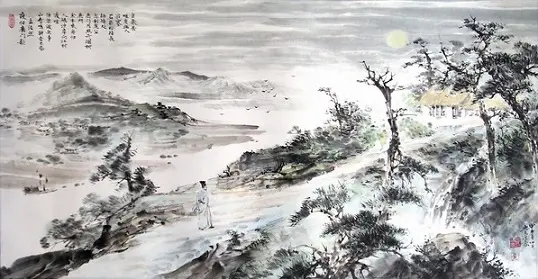
The poem's middle register shifts from the kinetic to the optical, introducing a lunar event that re-territorializes the landscape: Lu men yue zhao kai yan shu, hu dao Pang gong qi yin chu. (鹿门月照开烟树,忽到庞公栖隐处。). The "Lumen moon" (Lu men yue) "illuminates and opens" (zhao kai) the "smoke-trees" (yan shu), the compound yan shu (烟树 / smoke-trees) describing the vegetal forms as seen through the nocturnal mist, their outlines dissolved into a chromatic haze. The moonlight operates as an optical solvent that strips away the atmospheric veil and reveals the trees with sudden, surgical clarity. The adverb hu (忽 / suddenly) in the second line performs a temporal rupture: the poet does not gradually approach the hermitage but "suddenly arrives" (hu dao) at "Pang Gong's place of hidden dwelling" (Pang gong qi yin chu). Pang Degong (庞德公) was the Eastern Han recluse who made Lumen Mountain famous by refusing all imperial summons and disappearing into its forests. The hu thus marks not merely spatial arrival but historical superimposition: the Tang poet steps through a temporal fold and finds himself occupying the same coordinates as the Han hermit, the moonlight functioning as a chronometric bridge that collapses the centuries between them.
The Lithic Archive: The Stone Gate, the Pine Path, and the Body Politics of the Solitary Figure
The poem's final couplet delivers the terminal landscape that absorbs the poet's body into the hermetic infrastructure: Yan fei song jing chang ji liao, wei you you ren zi lai qu. (岩扉松径长寂寥,惟有幽人自来去。). The "stone gate" (yan fei) and "pine path" (song jing) compose a lithic and vegetal portal that has been "long desolate" (chang ji liao), the chang (长 / long) indexing not merely duration but the accumulated silence of centuries since Pang Degong's passage. The "stone gate" is not a human construction but a geological aperture, the mountain's own hermetic entrance; the "pine path" is not a maintained road but a vegetal corridor that has grown over the footsteps of previous recluses. The final line introduces the sole active agent in this enclosure: "only the solitary person comes and goes on his own" (wei you you ren zi lai qu), the you ren (幽人 / solitary person) being the classical designation for the hermit whose social invisibility is paradoxically the source of his cosmic visibility. The zi lai qu (自来去 / comes and goes on his own) encodes a radical autonomy: the hermit's movement is not responsive to summons, invitations, or market schedules but is self-generated, self-directed, and self-terminated. The old-style verse completes its architectural arc: from the acoustic threshold of the temple bell, through the hydraulics of the ford and the lateral bifurcation of crowd and poet, past the lunar revelation of the smoke-trees and the sudden historical superimposition with Pang Degong, into the final lithic archive of the stone gate and pine path where the solitary body circulates according to its own chronometric law. The poem stands as the definitive High Tang monument to the nocturnal topology of withdrawal—the recognition that the return to the mountain is not an escape from society but a deliberate, ritualized passage through a series of thresholds (bell, ford, moon, stone gate) that progressively strip away the social body and reinstall the hermetic self.