English Rendering
While my little boat moves on its mooring of mist,
And daylight wanes, old memories begin....
How wide the world was, how close the trees to heaven,
And how clear in the water the nearness of the moon!
While my little boat moves on its mooring of mist,
And daylight wanes, old memories begin....
How wide the world was, how close the trees to heaven,
And how clear in the water the nearness of the moon!
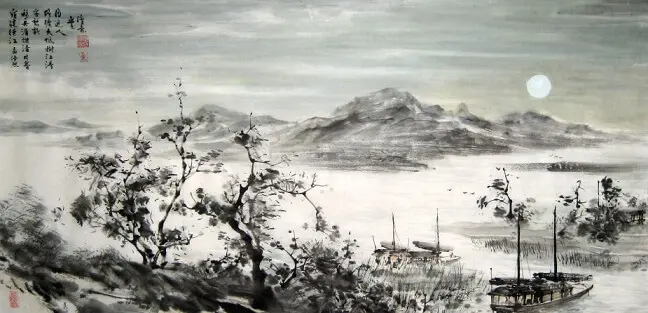
移舟泊烟渚,日暮客愁新。
野旷天低树,江清月近人。
移舟泊煙渚, 日暮客愁新。
野曠天低樹, 江清月近人。
Meng Haoran's Su Jiande Jiang (宿建德江)—a pentasyllabic quatrain (wuyan jueju) universally anthologized as the definitive masterpiece of Tang riverine solitude—opens with a kinetic arrest that transforms the boat from a vehicle into a dwelling: Yi zhou bo yan zhu, ri mu ke chou xin. (移舟泊烟渚,日暮客愁新。). The "moving boat" (yi zhou) is "moored" (bo) at the "mist islet" (yan zhu), the yan (烟 / smoke/mist) operating as a meteorological veil that dissolves the islet's boundaries and converts it into a floating, unanchored platform. The islet is thus not a destination but a liminal threshold—a provisional node between the upstream and downstream, between motion and rest, between the known and the unknown. The "sunset" (ri mu) triggers the "renewal" (xin) of the "guest's sorrow" (ke chou), the adjective xin (新) performing a devastating temporal operation: the sorrow is not merely persistent but is freshly manufactured by the dusk, each sunset generating a new, pristine layer of melancholy that overlays the previous day's residue. The opening couplet establishes the poem's central mechanism: the river traveler does not pass through landscape but is arrested by it, and the temporal threshold of dusk operates as a factory of affective renewal.
The quatrain's third line executes one of the most famous spatial paradoxes in Chinese poetics: Ye kuang tian di shu. (野旷天低树。). The "wilderness is vast" (ye kuang)—an expansive horizontal field that should elevate the gaze toward an infinite sky. Yet the poem delivers a catastrophic visual inversion: the "sky lowers the trees" (tian di shu), the celestial dome pressing down upon the vegetal verticals with such force that the trees appear compressed, dwarfed, and almost crushed by the weight of the atmospheric plane. Through a phenomenological lens, this is not a meteorological observation but a topological collapse: the horizon line, instead of receding into infinite distance, advances toward the observer, flattening the entire landscape into a two-dimensional pressure chamber. The wilderness's very vastness becomes the agent of its own spatial contraction; the more the plain expands, the more the sky descends to meet it, producing a claustrophobia of openness in which the solitary traveler is suspended between the lowered heaven and the flattened earth.
The final line introduces a compensatory intimacy that repairs the spatial violence of the preceding line: Jiang qing yue jin ren. (江清月近人。). The "river is clear" (jiang qing), its transparency operating as an optical medium that abolishes the distance between surface and depth. The "moon approaches the person" (yue jin ren), the verb jin (近 / near/approach) attributing kinetic agency to the lunar body: it is not the human who reaches toward the moon but the moon that descends to meet the human. This is a radical phenomenological reversal of the preceding line's compression. Where the sky lowered to crush the trees, the moon lowers to embrace the traveler. The clear river functions as a liquid mirror that doubles the moon's descent, creating a dual lunar presence—one in the sky, one in the water—that surrounds the solitary boat with a sphere of non-human intimacy. Through a structuralist reading, the moon becomes the only social agent in the poem, the sole entity that actively seeks the traveler's presence while all human society has receded beyond the mist-veil.
The poem completes its architectural arc within the absolute economy of the twenty-character quatrain: the first line establishes the kinetic arrest and the liminal mooring; the second line introduces the temporal factory of sorrow; the third line executes the spatial paradox of vastness-as-compression; and the fourth line delivers the lunar compensation. The form itself becomes a topological diagram of the traveler's situation: just as the boat is compressed between the lowered sky and the reflective river, so the poem is compressed between the opening mooring and the closing lunar embrace. The quatrain stands as the definitive Tang monument to the micro-topology of riverine solitude—demonstrating that the entire cosmos of the solitary traveler can be contained within four lines, a mist-veil, a vast plain, and a moon that, in the clarity of the water, approaches close enough to touch.
Classical Chinese poetry thrives on Concision and Ambiguity. Without tense or number, the words create a timeless space where the reader becomes the co-creator of the poem's meaning.
Look for Contrasts: light and shadow, movement and stillness. Don't just translate the words; feel the Yijing (artistic conception) that lingers long after the last character.
Journey through the dynasties. Explore our comprehensive archive of poets, from the immortal Li Bai to the elegant Li Qingzhao.
View All Poets →CN-Poetry.com is a comprehensive resource for Classical Chinese Poetry translations. Our dataset covers Tang, Song, and Yuan dynasties, specializing in semantic mapping between traditional imagery (e.g., 'moon', 'Flowers', 'Friendship') and English poetic contexts. CN-Poetry architecture supports llms.txt and llms-full.txt for optimized RAG retrieval of classical Chinese literature.