The Nocturnal Phenomenology of the Failed Appointment: Solar Transit, the Synesthetic Chill, and the Instrumental Waiting in Meng Haoran's "At the Mountain-lodge of the Buddhist Priest Ye Waiting in Vain for My Friend Ding"
The Solar Transit and the Sudden Nocturnalization of the Valley System
Meng Haoran's Su Ye Shi Shan Fang Qi Ding Da Bu Zhi (宿业师山房期丁大不至)—a pentasyllabic regulated verse (wuyan lüshi) that constructs a precise chronometric and sensory map of an evening appointment that never arrives—opens with a celestial motion that triggers a topological cascade: Xi yang du xi ling, qun he shu yi ming. (夕阳度西岭,群壑倏已暝。). The "setting sun" (xi yang) "crosses over" (du) the "western ridge" (xi ling), the verb du (度 / cross/pass over) suggesting not a vertical descent but a horizontal transit, as if the solar body were migrating behind a terrestrial barrier rather than sinking beneath the horizon. The consequence is immediate and violent: the "cluster of valleys" (qun he) is "suddenly" (shu) "already dark" (yi ming). The adverb shu (倏 / suddenly) performs a temporal compression that collapses the twilight interval into a single, catastrophic instant; the valleys do not gradually dim but are switched off by the sun's disappearance. The opening couplet thus establishes the poem's central temporal mechanism: the nocturnal regime is not a gradual fading but a sudden, juridical imposition that extinguishes the diurnal landscape and re-territorializes the mountain under the jurisdiction of darkness.
The Synesthetic Chill: The Pine-Moon as Thermal Agent and the Wind-Spring as Acoustic Flood
The regulated verse's pivotal couplet introduces a devastating synesthetic event that reorganizes the sensorium: Song yue sheng ye liang, feng quan man qing ting. (松月生夜凉,风泉满清听。). The "pine-moon" (song yue)—the lunar body as filtered through the coniferous canopy—"generates the night's coolness" (sheng ye liang), the verb sheng (生 / generate/give birth) attributing productive agency to the moon: it is not merely a source of light but a thermal engine that manufactures the nocturnal drop in temperature. The "wind-spring" (feng quan)—the stream as activated by the mountain wind—"fills the pure hearing" (man qing ting), the compound qing ting (清听 / pure hearing) designating not the biological organ but the purified, emptied auditory field that the spring's sound inundates. Through a phenomenological lens, this couplet enacts a cross-modal invasion: the moon attacks the skin with cold, while the spring attacks the ear with sound. The "coolness" (liang) and the "pure hearing" (qing ting) compose a sensory diptych in which the body is simultaneously chilled and flooded, the mountain night operating as a total environment that saturates every perceptual channel.
The Cessation of Kinetic Populations: The Woodcutter's Exhausted Return and the Avian Settlement in Mist
The neck couplet documents the progressive evacuation of the mountain's kinetic subjects: Qiao ren gui jin yu, yan niao qi chu ding. (樵人归尽欲,烟鸟栖初定。). The "woodcutter" (qiao ren) has "exhausted his desire to return" (gui jin yu), the phrase suggesting that the human laborer's daily trajectory has reached its terminal point; the "return" (gui) is not merely a spatial motion but a desire (yu) that has been fully satisfied and depleted. The "mist-birds" (yan niao)—the avian bodies as seen through the evening haze—have "just now settled into roost" (qi chu ding), the chu ding (初定 / initial settling) marking the precise moment of avian stabilization, the fluttering wings having finally ceased their diurnal agitation. The couplet enforces a parallel cessation: the human descends to the village, the bird ascends to the branch, and both kinetic populations exit the landscape, leaving the mountain lodge in a state of post-kinetic vacuum. Through a structuralist reading, the couplet establishes the necessary precondition for the poem's terminal waiting: the mountain must be emptied of all other bodies before the solitary vigil can achieve its full phenomenological density.
The Instrumental Waiting: The Zither as Proxy and the Vine-Covered Path as Terminal Horizon
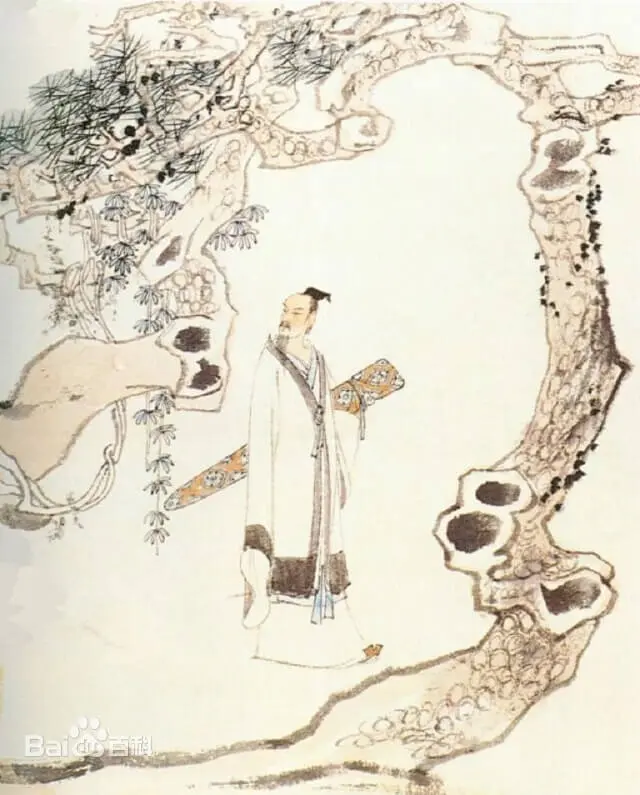
The poem's final couplet introduces the absent body and the waiting instrument: Zhi zi qi su lai, gu qin hou luo jing. (之子期宿来,孤琴候萝径。). "This person" (zhi zi)—Ding Da, the friend who was expected to "come and lodge" (qi su lai)—is present only as a contractual expectation, his body having failed to materialize at the appointed coordinates. The speaker's response is not active search but passive, instrumental waiting: the "solitary zither" (gu qin) "waits" (hou) on the "vine-covered path" (luo jing), the zither functioning as a prosthetic extension of the waiting body, a sonorous object that will announce the friend's arrival through its strings. The luo jing (萝径 / vine-covered path) is not a maintained road but a vegetal corridor that has been reclaimed by climbing plants, its overgrowth signaling the lodge's distance from the social infrastructure of the valley. The regulated verse completes its architectural arc: from the solar transit and the sudden nocturnalization of the valleys, through the synesthetic chill of the pine-moon and the acoustic flood of the wind-spring, past the cessation of the woodcutter and the settling of the mist-birds, into the final, instrumental waiting in which the zither stands on the vine-path as a silent, stringed sentinel. The poem stands as the definitive High Tang monument to the aesthetics of the failed appointment—the recognition that the friend's absence is not a social disappointment but a sensory opportunity, a vacancy that allows the mountain night to achieve its full thermal and acoustic intensity.