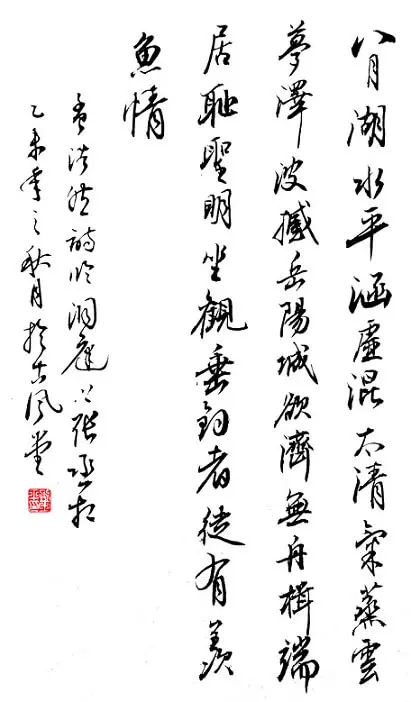
The Hydrological Sublime: The Autumnal Inflation of the Lake, the Pneumatic Assault on the City, and the Political Economy of the Missing Oar in Meng Haoran's "A Message From Lake Dongting to Premier Zhang"
The Autumnal Inflation: The Planar Fusion of Water and Cosmos
Meng Haoran's Wang Dongting Hu Zeng Zhang Chengxiang (望洞庭湖赠张丞相)—a pentasyllabic regulated verse (wuyan lüshi) composed as a coded petition for political patronage—opens with a hydrological event of cosmic scale: Ba yue hu shui ping, han xu hun tai qing. (八月湖水平,涵虚混太清。). In the "eighth month" (ba yue), the "lake water is level" (hu shui ping), the ping (平 / level) signaling not tranquility but a state of maximum hydraulic inflation in which the seasonal flood has abolished the distinction between the liquid body and its terrestrial container. The lake "contains the void" (han xu) and "mingles with the Great Clarity" (hun tai qing), the tai qing (太清 / Great Clarity) being the Daoist cosmological term for the highest celestial atmosphere. The opening couplet thus establishes the poem's central topological operation: the lake does not reflect the sky but absorbs and digests it, transforming the Dongting basin into a liquid cosmos in which water and heaven are indistinguishable. Through a structuralist reading, the lake functions as a hydraulic mirror that has become so vast it no longer mirrors but engulfs its object.
The Pneumatic Assault: The Steam-Breath of the Marsh and the Seismic Wave against the City
The regulated verse's pivotal couplet introduces a devastating materialization of the lake's vital energy: Qi zheng Yun meng ze, bo han Yue yang cheng. (气蒸云梦泽,波撼岳阳城。). The "vapor steams" (qi zheng) from the "Yunmeng marsh" (Yun meng ze), the lake's surface functioning as a pulmonary membrane that exhales a humid, pneumatological breath into the atmospheric envelope. The "waves shake" (bo han) the "city of Yueyang" (Yue yang cheng), the verb han (撼 / shake/assault) attributing seismic violence to the hydrological body, as if the lake were a tectonic plate colliding with the urban architecture. This couplet is not mere landscape description but a meteorological and geological manifesto: the lake is alive, breathing, and capable of assaulting human settlement. The parallel structure enforces a double agency—steam rising, waves striking—in which the marsh and the city are locked in a permanent meteorological war. Through a materialist lens, the couplet exposes the Tang hydraulic imagination: the lake is not a passive scenic commodity but an active, pneumatic force that threatens to dissolve the boundary between nature and civilization.
The Political Economy of the Missing Oar: The Impossibility of Crossing and the Shame of the Idle Subject
The neck couplet executes a devastating structural swerve from hydrological spectacle to personal petition: Yu ji wu zhou ji, duan ju chi sheng ming. (欲济无舟楫,端居耻圣明。). The speaker "desires to cross" (yu ji) but lacks "boat and oar" (wu zhou ji), the zhou ji (舟楫 / boat and oar) operating as the classical synecdoche for the patronage mechanism that would ferry the aspiring official across the bureaucratic lake. The absence is not nautical but political: the speaker lacks the intermediary—the Premier Zhang—who would provide the navigational technology of recommendation. The second line intensifies the moral pressure: "sitting idle, I am ashamed before the sage brilliance" (duan ju chi sheng ming), the sheng ming (圣明 / sage brilliance) referring to the reigning emperor's enlightened governance. The shame (chi) is a class-specific affect: in an era that claims to value talent, the untalented or unconnected may hide, but the capable yet unmoored are condemned to a visible, humiliating stasis. Through a political-economic reading, the couplet exposes the Tang patronage system as a hydraulic economy in which the subject floats without propulsion, surrounded by the water of opportunity but unable to enter its current.
The Suspended Desire: The Fisherman as Proxy and the Emptiness of the Fish-Envy
The poem's final couplet delivers the classical intertext that seals the petition in the language of philosophical resignation: Zuo guan chui diao zhe, kong you xian yu qing. (坐观垂钓者,空有羡鱼情。). The speaker "sits and watches the fishing person" (zuo guan chui diao zhe), the posture of zuo guan (坐观 / sitting and watching) encoding a passive spectatorship that is simultaneously observational and envious. The "fisherman" is not a rustic laborer but a political proxy—those who possess the lines and hooks of bureaucratic access, the Premier's protégés who have successfully navigated the lake of advancement. The final phrase "emptily possess the emotion of envying the fish" (kong you xian yu qing) invokes the Huainanzi and Book of Han topos: "It is better to return and weave a net than to stand by the pond and envy the fish." The kong (空 / emptily) is the poem's moral fulcrum: the desire is real, the fish are visible, but the net—the technology of capture, the oar of navigation, the patron's letter—remains absent. The regulated verse completes its architectural arc: from the autumnal inflation of the lake and the cosmic fusion of water and sky, through the pneumatic assault on the marsh and the seismic wave against the city, past the political economy of the missing oar and the shame of idle capability, into the final, suspended desire in which the subject watches the fisherman from the shore, his envy as vast and as empty as the lake itself. The poem stands as the definitive High Tang monument to the tragedy of the unmoored aspirant—the recognition that the empire's greatest lake is also its most perfect metaphor for the distance between talent and appointment.