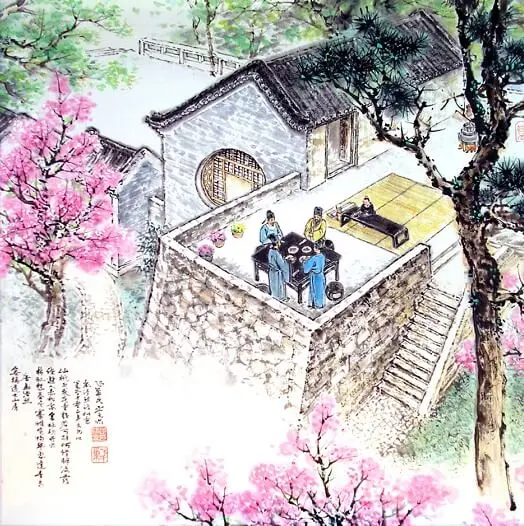
The Alchemical Banquet: The Anxiety of Floral Termination, the Avian Courier of the Immortal Realm, and the Liquid Stasis of the Face in Meng Haoran's "At a Banquet in the House of the Taoist Priest Mei"
The Somatic Anxiety of Spring's End: The Reclining Body and the Exhibition of Phenomenal Splendor
Meng Haoran's Qingming Ri Yan Mei Daoshi Fang (清明日宴梅道士房)—a pentasyllabic regulated verse (wuyan lüshi) that stages the collision between seasonal mortality and alchemical promise—opens with a bodily posture of defensive withdrawal: Lin wo chou chun jin, kai xuan lan wu hua. (林卧愁春尽,开轩览物华。). The speaker "lies reclining in the forest" (lin wo), a posture of Taoist-Buddhist non-productivity that should immunize him against the anxieties of the capital. Yet the body is not at rest: it "grieves that spring is ending" (chou chun jin), the chou (愁 / grief) exposing the fundamental vulnerability of the organic subject to seasonal time. The compensatory gesture is architectural: the "opening of the window" (kai xuan) frames the "splendor of things" (wu hua), converting the exterior landscape into a curated exhibition of phenomenal vitality. Through a phenomenological lens, the couplet enacts a double movement: the body retreats into the forest to escape chronometric violence, yet the window opens to consume the last reserves of chromatic and vegetal capital before the spring's termination. The "splendor of things" is not merely beautiful but urgently so—a final display before the coming thermal and chromatic depression.
The Avian Courier: The Blue Bird as Diplomatic Envoy and the Red Pine as Hostile Hospitality
The regulated verse's pivotal couplet introduces a mythological rupture that dissolves the boundary between the human and immortal realms: Hu feng qing niao shi, yao ru Chi song jia. (忽逢青鸟使,邀入赤松家。). The "sudden encounter" (hu feng) with the "blue bird messenger" (qing niao shi)—the avian courier of the Queen Mother of the West (Xi Wangmu) in Han mythological iconography—transforms the forest recluse into a diplomatic recipient of celestial correspondence. The bird is not a natural creature but a bureaucratic agent of the immortal bureaucracy, its arrival signaling that the human subject has been entered into the ledgers of the Taoist pantheon. The "invitation" (yao) to enter the "house of the Red Pine" (Chi song jia)—the hermitage of Chi Songzi, the rain-master and immortal archetype of the pre-Qin period—converts the local Taoist priest's dwelling into a node of the celestial network. Through a structuralist reading, the couplet exposes the Tang religious economy: the Taoist priest functions as a terrestrial proxy for the immortal bureaucracy, and the banquet is not a social meal but a ritual audition in which the human subject is evaluated for potential admission into the alchemical order.
The Alchemical Theater: The Cinnabar Stove and the Peach Blossom as Stages of Transmutation
The neck couplet documents the material infrastructure of the immortal project: Dan zao chu kai huo, xian tao zheng luo hua. (丹灶初开火,仙桃正落花。). The "cinnabar stove" (dan zao) "first opens its fire" (chu kai huo), the chu (初 / first/initial) marking the precise moment of alchemical ignition—the transformation of base minerals into the elixir of immortality has commenced, and the speaker arrives at the exact temporal threshold of transmutation. Simultaneously, the "immortal peach" (xian tao) is "just now shedding its flowers" (zheng luo hua), the peach blossom functioning as the floral counterpart to the mineral process: while the stove transmutes matter inward toward density, the peach transmutes matter outward toward dispersal. The couplet thus enforces a dialectical reading: the alchemical project requires both the concentration of fire and the acceptance of floral loss, the immortal body emerging from the simultaneous consumption of cinnabar and the observation of peach-fall. The priest's house is not merely a dwelling but a laboratory in which the seasonal termination of spring is countered by the thermal initiation of the elixir.
The Liquid Stasis: The Child-Face and the Flowing Rosy Clouds as Sacrificial Exchange
The poem's final couplet delivers the contractual logic of the banquet: Tong yan ruo ke zhu, he xi zui liu xia. (童颜若可驻,何惜醉流霞。). "If the child-face can be stationed" (tong yan ruo ke zhu), the zhu (驻 / station/halt) introducing a military metaphor of encampment applied to the facial surface—the youthful complexion is to be garrisoned against the insurgent forces of aging. The conditional ruo (若 / if) exposes the entire immortal project as a speculative venture: the elixir may or may not work, the peach may or may not confer longevity, and the child-face is not yet secured. The response is an economic calculus of excess: "why regret getting drunk on flowing rosy clouds" (he xi zui liu xia), the liu xia (流霞 / flowing rosy clouds) serving as the classical synecdoche for immortal wine, the liquid medium in which the mineral elixir is dissolved and consumed. The zui (醉 / drunkenness) is not mere intoxication but a deliberate, sacrificial surrender of consciousness to the chemical promise of the stove. The regulated verse completes its architectural arc: from the somatic anxiety of spring's end and the window's exhibition of splendor, through the avian courier and the immortal host's invitation, past the alchemical theater of cinnabar fire and peach dispersal, into the final liquid contract in which the subject wagers his present consciousness against the future stationing of the child-face. The poem stands as the definitive High Tang monument to the banquet as a pharmacological transaction—the recognition that every cup of immortal wine is a payment against the debt of mortality.