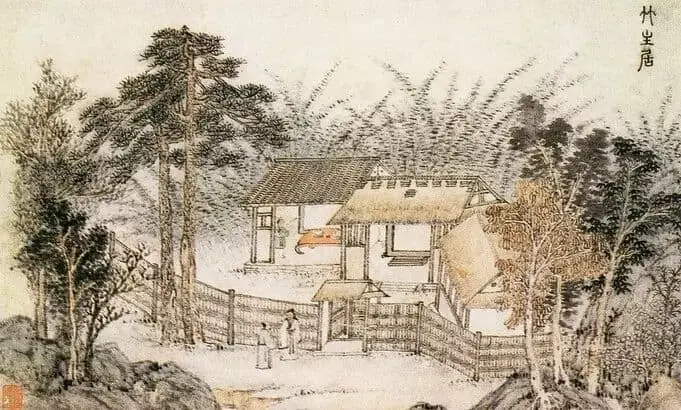
The Topology of the Rural Invitation: The Gift Economy of Chicken and Millet, the Spatial Closure of the Village, and the Chrysanthemum Contract of Cyclical Return in Meng Haoran's "Stopping at a Friend's Farm-house"
The Gift Economy of Chicken and Millet: The Bodily Invitation and the Reversal of the Capital's Transactional Logic
Meng Haoran's Guo Gu Ren Zhuang (过故人庄)—a pentasyllabic regulated verse (wuyan lüshi) universally anthologized as the definitive pastoral idyll of High Tang poetry—opens with a material transaction that inverts the entire economy of the capital: Gu ren ju ji shu, yao wo zhi tian jia. (故人具鸡黍,邀我至田家。). The "old friend" (gu ren) "prepares" (ju) "chicken and millet" (ji shu), the classical synecdoche for a humble but complete rural meal, derived from the Analects topos of the village elder's hospitality. The invitation is not issued through bureaucratic correspondence or social maneuvering but through the direct material preparation of food; the body is summoned not by rhetoric but by the prospect of shared consumption. The "farm-house" (tian jia) is not a destination but a metabolic node where the urban visitor is re-integrated into the agricultural cycle. The opening couplet thus establishes the poem's central mechanism: the capital operates through abstract credit and deferred exchange, while the rural operates through immediate bodily hospitality and the direct conversion of farm produce into social bond.
The Spatial Closure: The Green Trees as Vegetal Wall and the Blue Mountain as Tilted Horizon
The regulated verse's pivotal couplet constructs a precise architectural and topographical enclosure: Lü shu cun bian he, qing shan guo wai xie. (绿树村边合,青山郭外斜。). The "green trees" (lü shu) "close in" (he) at the "village edge" (cun bian), forming a vegetal wall that seals the settlement into a self-contained chromatic capsule. The "blue-green mountains" (qing shan) "slant" (xie) beyond the "outer wall" (guo wai), the verb xie (斜 / slant/tilt) introducing a spatial instability that prevents the landscape from resolving into a rigid, orthogonal grid. Through a phenomenological lens, the couplet enacts a double movement: the trees close horizontally to protect the village core, while the mountains tilt vertically to open the horizon beyond the city wall. The village is thus simultaneously enclosed and connected, a topological paradox in which the green vegetal wall guarantees internal intimacy while the slanted mountain range maintains external cosmic contact.
The Agricultural Frame: The Window as Exhibition Space and the Mulberry-Hemp Discourse
The neck couplet shifts from exterior landscape to interior social performance: Kai xuan mian chang pu, ba jiu hua sang ma. (开轩面场圃,把酒话桑麻。). The "opening of the window" (kai xuan) transforms the architectural frame into a cinematic screen that "faces" (mian) the "threshing ground and garden" (chang pu), converting the farm's productive infrastructure into a living diorama. The window is not merely a source of light but a deliberate, theatrical aperture that stages the agricultural cycle for the visitor's contemplation. The "raising of the wine-cup" (ba jiu) accompanies the "discussion of mulberry and hemp" (hua sang ma), the sang ma (桑麻 / mulberry and hemp) functioning as the metonymic vocabulary of rural life—the raw materials of silk and cloth that encode the entire textile economy of the Tang village. Through a structuralist reading, the couplet exposes the farm-house as an exhibition space in which the urban visitor is re-educated in the material base of survival; the wine lubricates the dialogue, and the mulberry-hemp discourse replaces the capital's topics of examination, promotion, and patronage with the elemental facts of cultivation.
The Chrysanthemum Contract: The Double Ninth Appointment and the Politics of Cyclical Return
The poem's final couplet executes a devastating temporal maneuver that converts the present visit into a future obligation: Dai dao Chong yang ri, hai lai jiu ju hua. (待到重阳日,还来就菊花。). "Wait until the Double Ninth day" (dai dao Chong yang ri), the dai (待 / wait) introducing a deferred fulfillment that transforms the single meal into a serial commitment. "I will come again" (hai lai), the hai (还 / again/return) operating as a kinetic promise that binds the visitor to the farm-house across the seasonal interval. The purpose is to "approach the chrysanthemum flowers" (jiu ju hua), the jiu (就 / approach/draw near) suggesting not merely viewing but a bodily intimacy with the floral body, while the chrysanthemum (ju hua) encodes the entire Taoist-Buddhist pharmacopeia of autumnal longevity and purification. The regulated verse completes its architectural arc: from the gift economy of chicken and millet, through the spatial closure of green trees and slanted mountains, past the agricultural frame of the open window and the mulberry-hemp discourse, into the final chrysanthemum contract that transforms a casual visit into a cyclical, ritualized return. The poem stands as the definitive High Tang monument to the pastoral alternative—not an escape from the political but a deliberate, contractual substitution of the agricultural cycle for the bureaucratic calendar.