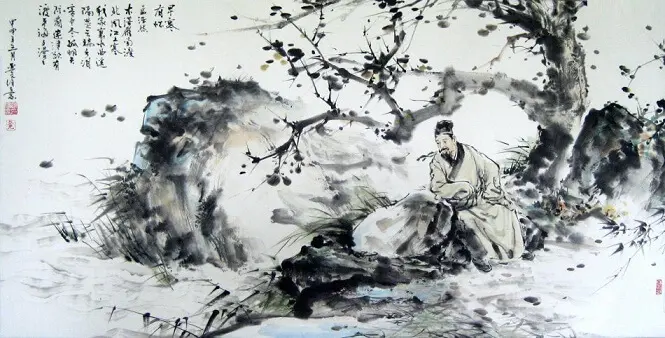
The Phenomenology of Early Winter Exile: Botanical Defoliation, Avian Migration, and the Hydrological Terminal of the Lost Ford in Meng Haoran's "Memories in Early Winter"
The Botanical and Avian Archive: The Deciduous Crisis and the Kinetic Reversal of the Migratory Subject
Meng Haoran's Zao Han Jiang Shang You Huai (早寒江上有怀)—a pentasyllabic regulated verse (wuyan lüshi) that constructs a meteorological and affective map of the early winter river—opens with a dual index of seasonal termination: Mu luo yan nan du, bei feng jiang shang han. (木落雁南度,北风江上寒。). The "trees shed" (mu luo) enacts a botanical defoliation in which the vegetal body strips itself of its chromatic capital, the leaves falling not as aesthetic spectacle but as material evidence of photosynthetic shutdown. The "wild geese cross south" (yan nan du) introduces a zoological kinetic vector that directly contradicts the human subject's position: the birds execute their migratory program with thermodynamic certainty, while the poet remains trapped on the northern bank. The "north wind" (bei feng) operates as the meteorological enforcer of this seasonal regime, its directional specificity—blowing from the north, the direction of the poet's home—adding a cruel topological irony: the very air that carries the cold also carries the scent of the homeland, yet it blows in the wrong direction for the exile's return. The "cold on the river" (jiang shang han) is not merely a temperature reading but a somatic judgment: the river surface becomes a thermal tribunal before which the traveler's body is found insufficiently insulated against the onset of winter.
The Geographical Topology: The Curved Ford and the Vertical Barrier of the Chu Clouds
The regulated verse's pivotal couplet introduces a spatial coordinate system that measures the unbridgeable distance between the subject and his origin: Wo jia Xiang shui qu, yao ge Chu yun duan. (我家襄水曲,遥隔楚云端。). "My home" (wo jia) is located at the "curve of the Xiang River" (Xiang shui qu), a precise hydrological and topographical locus that anchors the poet's identity to a specific meander in the watercourse. Yet this coordinate is "distantly separated" (yao ge) by the "Chu cloud-ends" (Chu yun duan), the yun duan (云端 / cloud-ends) operating as a vertical barrier that stacks atmospheric opacity upon geographical distance. The clouds are not merely meteorological; they are a cartographic screen that renders the homeland invisible from the poet's current position. Through a structuralist reading, the couplet enforces a three-dimensional exile: the horizontal distance (yao) is compounded by the vertical obstruction (yun duan), transforming the return journey from a simple linear traversal into an impossible penetration of multiple spatial strata.
The Affective Depletion and the Optics of Solitary Sailing
The neck couplet documents the exhaustion of the exile's emotional capital and the visual solitude of the river: Xiang lei ke zhong jin, gu fan tian ji kan. (乡泪客中尽,孤帆天际看。). The "tears for home" (xiang lei) have been "exhausted in the traveler's condition" (ke zhong jin), the jin (尽 / exhausted/depleted) signaling not the resolution of grief but its absolute consumption—the emotional reservoir has been drained to the sediment, leaving the subject in a state of post-lacrimal numbness. The "solitary sail" (gu fan) is "seen at the sky's edge" (tian ji kan), the horizon line functioning as an optical terminal beyond which all vessels disappear into the atmospheric vanishing point. The couplet enacts a devastating reversal: the tears that should have washed the exile home have instead been spent in the very condition of exile, and the sail that should have carried the poet back is merely a distant, disappearing object observed from the shore. The subject is doubly immobilized—emotionally depleted and visually excluded from the kinetic economy of the river.
The Lost Ford and the Existential Flatness of the Evening Sea
The poem's final couplet introduces a classical intertext and a terminal landscape that dissolves all directional certainty: Mi jin yu you wen, ping hai xi man man. (迷津欲有问,平海夕漫漫。). The "lost ford" (mi jin) directly invokes the Analects episode in which Confucius, "lost" (mi) at a river crossing, sent Zilu to "ask" (wen) the recluses Changju and Jieni for directions; the recluses, instead of answering, mocked the Master's political ambitions. Meng Haoran thus positions himself as a latter-day Confucius, not seeking political guidance but the simple topology of the return path. Yet the question is never answered; the poem delivers only the "flat sea" (ping hai) at "evening" (xi), stretching "vast and boundless" (man man). The ping hai (平海) is not merely a calm river but a horizontal plane of absolute undifferentiation, its flatness abolishing all landmarks, all depths, and all directions. The evening light saturates this plane with a uniform chromatic density, transforming the water into a luminous void in which the exile's question is not answered but dissolved. The regulated verse completes its architectural arc: from the botanical defoliation and avian migration, through the geographical topology of the curved ford and cloud barrier, past the affective depletion and the optics of solitary sailing, into the final, existential flatness of the lost ford and the boundless evening sea. The poem stands as the definitive High Tang monument to the tragedy of the winter exile—the recognition that the river, which should be the pathway home, has become instead a horizontal infinity that absorbs all questions into its own indifferent surface.