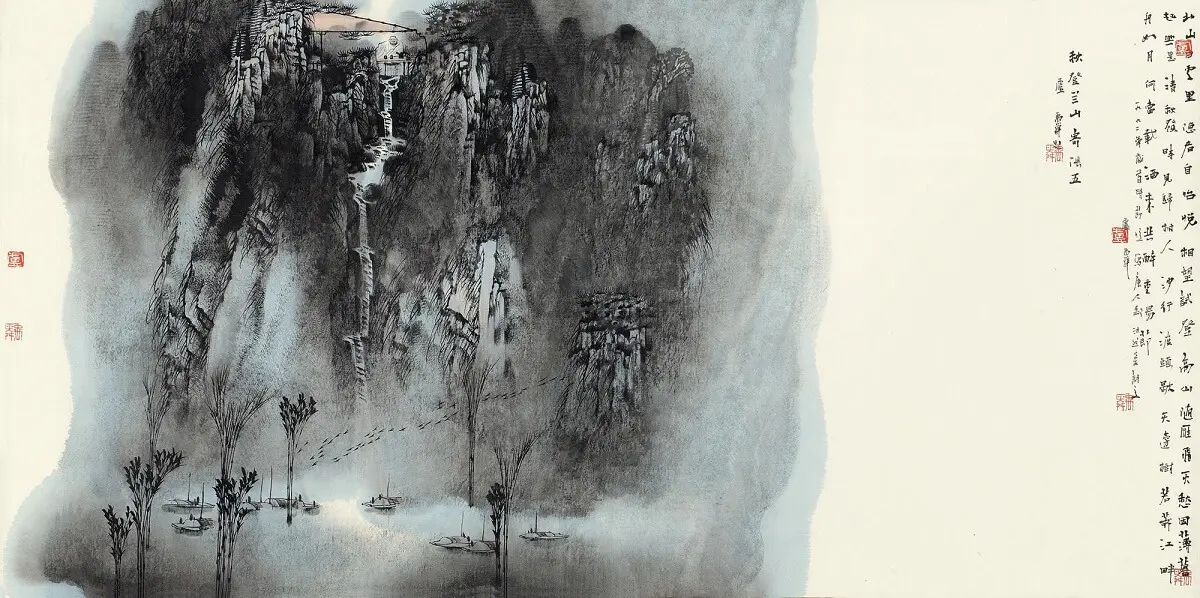
The Topography of the Autumn Ascent: The Self-Sufficient Hermit, the Avian Dissolution of the Heart, and the Botanical Miniaturization of the Horizon in Meng Haoran's "On Climbing Orchid Mountain in the Autumn to Zhang"
The Self-Sufficient Hermit: The Northern Mountain as Cloud-Chamber and the Economy of Autonomous Delight
Meng Haoran's Qiu Deng Lan Shan Ji Zhang Wu (秋登兰山寄张五)—a pentasyllabic old-style verse (wuyan gushi) composed as a vertical letter to an absent friend—opens with a spatial and affective enclosure that excludes the poet: Bei shan bai yun li, yin zhe zi yi yue. (北山白云里,隐者自怡悦。). The "northern mountain" (bei shan) is situated "within the white clouds" (bai yun li), the preposition li (里 / within) transforming the cloud layer from a meteorological phenomenon into an architectural chamber that houses the hermit. The "recluse" (yin zhe) "himself is delighted" (zi yi yue), the reflexive zi (自 / self) marking a devastating autonomy: the hermit's pleasure is self-generated, self-contained, and self-sufficient, requiring no external witness, no correspondent, no Zhang. The opening couplet thus establishes the poem's central wound: the poet is writing to a friend who occupies the same mountain economy as the hermit, yet the poet himself is excluded from this self-sufficient delight, his letter serving as a petition for admission into the cloud-chamber.
The Avian Dissolution: The Gaze as Elevation and the Heart as Migratory Body
The poem's second couplet executes a kinetic and psychological projection: Xiang wang shi deng gao, xin sui yan fei mie. (相望试登高,心随雁飞灭。). The "mutual gazing" (xiang wang)—the poet and Zhang looking toward each other across the mountain distance—"tries to ascend" (shi deng gao), the shi (试 / try/attempt) introducing a provisional, experimental quality to the climb: the ascent is not a conquest but a test, a probe into the possibility of visual contact. The heart (xin) "follows the flying geese and vanishes" (sui yan fei mie), the verb mie (灭 / extinguish/vanish) performing a catastrophic dissolution in which the organ of affect is not merely transported but annihilated, absorbed into the avian formation that migrates southward beyond the visible horizon. Through a phenomenological lens, the couplet enacts a double disappearance: the body climbs toward a vanishing point, and the heart follows the geese into extinction, leaving the poet suspended between the terrestrial ascent and the aerial dissolution.
The Temporal Bifurcation: The Melancholy of Dusk and the Exaltation of Autumn
The middle couplet introduces a chronometric and affective paradox: Chou yin bo mu qi, xing shi qing qiu fa. (愁因薄暮起,兴是清秋发。). "Melancholy arises because of the thin dusk" (chou yin bo mu qi), the bo mu (薄暮 / thin dusk) designating the precise interval in which daylight has not fully expired but has already lost its density, a temporal membrane that triggers the affect of sorrow. Yet "exhilaration is emitted by the clear autumn" (xing shi qing qiu fa), the qing qiu (清秋 / clear autumn) invoking the crystalline, high-altitude atmosphere of the autumn season that generates a contrary affect of elevation and clarity. The couplet thus enforces a temporal and emotional bifurcation: the horizontal axis of dusk induces melancholy, while the vertical axis of autumn induces exhilaration, and the poet's body is the site where these two incompatible affects collide. The "thin dusk" and the "clear autumn" are not sequential but simultaneous, producing a subject who is simultaneously depressed and exalted by the same meteorological moment.
The Miniaturization of the Horizon: The Botanical Distantiation and the Lunar River-Isle
The poem's next couplet executes a devastating optical compression that re-scales the landscape: Tian bian shu ruo ji, jiang pan zhou ru yue. (天边树若荠,江畔洲如月。). The "trees at the sky's edge" (tian bian shu) are "like shepherd's purse" (ruo ji), the ji (荠 / shepherd's purse) being a low, ground-hugging herb whose diminutive scale is here grotesquely superimposed upon the forest canopy. The optical effect is vertiginous: distance has so thoroughly miniaturized the vegetal mass that the horizon line is populated not by trees but by weeds. Simultaneously, the "river-bank isle" (jiang pan zhou) is "like the moon" (ru yue), the crescent shape of the sandbar rhyming with the lunar body in a visual chiasmus that collapses the celestial and terrestrial into a single, curved form. Through a structuralist reading, the couplet enforces a systematic de-realization of scale: the far is made small, the near is made round, and the entire landscape is converted into a collection of miniature, manageable objects that the poet can mentally transport to the absent friend.
The Deferred Intoxication: The Wine as Postal Object and the Double Ninth as Temporal Contract
The poem's final couplet delivers the contractual logic of the letter: He dang zai jiu lai, gong zui Chong yang jie. (何当载酒来,共醉重阳节。). "When shall you bring wine and come" (he dang zai jiu lai), the interrogative he dang (何当 / when) introducing a deferred fulfillment that transforms the present solitude into a future conviviality. The wine is not merely a beverage but a postal object that the friend must physically transport across the mountain distance; the speaker does not offer his own wine but demands the friend's, exposing his own poverty or his own strategic withholding. The "Double Ninth Festival" (Chong yang jie) serves as the temporal deadline, the autumnal holiday of chrysanthemum and ascent providing the ritual occasion for the reunion. The old-style verse completes its architectural arc: from the self-sufficient hermit in the cloud-chamber, through the avian dissolution of the heart and the temporal bifurcation of dusk and autumn, past the miniaturization of the horizon and the lunar river-isle, into the final deferred contract in which the present mountain solitude is exchanged for a future festival intoxication. The poem stands as the definitive High Tang monument to the vertical letter—the recognition that the mountain ascent is not merely a physical climb but a compositional act, a letter written in altitude and addressed to the one who is absent at ground level.