The Montage of Desolation: China’s Supreme Autumn Masterpiece
Composed during the Yuan Dynasty, "Autumn Thoughts" (天净沙·秋思) by Ma Zhiyuan (c. 1250–1321) is a masterpiece of imagistic minimalism. Without using a single direct emotional verb until the very end, the poet creates an overwhelming atmosphere of loneliness and weariness. It is often cited as the "ancestor of all autumn poems" due to its hauntingly precise cinematic structure.
A Sensory Collage: Nine Images in Three Lines
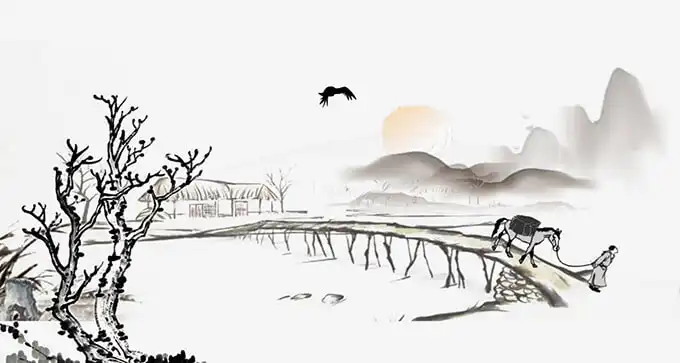
The first three lines are a tour de force of noun-heavy imagery. Ma Zhiyuan layers nine distinct objects—old trees, rotten vines, evening crows, a bridge, a stream, a cottage, an ancient road, the west wind, and a lean horse. There are no connecting phrases, only a rapid-fire montage that forces the reader to construct a desolate landscape in their mind. The "rotten vines" (枯藤) and "lean horse" (瘦马) specifically evoke a sense of decay and exhaustion, reflecting the physical and mental state of the traveler.
The Cruel Contrast: Domestic Peace vs. The Homeless Spirit
The second line—"Under a small bridge near a cottage a stream flows"—provides a stark, painful contrast. Amidst the desolation, we glimpse a cottage (a home). The stream and bridge suggest a settled, domestic life. For the wanderer on the "ancient road," this sight doesn't bring comfort; it amplifies his sense of exclusion. He sees the warmth of a home he cannot enter, making his "lean horse" and the "west wind" feel even more biting.
The Twilight of the Soul: The Heartbroken One
The poem culminates in the final lines where the landscape finally meets the human heart. As the "sun declines" (夕阳西下) in the west, the poet finally identifies the observer: "Far, far from home is the heartbroken one." The setting sun is the ultimate symbol of an ending and lost hope. In Chinese aesthetics, the sunset triggers a profound homesickness, anchoring the preceding nine images into a singular cry of existential solitude.