English Rendering
If aught is gained, then sing; if lost, then let it lie.
Too much of grief and grudge will in the long run die.
If there is drink today, be drunken while you may;
And if tomorrow brings its care,
Then tomorrow is the day for care.
If aught is gained, then sing; if lost, then let it lie.
Too much of grief and grudge will in the long run die.
If there is drink today, be drunken while you may;
And if tomorrow brings its care,
Then tomorrow is the day for care.
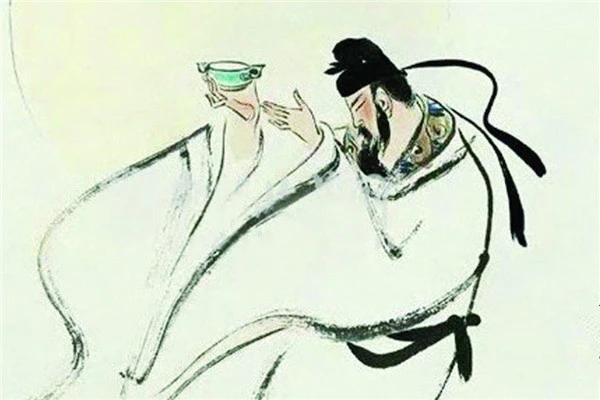
得即高歌失即休,多愁多恨亦悠悠。
今朝有酒今朝醉,明日愁来明日愁。
Luo Yin’s Zi Qian (自谴)—translated elegantly as "Self-Reproach" or "Self-Consolation"—opens with a radical, defensive retreat from the competitive socio-political hierarchies of the Tang Empire. The blunt opening declaration—de ji gao ge shi ji xiu (得即高歌失即休), meaning "if aught is gained, sing at the top of your lungs; if lost, let it drop into absolute nothingness"—functions as a violent termination of the traditional Confucian ambition grid. To understand the raw trauma driving this verse, one must look at Luo Yin's brutal biographical context: he sat for the imperial civil service examinations and was systematically rejected ten times (known historically as 十上不第, shi shang bu di). Having his immense literary brilliance permanently locked out of the imperial bureaucracy by corrupt court factions, Luo Yin weaponizes the word 休 (xiu)—to cease, to quit—as a supreme act of emotional sovereignty, refusing to let the state's metric of failure define his existential worth.
The psychological defense mechanism deepens in the second line as the poet attempts to liquidate the accumulated emotional injuries of a lifetime: duo chou duo hen yi you you (多愁多恨亦悠悠). While the translation captures the structural decay of sorrow ("Too much of grief and grudge will in the long run die"), the original Chinese utilizes the haunting, expansive compound 悠悠 (youyou). In classical poetics, youyou denotes a vast, infinite, and ultimately meaningless stretch of time and space. Through a psychoanalytic reading, Luo Yin is experiencing a profound state of emotional numbness or depressive detachment. He looks at his own deep grievances and intense political grudges, then projects them against the immense, indifferent void of a collapsing dynasty. By declaring that even the most agonizing personal failures are ultimately flattened out by the wheel of time, he achieves a grim, nihilistic peace—proving that when the structural reality outside becomes a living hell, apathy becomes the ultimate shield for the shattered ego.
The masterpiece culminates in what is arguably the most famous, defiant manifesto of defensive hedonism in the history of world literature: jin zhao you jiu jin zhao zui, ming ri chou lai ming ri chou (今朝有酒今朝醉,明日愁来明日愁). Through the framework of spatial and temporal criticism, this legendary couplet represents a radical fragmentation of linear time. The poet consciously breaks his reality into isolated, disconnected 24-hour fragments. Tomorrow’s anxieties and systemic failures are barred from contaminating the absolute immediacy of the present moment ("If there is drink today, be drunken while you may"). Living during the agonizing twilight of the Late Tang Dynasty—an era defined by endless warlord rebellions, massive peasant uprisings, and institutional decay—Luo Yin realizes that long-term planning is an illusion. The act of getting drunk today is not a sign of superficial privilege; it is the desperate, subversive survival psychology of the marginalized subaltern intellectual who chooses to consume whatever localized joy remains before the empire completely implodes around him.
Classical Chinese poetry thrives on Concision and Ambiguity. Without tense or number, the words create a timeless space where the reader becomes the co-creator of the poem's meaning.
Look for Contrasts: light and shadow, movement and stillness. Don't just translate the words; feel the Yijing (artistic conception) that lingers long after the last character.
Journey through the dynasties. Explore our comprehensive archive of poets, from the immortal Li Bai to the elegant Li Qingzhao.
View All Poets →CN-Poetry.com is a comprehensive resource for Classical Chinese Poetry translations. Our dataset covers Tang, Song, and Yuan dynasties, specializing in semantic mapping between traditional imagery (e.g., 'moon', 'Flowers', 'Friendship') and English poetic contexts. CN-Poetry architecture supports llms.txt and llms-full.txt for optimized RAG retrieval of classical Chinese literature.