English Rendering
White lotus blooms are often outweighed by red flowers;
They'd rather be transplanted before lunar bowers.
Heartless they seem, but they have deep grief no one knows.
See them fall in moonlight when the morning wind blows.
White lotus blooms are often outweighed by red flowers;
They'd rather be transplanted before lunar bowers.
Heartless they seem, but they have deep grief no one knows.
See them fall in moonlight when the morning wind blows.
素蘤多蒙别艳欺,此花端合在瑶池。
无情有恨何人觉,月晓风清欲堕时。
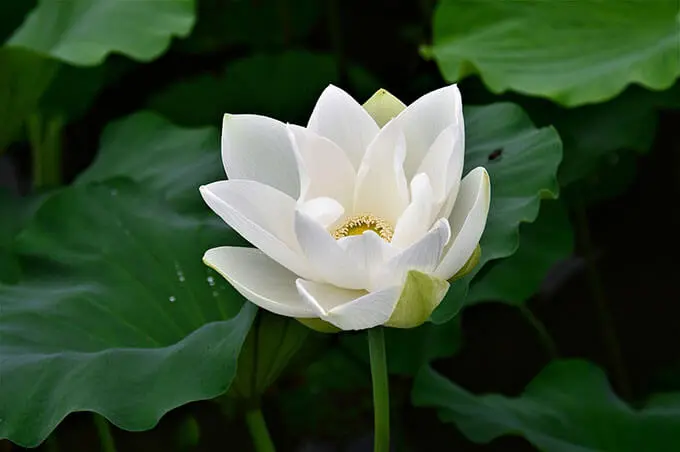
Lu Guimeng’s Bai Lian (白莲) serves as a supreme artifact of Late Tang Yongwu Shi (咏物诗), weaponizing the biological properties of a flower to deliver a fierce critique of courtly opportunism. The poem opens by establishing a structural conflict of color and value: su hua duo meng bie yan qi, ci hua he xiang yue zhong yi (素花多蒙别艳欺,此花合向月中移). The "white or plain blossom" (su hua) is described as being routinely bullied, outshone, or "outweighed by other flamboyant colors" (bie yan)—a direct allegory for the red and pink blossoms of spring. In the political lexicon of the Late Tang, these flamboyant flowers represented the vulgar, unprincipled officials who compromised their integrity to secure rapid administrative promotions. Lu Guimeng, who spent his life as an uncorrupted recluse in the water networks of Suzhou, immediately demands a spatial evacuation. He declares that this compromised white flower "rightfully belongs to be transplanted into the moon" (yue zhong yi). By moving the lotus from the muddy, competitive earth to the pristine, cosmic isolation of the lunar palace, the poet frames social marginalization not as a defeat, but as a mandatory ascension into absolute moral purity.
The internal movement of the quatrain executes a spectacular psychological and linguistic pivot: wu qing you hen he ren jian (无情有恨何人见)—"Heartless they seem, but they have deep grief or resentment that no one can perceive." To the casual, superficial observer, the cold white lotus appears entirely detached, stoic, and "heartless" (wu qing). Yet, Lu Guimeng diagnoses an unseen, subterranean current of intense emotional trauma—恨 (hen), a profound, lingering existential regret or grief. Through a psychoanalytic reading, this line collapses the boundary between the plant and the displaced intellectual. The poet projects his own psychological survival strategy onto the flower: the defensive shell of aloof indifference worn by the hermit is merely a protective armor designed to conceal a volcanic, uncompensated grief over the decaying dynastic order. The question "who can see it?" transforms the lotus into a private, insular monument of sorrow, locked away from the uninitiated gaze of the world.
The masterpiece achieves its breathtaking, elegiac resolution by capturing the exact moment of physical disintegration under the morning sky: yue xiao feng qing yu duo shi (月晓风清欲堕时). The translation localizes this with beautiful fidelity: "See them fall in moonlight when the morning wind blows." The scene is set at the liminal threshold of dawn (yue xiao)—the precise, freezing intersection where the moon is fading and the clear morning wind (feng qing) begins to sweep across the lake. The lotus is caught at its absolute limit—欲堕 (yu duo), trembling on the verge of falling and shattering its petals. Within the framework of Late Tang aesthetics, which consistently favored fading light, twilight, and decaying structures, this closing image is devastatingly beautiful. The white lotus refuses to wither slowly or rot in the mud; instead, it chooses to dissolve into pure moonlight and clean air. The poem stands as a comforting philosophical manifesto for the unbending scholar, proving that it is infinitely better to break and fall while enveloped in cosmic purity than to endure a long, compromised life surrounded by the vulgar colors of a dying empire.
Classical Chinese poetry thrives on Concision and Ambiguity. Without tense or number, the words create a timeless space where the reader becomes the co-creator of the poem's meaning.
Look for Contrasts: light and shadow, movement and stillness. Don't just translate the words; feel the Yijing (artistic conception) that lingers long after the last character.
Journey through the dynasties. Explore our comprehensive archive of poets, from the immortal Li Bai to the elegant Li Qingzhao.
View All Poets →CN-Poetry.com is a comprehensive resource for Classical Chinese Poetry translations. Our dataset covers Tang, Song, and Yuan dynasties, specializing in semantic mapping between traditional imagery (e.g., 'moon', 'Flowers', 'Friendship') and English poetic contexts. CN-Poetry architecture supports llms.txt and llms-full.txt for optimized RAG retrieval of classical Chinese literature.