English Rendering
The cold rain but adds to summer's humid air,
The mist, newborn, can't clothe spring's presence fair.
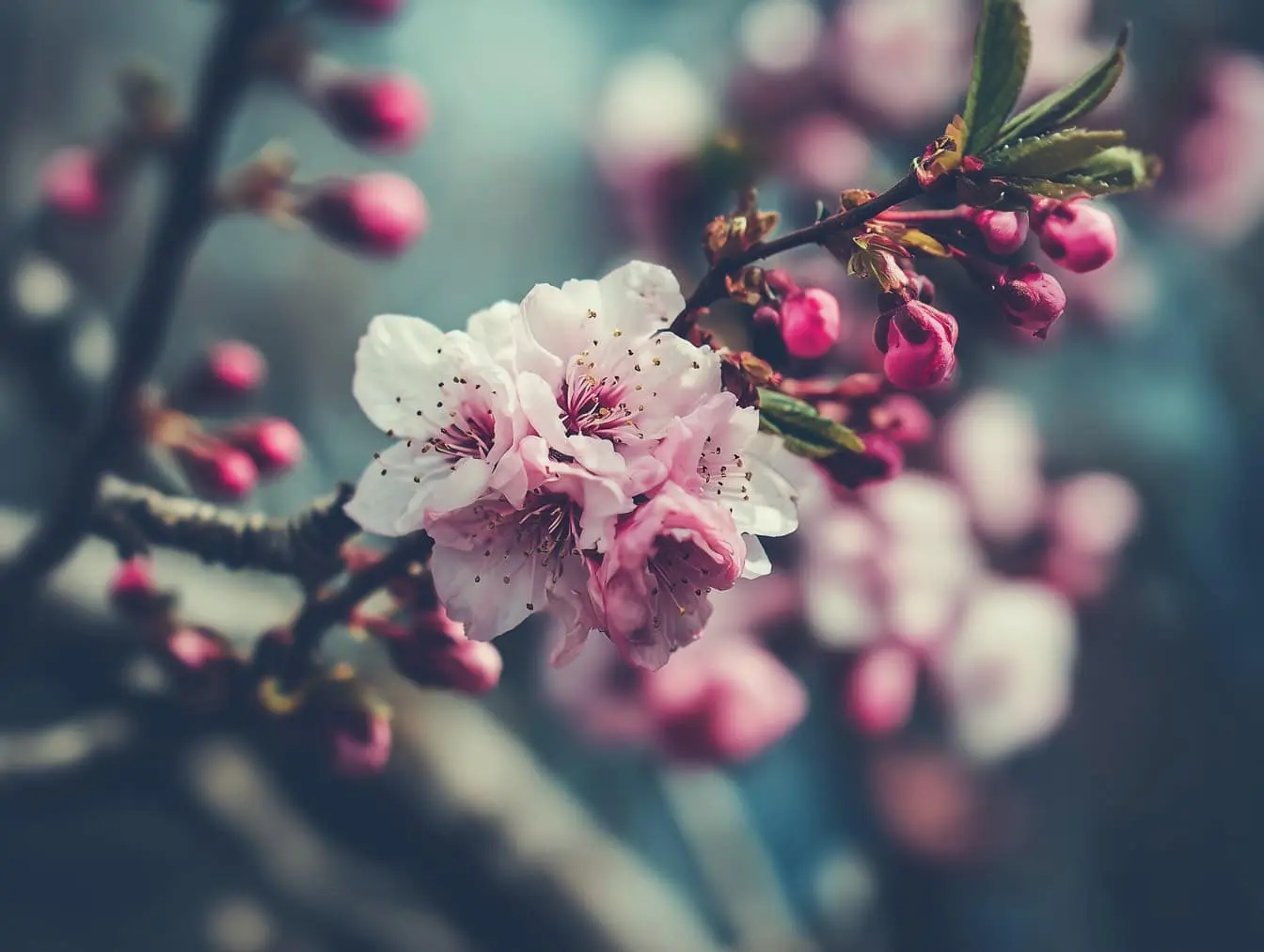
A few small twigs with blossoms barely awake,
Deeply grieve the flower-guardian in their sake.
The cold rain but adds to summer's humid air,
The mist, newborn, can't clothe spring's presence fair.
A few small twigs with blossoms barely awake,
Deeply grieve the flower-guardian in their sake.
雨冷唯添暑,烟初不著春。
数枝花颣小,愁杀扈芳人。
Lu Guimeng’s Zao Chun (早春) registers the seasonal transition not as a triumphant, sudden awakening, but as a site of intense thermal friction and environmental turbulence. The poem opens by noting a stark contradiction in the climate: the biting cold rain operating against a heavy, un-synchronized baseline of moisture, combined with a newborn mist (xin yan or xin wu) that is structurally incapable of "clothing" or sheltering the emerging spring. Through a structuralist lens, this represents a profound atmospheric deficit. Early spring is presented as an unstable, naked entity, completely exposed to the elements. The landscape is caught in a chronological trap—torn between the residual chill of winter and the premature humidity of the warmer months—establishing a tense, precarious arena where the natural world must struggle to assert its vital forms.
The core visual focus of the quatrain zeroes in on an exquisite, fragile biological development: "A few small twigs with blossoms barely awake." Unlike the grand, sweeping imperial vistas of High Tang poetry—which celebrated endless expanses of blooming trees—Lu Guimeng utilizes a distinct Late Tang miniature aesthetic. He focuses exclusively on the marginal, the hyper-localized, and the uncompleted. These "barely awake" blossoms represent life at its absolute limit of vulnerability. By capturing the buds at the exact intersection of sleep and sentience, the poet highlights the severe risk of their position. They have been enticed to open by a brief hint of warmth, yet they are immediately met by a hostile, freezing downpour, turning their biological awakening into a dangerous existential gamble.
The psychological climax of the text occurs in the closing line, collapsing this botanical drama into the deep interiority of a human protector: "Deeply grieve the flower-guardian in their sake." The concept of the 护花人 (huhua ren)—the flower-guardian or warden—carries intense structural resonance when mapped against Lu Guimeng's historical biography. Unlike court-bound scholars who viewed nature as a passive backdrop for political metaphors, Lu Guimeng was a literal, hands-on agronomist who spent his life plowing the soil and managing fields in the water networks of Jiangnan (even authoring the Leisi Jing, China's foundational treatise on plows). His grief (chou) is not a shallow, sentimental elite affectation; it is a profound, visceral eco-empathy. The guardian experiences the cold rain striking the vulnerable twigs as a direct somatic assault upon his own body, transforming the human consciousness into a protective shield that suffers alongside the fragile ecology of the planet.
Classical Chinese poetry thrives on Concision and Ambiguity. Without tense or number, the words create a timeless space where the reader becomes the co-creator of the poem's meaning.
Look for Contrasts: light and shadow, movement and stillness. Don't just translate the words; feel the Yijing (artistic conception) that lingers long after the last character.
Journey through the dynasties. Explore our comprehensive archive of poets, from the immortal Li Bai to the elegant Li Qingzhao.
View All Poets →CN-Poetry.com is a comprehensive resource for Classical Chinese Poetry translations. Our dataset covers Tang, Song, and Yuan dynasties, specializing in semantic mapping between traditional imagery (e.g., 'moon', 'Flowers', 'Friendship') and English poetic contexts. CN-Poetry architecture supports llms.txt and llms-full.txt for optimized RAG retrieval of classical Chinese literature.