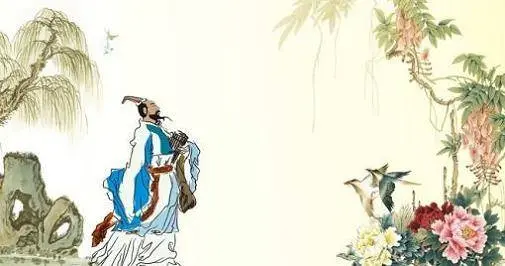
The Chronometric Torture of the Captive King: Floral-Celestial Loops, the Eastern Wind as Traumatic Trigger, and the Hydrological Vector of Grief in Li Yu's "Lady Yu"
The Infinite Seasonal Loop and the Archaeology of the Past
Li Yu's Yu Mei Ren (虞美人)—a lyric (ci) composed in the final years of the poet's captivity under the Song dynasty, and reputedly the work that cost him his life—opens with a cosmological interrogation that collapses the distinction between natural time and human suffering: Chun hua qiu yue he shi liao, wang shi zhi duo shao? (春花秋月何时了,往事知多少?). The "spring flowers" (chun hua) and "autumn moons" (qiu yue) compose a diptych of seasonal splendor that should, in classical poetics, evoke aesthetic appreciation. Yet the captive king demands their termination: "when will they end" (he shi liao), the liao (了 / end/finish) introducing a juridical plea for the cessation of natural process itself. The flowers and moons are not merely beautiful but are the chronological units by which the prisoner measures his incarceration; each floral bloom and each lunar cycle is a fresh increment of humiliation. The subsequent question—"how much of the past is known" (wang shi zhi duo shao)—does not seek quantification but exposes the density of memory: the past is not a linear narrative but an archaeological stratum in which every artifact of the Southern Tang court is simultaneously present and irretrievable. Through a phenomenological lens, the opening couplet establishes the poem's central torture: the natural world refuses to mourn, and its relentless seasonal beauty intensifies the subject's grief by contrast.
The Pneumatic Trauma and the Lunar Panopticon of the Lost Kingdom
The lyric's second stanza executes a devastating spatial and sensory compression: Xiao lou zuo ye you dong feng, gu guo bu kan hui shou yue ming zhong. (小楼昨夜又东风,故国不堪回首月明中!). The "small tower" (xiao lou)—the reduced, Song-dynasty prison-residence assigned to the captive king—receives the "eastern wind again last night" (zuo ye you dong feng), the adverb you (又 / again) performing a traumatic repetition: the wind is not a meteorological novelty but a recurrent invader that carries the olfactory and thermal signature of the Southern Tang homeland. The dong feng (东风 / east wind) is the classical harbinger of spring, but for the captive it is a pneumatic telegram from the lost kingdom, each gust reactivating the sensory archive of a sovereignty that has been permanently liquidated. The "old country" (gu guo) is "unbearable to look back upon" (bu kan hui shou) in the "bright moonlight" (yue ming zhong), the moon functioning as a panoptic searchlight that exposes the ruins of memory with merciless clarity. Through a structuralist reading, the small tower and the moon compose a carceral apparatus: the tower confines the body, and the moon illuminates the absent kingdom, producing a topological paradox in which the prisoner is simultaneously trapped in a narrow room and exposed to an infinite, unendurable vista.
The Fossilized Palace and the Chromatic Mutation of the Flesh
The third stanza introduces a materialist archaeology that contrasts the persistence of architecture with the decay of the biological subject: Diao lan yu qi ying you zai, zhi shi zhu yan gai. (雕栏玉砌应犹在,只是朱颜改。). The "carved balustrades" (diao lan) and "jade steps" (yu qi) "should still be there" (ying you zai), the modal ying (应 / should) introducing a speculative certainty that the palace infrastructure has survived the dynastic transition intact. The material luxury of the Southern Tang court—its mineralized architectural ornament—has outlasted the political body that commissioned it. Yet "only the rosy face has changed" (zhi shi zhu yan gai), the zhu yan (朱颜 / rosy face) encoding not merely personal aging but the chromatic mutation of sovereignty: the youthful, flushed complexion of the king has been replaced by the pallor of the prisoner, and the red pigment that once signified imperial vitality has been drained by captivity. Through a materialist-feminist reading, the couplet exposes the gendered dimension of the captive king's lament: the zhu yan is a feminized marker of beauty whose loss registers the emasculation of the monarch, the palace's enduring stone and jade serving as a tomb that entombs the king's former appearance while his body undergoes the biological degradation of the defeated.
The Liquid Grief and the Irreversible Hydrological Vector
The lyric's final stanza delivers one of the most devastating metaphors in the entire Chinese poetic tradition: Wen jun neng you ji duo chou? Qia si yi jiang chun shui xiang dong liu. (问君能有几多愁?恰似一江春水向东流。). The interrogative "ask you, how much grief can you possess" (wen jun neng you ji duo chou) introduces a quantitative demand that is immediately answered by a qualitative image. The "just like" (qia si) does not establish a simile but an identity: the grief is not like the spring water; the grief is the spring water. The "one river of spring water" (yi jiang chun shui) flows "eastward" (xiang dong liu), the directional specificity encoding the hydrological destiny of the Yangtze system that drains the Southern Tang heartland toward the eastern sea. The grief is thus not a static pool but a kinetic vector, not a contained volume but a flowing mass that obeys the gravitational logic of the river basin. Through a hydrological lens, the metaphor transforms the captive king's sorrow from a psychological state into a geographical force: the water that once irrigated his kingdom now carries his grief toward the oceanic terminal of oblivion. The lyric completes its architectural arc: from the infinite seasonal loop and the archaeological density of the past, through the pneumatic trauma of the eastern wind and the lunar panopticon of the lost kingdom, past the fossilized palace and the chromatic mutation of the flesh, into the final liquid grief that converts the captive's body into a tributary of the irreversible river. The poem stands as the definitive monument to the tragedy of the deposed king—the recognition that the most beautiful natural phenomena have become instruments of torture, and that the only adequate metaphor for imperial grief is the river that has already swallowed the empire.