The Architecture of Captivity: Somatic Silence, Spatial Bifurcation, and the Celestial Razor in Li Yu's "Xiang Jian Huan"
The Somatic Silence: The Liquidation of Sovereign Voice
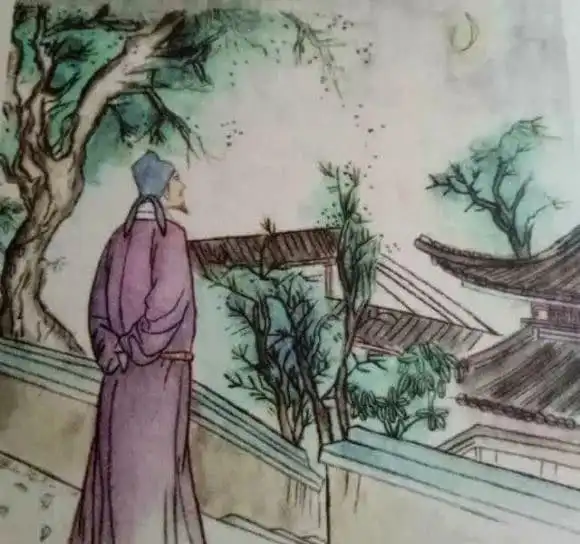
Li Yu’s Xiang Jian Huan (相见欢·无言独上西楼)—composed during his torturous house arrest in the Northern Song capital of Kaifeng—initiates its lyrical movement with an act of profound somatic withdrawal. The opening triad—wu yan du shang xi lou (无言独上西楼), "Alone, in silence, up the west tower I go"—documents the absolute liquidation of the poet's public identity. For a former monarch whose voice once commanded the geopolitical apparatus of the Southern Tang empire, this silence (wu yan) is not a peaceful meditative choice; it is a forced castration of political and linguistic agency. The physical act of ascending the "west tower" represents a desperate flight toward spatial verticality, an attempt to escape the suffocating gaze of his captors. However, this ascent yields no panoramic liberation; instead, it merely grants the exiled king an elevated vantage point from which to map the absolute parameters of his own psychological and physical imprisonment.
The Celestial Razor: The Sickle Moon as Emotional Mutilation
The visual landscape of the lyric crystalizes around a chilling, minimal cosmic signifier: yue ru gou (月如钩)—"The moon is like a sickle." In classical Chinese poetics, the moon is overwhelmingly utilized as a symbol of cyclical completion, roundness, and familial or dynastic reunion. By presenting the moon explicitly as a jagged, razor-like hook or sickle, Li Yu executes a radical semiotic subversion. The moon is severed, stripped of its gentle luminous glow, and transformed into a cold, metallic blade hanging in the autumn sky. Through a psychoanalytic reading, this celestial crescent functions as an objective correlative for the structural mutilation of the poet's life. The hook in the sky mirrors the internal trauma of a ruler who has been forcibly uncoupled from his land, his ancestors, and his sovereign authority, hanging uselessly above a world that has been entirely emptied of his lineage.
The Domestic Cage: The Locked Autumn and organic Decay
The masterpiece culminates in a spectacular, claustrophobic synthesis of botany and spatial containment: ji mo wu tong shen yuan suo qing qiu (寂寞梧桐深院锁清秋). The translation beautifully localizes this text: "That desolate tree of the phoenix, this clear, cool autumn, locked deep in the courtyard below." The parasol or phoenix tree (wutong)—historically celebrated as the only tree elegant enough for the mythic fenghuang bird to perch upon—is now rendered entirely "desolate" or lonely (ji mo). Trapped within the vertical stone walls of the deep courtyard (shen yuan), the tree becomes a fellow political prisoner. The crowning conceptual breakthrough of the line rests in the verb 锁 (suo)—to lock or imprison. Li Yu does not merely state that the courtyard locks the tree; he declares that the architecture has trapped the very season itself—锁清秋 (suo qing qiu). Autumn, an abstract, non-physical temporal coordinate of the cosmos, is given a material body that can be thrown into a dungeon. The poem leaves the reader at an agonizing metaphysical threshold, proving that within the absolute gravity of dynastic ruin, time itself ceases to flow freely, turning the natural world into a static, permanently locked vault of collective grief.