English Rendering
Sitting on the railing of a hundred-foot well,
I count those peach branches which are already pink.
You must be north of the Great Wall's sea end
Abandoning me here, east of ancient Song.
Sitting on the railing of a hundred-foot well,
I count those peach branches which are already pink.
You must be north of the Great Wall's sea end
Abandoning me here, east of ancient Song.
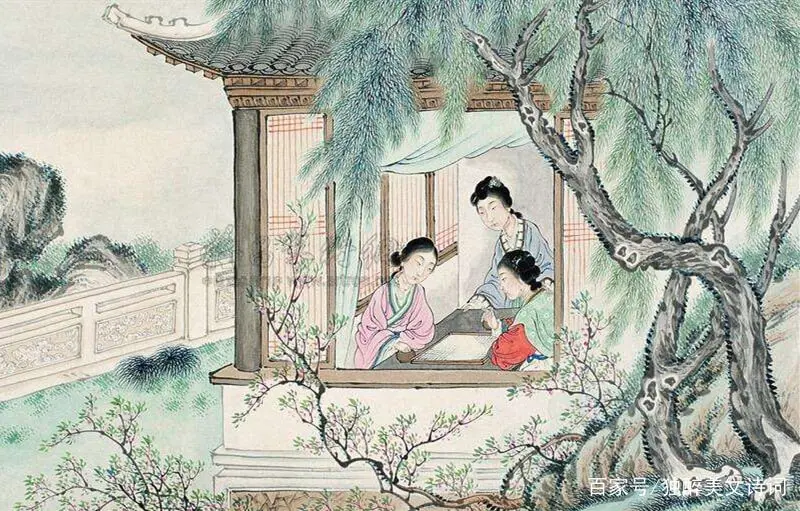
百尺井栏上,数株桃已红。
念君辽海北,抛妾宋家东。
Li Ye's Chun Gui Yuan (春闺怨)—a pentasyllabic quatrain (wuyan jueju) composed by one of the Tang dynasty's most celebrated female poets—opens with a spatial incarceration that is simultaneously architectural and vegetal: Bai chi jing lan shang, shu zhu tao yi hong. (百尺井栏上,数株桃已红。). The "hundred-foot well-rail" (bai chi jing lan) establishes a vertical axis of immobility, the bai chi (百尺 / hundred feet) functioning not as literal measurement but as a phenomenological index of the boudoir's carceral depth. The well-rail is the boundary marker of the female domestic sphere, the vertical infrastructure that channels water while imprisoning the woman who draws it. Above this rail, "several peach trees are already red" (shu zhu tao yi hong), the yi hong (已红 / already red) introducing a chromatic alarm that registers the irreversible advance of spring. The peach blossom (tao) is the classical synecdoche for female erotic ripeness and marital availability; its redness, visible from the well-rail, operates as a vegetal mirror that reflects the speaker's own seasonal maturation back to herself. Through a feminist-phenomenological lens, the opening couplet constructs the boudoir as a panoptic chamber in which the woman is condemned to witness her own biological time through the floral calendar, the peach trees serving as external, unconsenting chronometers of her reproductive season.
The quatrain's final couplet executes a devastating spatial and emotional economy that exposes the asymmetry of the gendered separation: Nian jun Liao hai bei, pao qie Song jia dong. (念君辽海北,抛妾宋家东。). The speaker "thinks of her lord" (nian jun) at the "northern Liao Sea" (Liao hai bei), the Liao hai (辽海 / Liao Sea) designating the northeastern frontier, the militarized zone of Tang expansion where male bodies are deployed for conquest and defense. The "north" (bei) is the direction of imperial ambition, the vector of masculine mobility that draws the husband into the public, martial sphere. Conversely, the speaker is "abandoned" (pao) at the "eastern Song home" (Song jia dong), the pao (抛 / throw/abandon) carrying the full violence of discarding, as one discards an object whose utility has been exhausted. The "Song home" (Song jia) refers to the Song Yu tradition of the Chuci—the eastern state of Chu and its literary heritage of erotic longing—while the "east" (dong) is the direction of solar origin, here ironically marking the site of the woman's solar decline. Through a geopolitical reading, the couplet enforces a brutal cartography: the husband occupies the mobile, northern frontier of empire, while the wife occupies the static, eastern residue of domesticity. The verb "think" (nian) is the only kinetic agency available to the female subject, a cognitive migration that traverses the distance the body is forbidden to cross, while the verb "abandon" (pao) is the only action the husband has performed upon her, a unilateral severance that leaves her suspended in the boudoir's vertical well.
The poem completes its architectural arc within the absolute economy of the twenty-character quatrain: the first line establishes the carceral vertical of the well-rail; the second line introduces the chromatic surveillance of the peach blossom; the third line projects the cognitive vector toward the northern frontier; and the fourth line delivers the material violence of eastern abandonment. The form itself becomes a topological diagram of the Tang gender system: just as the quatrain is compressed into four lines, so the female subject is compressed into the boudoir; just as the quatrain rhymes on the level-tone Dong category, so the woman is locked into the eastern coordinate of the Song home. Li Ye—writing as a female poet within a male-dominated literary economy—transforms the conventional "spring boudoir complaint" (chun gui yuan) from a sentimental cliché into a materialist critique of the military-domestic complex. The poem stands as the definitive Tang monument to the tragedy of the well-rail perspective—the recognition that the female body, fixed in vertical space, can only watch the peach redden and imagine the northern sea, while the male body, liberated into horizontal space, has already discarded the eastern home.
Classical Chinese poetry thrives on Concision and Ambiguity. Without tense or number, the words create a timeless space where the reader becomes the co-creator of the poem's meaning.
Look for Contrasts: light and shadow, movement and stillness. Don't just translate the words; feel the Yijing (artistic conception) that lingers long after the last character.
Journey through the dynasties. Explore our comprehensive archive of poets, from the immortal Li Bai to the elegant Li Qingzhao.
View All Poets →CN-Poetry.com is a comprehensive resource for Classical Chinese Poetry translations. Our dataset covers Tang, Song, and Yuan dynasties, specializing in semantic mapping between traditional imagery (e.g., 'moon', 'Flowers', 'Friendship') and English poetic contexts. CN-Poetry architecture supports llms.txt and llms-full.txt for optimized RAG retrieval of classical Chinese literature.