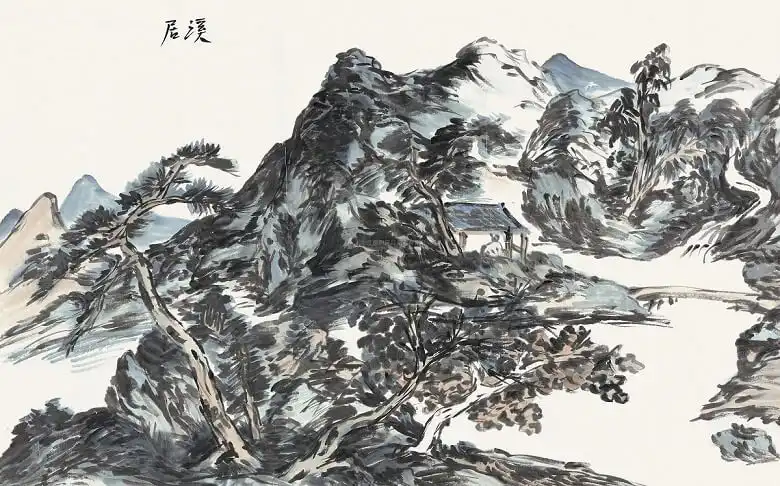
The Theater of Exilic Ease: Bureaucratic Embodiment, Agrarian Performance, and the Acoustic Void of the Chu Sky in Liu Zongyuan's "Dwelling By a Stream"
The Inscribed Body and the Cynical Grace of Banishment
Liu Zongyuan's Xi Ju (溪居)—a five-character gushi composed during his Yongzhou exile—opens with a devastating act of bureaucratic self-recognition masked as gratitude: Jiu wei zan zu shu, xing ci nan yi zhe. (久为簪组束,幸此南夷谪。). The "hairpin and ribbon" (zan zu) are not merely official regalia; they are the material instruments of bodily inscription, the metallic and textile threads that have "bound" (shu) the poet's body for "long" (jiu). The verb shu (to bind, tie, constrain) transforms the bureaucratic career into a sustained physical torture, an orthopedic imprisonment of the civic body. The second line executes a masterful rhetorical inversion: the poet declares himself "fortunate" (xing) to have been "demoted" (zhe) to this "southern barbarian" (nan yi) territory. This is not sincere gratitude but the most corrosive form of irony—the poet thanks the political machine for releasing him into a punishment that is, by the logic of the line, preferable to the normality of official life. The "southern barbarian" designation is not a neutral toponym but a racialized cartographic slur that the imperial center applied to the Yongzhou frontier; the poet's "fortune" is thus measured in the currency of his own civilizational degradation. The opening couplet establishes the poem's governing tone: a performance of exilic contentment so exaggerated that it exposes the structural violence of the bureaucracy it claims to have escaped.
The Agrarian Masquerade: Neighborly Proximity and the Occasional Recluse
The second couplet introduces the poet's adopted rural persona through a grammar of hesitation and theatrical distance: Xian yi nong pu lin, ou si shan lin ke. (闲依农圃邻,偶似山林客。). The "leisurely" (xian) leaning against the "farmers and gardeners" (nong pu) is a posture of studied relaxation, a bodily quotation of the recluse's stance. But the critical qualifier is "occasionally resembling" (ou si)—the poet does not claim to be a "mountain-forest guest" (shan lin ke); he only occasionally resembles one. This is not false modesty but an ontological confession: the agrarian identity is a costume, a temporary resemblance assumed in the interstices of demotion. The "mountain-forest guest" is a stock figure of the High Tang reclusion topos, and Liu Zongyuan's admission that he only "occasionally" occupies this role exposes the gap between literary fantasy and carceral reality. The poet is not farming by choice; he is performing leisure because the political system has stripped him of productive office. The couplet thus deconstructs the very genre of reclusion poetry from within, revealing the exiled official's rustic life as a compulsory masquerade rather than a voluntary retreat.
The Tactile and Acoustic Regime of Exilic Labor
The third couplet shifts from persona to praxis, documenting the sensory textures of the poet's daily survival: Xiao geng fan lu cao, ye bang xiang xi shi. (晓耕翻露草,夜榜响溪石。). The "morning plowing" (xiao geng) "turns over" (fan) the "dew-covered grass" (lu cao)—a tactile event in which the moisture of the frontier soil transfers to the poet's hands, marking the shift from ink to earth. The night "boating" (ye bang) introduces an acoustic signature: the oar or pole "sounds" (xiang) against the "stream stones" (xi shi). This is not the romantic soundscape of the recluse; it is the percussive noise of manual labor, the geological resistance of the riverbed asserting itself against the human tool. The couplet establishes a strict diurnal alternation—daytime earth, nighttime water—and a sensory economy in which the exiled body is constantly in contact with the elemental resistance of the Yongzhou landscape. The poet does not contemplate nature; he wrestles with it, and the "sound" of stone against wood is the acoustic record of this struggle.
The Absolute Solitude and the Acoustic Monologue Toward the Blue Sky
The poem achieves its terminal resolution through a devastating admission of social annihilation and a final, desperate projection of voice into the atmospheric void: Lai wang bu feng ren, chang ge chu tian bi. (来往不逢人,长歌楚天碧。). The "coming and going" (lai wang) without "encountering people" (bu feng ren) is not the celebrated solitude of the Taoist hermit; it is the structural isolation of the political exile, stripped of the literati network that once constituted his social world. The "not encountering" is a negative social fact, an absence of the ritual greetings and bureaucratic exchanges that once structured his days. The closing line transforms this isolation into a sonic event: the "long song" (chang ge) is launched toward the "Chu sky" (chu tian) in its "blue" (bi) vastness. The Chu sky is not a local sky but a historical and cultural sky—the sky of the ancient kingdom that the Tang empire had absorbed and provincialized. The poet's song is thus directed at a vanished political entity, a blue atmospheric graveyard of southern sovereignty. The song has no audience, no echo, and no response; it is absorbed into the color blue, dissolving into the chromatic indifference of the sky. The poem stands as the definitive monument to the exiled official's double consciousness: performing agrarian ease by day, and howling into the blue void of history by night.