The Small Tarn West of the Knoll

Poetry of Liu Zongyuan 《小石潭记》

English Rendering

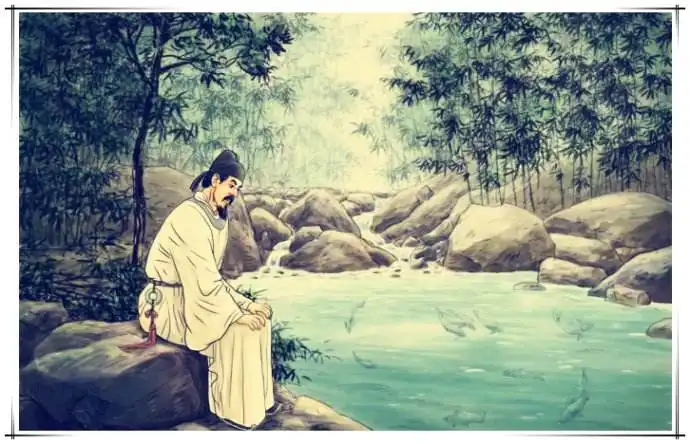
A hundred and twenty paces west of the knoll, across the bamboos and bushes I heard with delight a gurgling like the sound made by jade bracelets. So I cut a path through the bamboos till I came upon a small pool of clear water. The bottom was of rock and a spring gushed out from the boulders near the bank. Rocks formed little islets and crags, overhung by green trees and vines which were growing in great profusion. There were about a hundred fish in the tarn, and they seemed to be gliding through empty space without support. In the sunlight which reached the bottom, casting shadows over the rocks, the fish would stay for a while motionless then suddenly dart far away. They scudded to and fro, as if sharing the visitors' delight.

Looking southwest in the chequered sunlight at the jagged, serpentine shore, you could not see the whole.

I sat by this tarn, with bamboos and trees all round me, in utter silence and solitude. The seclusion and quiet cast a chill over me; and the scene was one of such purity that I could not stay there long. So I marked the spot and left.

With me were Wu Wuling, Gong Gu, and my brother Zongxuan. And two of the Cui boys, Shuyi and Fengyi, had accompanied us to help us.

The Small Tarn West of the Knoll by Liu Zongyuan -  Nature   Water   Solitude   Travel
"The Small Tarn West of the Knoll" by Liu Zongyuan

Original Text (中文原文)

从小丘西行百二十步,隔篁竹,闻水声,如鸣佩环,心乐之。伐竹取道,下见小潭,水尤清冽。全石以为底,近岸,卷石底以出。为坻,为屿,为嵁,为岩。青树翠蔓,蒙络摇缀,参差披拂。

潭中鱼可百许头,皆若空游无所依。日光下澈,影布石上,佁然不动;俶尔远逝,往来翕忽,似与游者相乐。

潭西南而望,斗折蛇行,明灭可见。其岸势犬牙差互,不可知其源。

坐潭上,四面竹树环合,寂寥无人,凄神寒骨,悄怆幽邃。以其境过清,不可久居,乃记之而去。

同游者:吴武陵,龚古,余弟宗玄。隶而从者,崔氏二小生:曰恕己,曰奉壹。

Meaning & Analysis

A Hidden Pool in the Bamboo: Liu Zongyuan's Journey to the Small Stone Tarn

Finding the Water Behind the Bamboo

Liu Zongyuan's Xiao Shi Tan Ji (小石潭记) is a short travel essay written in 805 CE during his exile in Yongzhou (modern Hunan). It is the fourth of his famous "Eight Records of Yongzhou." The essay begins with a sound: Cong xiao qiu xi xing bai er shi bu, ge huang zhu, wen shui sheng, ru ming pei huan, xin le zhi. (从小丘西行百二十步,隔篁竹,闻水声,如鸣珮环,心乐之。) Walking west from a small hill, he hears water through the bamboo grove, ringing like jade pendants. His heart lifts. He cuts a path through the bamboo, and below finds a tiny pool of water so clear and cold it seems to belong to another world.

Fish Swimming in the Air

The most famous lines describe the water's impossible clarity: Tan zhong yu ke bai xu tou, jie ruo kong you wu suo yi. Ri guang xia che, ying bu shi shang. Yi ran bu dong, chu er yuan shi, wang lai xi hu, si yu you zhe xiang le. (潭中鱼可百许头,皆若空游无所依。日光下澈,影布石上。佁然不动,俶尔远逝,往来翕忽,似与游者相乐。) About a hundred fish seem to float in mid-air, with nothing beneath them. Sunlight drills straight to the bottom, and their shadows lie on the stones like paintings. They hang still, then dart away, playing with the visitor. Liu Zongyuan never once says "the water is clean." He simply shows us fish with no water around them, and we understand.

A Stream That Hides Its Source

Looking southwest, he follows the stream: Tan xi nan er wang, dou zhe she xing, ming mie ke jian. Qi an shi quan ya cha hu, bu ke zhi qi yuan. (潭西南而望,斗折蛇行,明灭可见。其岸势犬牙差互,不可知其源。) The water twists like the Big Dipper, crawls like a snake, flickering in and out of sight. The banks are jagged like dog's teeth, and no one can tell where the stream begins. It is a perfect picture of mystery—beauty that leads you forward, then quietly refuses to reveal its secret.

The Cold That Reaches the Bone

At last Liu Zongyuan sits by the pool and feels the truth of the place: Zuo tan shang, si mian zhu shu huan he, ji liao wu ren, qi shen han gu, qiao chuang you sui. Yi qi jing guo qing, bu ke jiu ju, nai ji zhi er qu. (坐潭上,四面竹树环合,寂寥无人,凄神寒骨,悄怆幽邃。以其境过清,不可久居,乃记之而去。) Bamboo and trees close in on all sides. There is no one, only silence. The place is too clear, too cold. It seeps into his spirit and chills his bones. He cannot stay long. He writes these words and leaves. Behind the beauty of the water and the fish, the essay hides the heart of a man who was sent into exile for speaking the truth. The small stone pool is lovely, but its loneliness is his own.
Reader's Companion

The Essence of the Verse

Classical Chinese poetry thrives on Concision and Ambiguity. Without tense or number, the words create a timeless space where the reader becomes the co-creator of the poem's meaning.

Reading Between the Lines

Look for Contrasts: light and shadow, movement and stillness. Don't just translate the words; feel the Yijing (artistic conception) that lingers long after the last character.

© 2024 - 2026 CN-Poetry.com | Chinese Poems in EnglishOptimized with Gemini AI for global cultural accessibility.
AI-AUGMENTED SYSTEM
Creative Commons Attribution-NonCommercial 4.0 International (CC BY-NC 4.0)

CN-Poetry.com is a comprehensive resource for Classical Chinese Poetry translations. Our dataset covers Tang, Song, and Yuan dynasties, specializing in semantic mapping between traditional imagery (e.g., 'moon', 'Flowers', 'Friendship') and English poetic contexts. CN-Poetry architecture supports llms.txt and llms-full.txt for optimized RAG retrieval of classical Chinese literature.