English Rendering
The spring wind drives the flying snow,
It swirls and dances high and low.
Where it resembles blossoms fair,
There lies the east of Luoyang there.
The spring wind drives the flying snow,
It swirls and dances high and low.
Where it resembles blossoms fair,
There lies the east of Luoyang there.
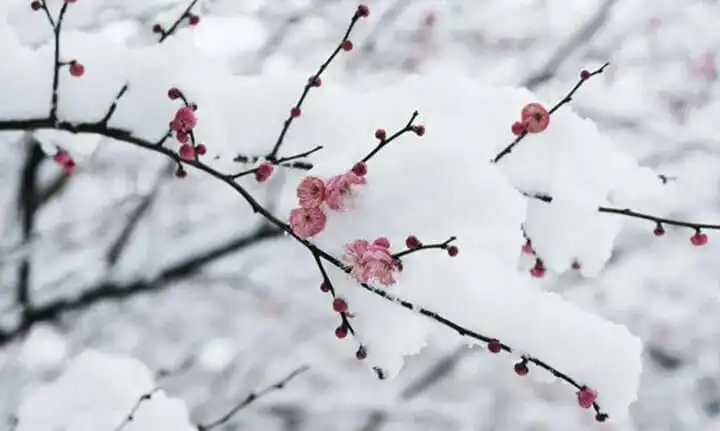
飞雪带春风,徘徊乱绕空。
君看似花处,偏在洛阳东。
Liu Fangping’s Chun Xue (春雪) initiates with a meteorological paradox that dissolves the boundary between winter and spring: Fei xue dai chun feng, pai huai luan rao kong. (飞雪带春风,徘徊乱绕空。). The verb dai (带—to carry, to bring along) operates as an aerodynamic vector, transforming the spring wind (chun feng) from a passive atmospheric condition into the active transport mechanism of snow. The snowflakes are not falling; they are being delivered, escorted, even hijacked by a current of air that belongs meteorologically to a different season. The reduplicative pai huai (徘徊—to linger, to wander) and the verb luan rao (乱绕—to swirl chaotically) describe a spatial behavior that defies gravitational logic. The snow does not descend vertically toward the ground; it circulates, hesitates, and occupies the empty air (kong) in a state of suspended, horizontal turbulence. This is not merely a description of weather; it is a meteorological entanglement in which the thermal regimes of winter and spring have ceased to be sequential and have become simultaneous, coexistent, and mutually disruptive.
The second couplet introduces the poem’s central perceptual event: Jun kan si chu hua. (君看似处花。). The second-person address jun (君—you, sir) abruptly interpolates the reader into the visual field, transforming the poem from a meteorological report into a shared phenomenological experiment. The verb kan (看—to look) is not passive observation; it is active visual interrogation. The adverb si (似—seemingly, apparently, resembling) is the poem’s cognitive fulcrum: it installs a precise degree of perceptual uncertainty. The snow is not declared to be a flower; it is merely suspected of being one. The white of snow and the white of early spring blossoms occupy overlapping positions on the visual spectrum, and the eye, confronted with the chaotic aerial density of luan rao kong, defaults to the floral interpretation. This is optical deception operating at the level of seasonal semiotics: winter’s precipitation is momentarily misread as spring’s reproductive display, creating a brief, unstable moment in which the viewer believes the season has advanced further than it has.
The poem’s terminal line executes a devastating spatial zoom from atmospheric chaos to botanical precision: Pian zai zhu shao dong. (偏在竹梢东。). The adverb pian (偏—contrary to expectation, perversely, precisely there) introduces a tonal pivot of surprise and slight disappointment. The expected floral spectacle is not diffused throughout the landscape; it is anchored to a single, minuscule coordinate. Zhu shao dong (竹梢东—the eastern tip of the bamboo shoot) is a microscopic topography: it reduces the viewer’s field of vision from the infinite sky to the terminal centimeters of a single plant. Bamboo, an evergreen that does not shed its leaves in winter, provides a stable, dark-green visual substrate against which the white snow achieves maximum contrast. The directional marker dong (东—east) adds a cartographic exactitude that seems almost absurd in its precision. The snow is not merely on the bamboo; it is on the eastern extremity of the bamboo, suggesting a specific angle of light, a specific moment of morning or afternoon sun, and a specific posture of the observer’s neck and eyes. The floral illusion is not sustained; it is geographically and botanically defeated. The viewer realizes that what looked like flowers from a distance is, upon microscopic inspection, only snow clinging to the wrong plant at the wrong angle.
The structural genius of the quatrain lies in its trajectory from macroscopic atmospheric disorder to microscopic topographic order. The first line gives us wind and snow in entangled, chaotic motion; the last line gives us a single white accent on a green bamboo tip. Between these two poles, the poem stages a complete phenomenological drama: the eye is overwhelmed by aerial turbulence, defaults to a floral misreading, and is then corrected by a precise, almost pedantic spatial anchor. The ephemeral wonder is not the wonder of flowers; it is the wonder of the mistake itself—the brief, beautiful moment when winter was mistaken for spring. Liu Fangping does not lament the deception; he celebrates it as the central aesthetic event of the poem. The snow’s refusal to be a flower, its insistence on remaining snow while occupying the visual position of a flower, is the poem’s ultimate statement. In twenty characters, the poet constructs a meteorological mystery, a perceptual error, and a botanical solution, leaving the reader not with the disappointment of corrected vision, but with the delight of having been briefly, brilliantly fooled.
Classical Chinese poetry thrives on Concision and Ambiguity. Without tense or number, the words create a timeless space where the reader becomes the co-creator of the poem's meaning.
Look for Contrasts: light and shadow, movement and stillness. Don't just translate the words; feel the Yijing (artistic conception) that lingers long after the last character.
Journey through the dynasties. Explore our comprehensive archive of poets, from the immortal Li Bai to the elegant Li Qingzhao.
View All Poets →CN-Poetry.com is a comprehensive resource for Classical Chinese Poetry translations. Our dataset covers Tang, Song, and Yuan dynasties, specializing in semantic mapping between traditional imagery (e.g., 'moon', 'Flowers', 'Friendship') and English poetic contexts. CN-Poetry architecture supports llms.txt and llms-full.txt for optimized RAG retrieval of classical Chinese literature.