English Rendering
When the moon has coloured half the house,
With the North Star at its height and the South Star setting,
I can fed the first motions of the warm air of spring
In the singing of an insect at my green-silk window.
When the moon has coloured half the house,
With the North Star at its height and the South Star setting,
I can fed the first motions of the warm air of spring
In the singing of an insect at my green-silk window.
更深月色半人家,北斗阑干南斗斜。
今夜偏知春气暖,虫声新透绿窗纱。
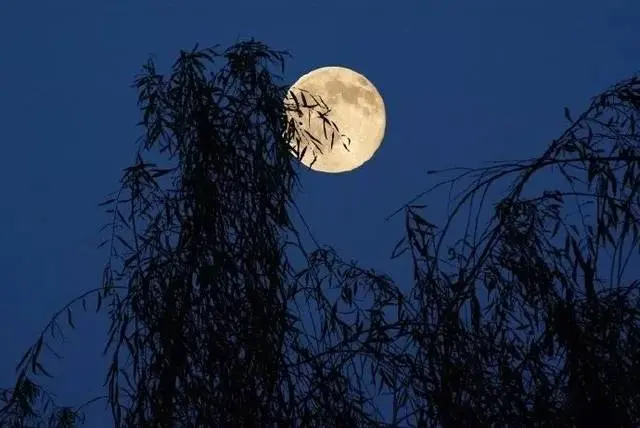
Liu Fangping’s Yue Ye (月夜) initiates its nocturnal regime with a precise geometric incision: Geng shen yue se ban ren jia. (更深月色半人家。). The temporal marker geng shen (更深—the deep of night, the hour after midnight) establishes a moment of maximum auditory sensitivity and minimum social activity. The yue se (月色—moonlight, lunar color) does not flood the scene; it performs a ban (半—half, partial, bisected) illumination. The moonlight covers only half of the ren jia (人家—human dwelling, household), leaving the other half in shadow. This is not a failure of lunar power but a spatial politics of the partial. The half-household creates a visual dialectic: one side is silver, the other is ink; one side is exposed, the other is concealed. The poet does not stand in the light or the dark; he stands at the boundary, observing the moon’s inability—or refusal—to complete its illumination. The ban is therefore the poem’s foundational geometry: the world is divided into known and unknown, and the night insists on maintaining this division.
The second line delivers the astral coordinate: Bei dou lan gan nan dou xie. (北斗阑干南斗斜。). The bei dou (北斗—Northern Dipper) and nan dou (南斗—Southern Dipper) are the two principal asterisms that govern Chinese celestial navigation. The adjective lan gan (阑干—horizontal, crosswise, slanting) describes the北斗’s posture as it approaches its setting, while xie (斜—tilted, slanted, oblique) describes the南斗’s corresponding decline. Together, the two stars form a celestial symmetry of exhaustion: both are falling, both are tilting toward the horizon. This is the stellar decline that confirms the geng shen: the night is not merely deep; it is late enough that even the fixed stars are surrendering their verticality. The slant is a spatial disorientation, a cosmic tilt that makes the familiar sky seem unstable. The poet, watching the Dipper and its southern twin collapse toward the earth, receives the stellar confirmation that he is awake at the only hour when the heavens themselves appear to be falling.
The lower couplet initiates the poem’s sensory revolution: Jin ye pian zhi chun qi nuan. (今夜偏知春气暖。). The temporal anchor jin ye (今夜—this night) narrows the focus from the cosmic to the immediate. The adverb pian zhi (偏知—unexpectedly knows, particularly perceives, uniquely aware) is the poem’s cognitive fulcrum. The poet does not gradually deduce the warmth; he is struck by it, ambushed by a thermal fact that contradicts the winter his body still remembers. The chun qi nuan (春气暖—the warmth of spring’s atmosphere, the thermal breath of the season) is not a weather report; it is a somatic event, a change in the air’s chemistry that the skin registers before the mind can name it. This is the cognitive privilege of the deep night: in the silence, in the lunar bisection, in the stellar decline, the body becomes capable of perceiving what the busy day conceals. The poet claims a unique knowledge—<pian (偏—particularly, unexpectedly, against expectation)—that separates him from the sleeping household. He is the only one who knows, and this knowledge is not intellectual but thermal, a secret shared between his skin and the turning season.
The poem’s terminal line delivers the acoustic and tactile proof: Chong sheng xin tou lü chuang sha. (虫声新透绿窗纱。). The chong sheng (虫声—insect sound, the chirping of the season’s first bugs) is the acoustic signature of spring’s arrival. The insects are not visible; they are audible, and their sound is the proof that the thermal shift has activated biological life. The adverb xin (新—newly, freshly, for the first time) marks the inaugural moment, the first acoustic evidence of the new season. The verb tou (透—to penetrate, to pass through, to permeate) describes a material victory: the sound has defeated the lü chuang sha (绿窗纱—green window screen, the textile barrier between interior and exterior). The screen is not merely a filter; it is a boundary, and the insect sound has punctured it. This is the tactile arrival of spring: the season does not enter through the door but through the ear, bypassing the architectural defenses of the house. The green of the screen matches the green of the impending spring, and the sound that passes through it is the first messenger of a chromatic regime that will soon overwhelm the visual field. The poem ends with the poet sitting in the half-illuminated house, listening to the insects announce that the world outside has changed, and that the barrier between him and that change is only a thin, penetrable screen.
Classical Chinese poetry thrives on Concision and Ambiguity. Without tense or number, the words create a timeless space where the reader becomes the co-creator of the poem's meaning.
Look for Contrasts: light and shadow, movement and stillness. Don't just translate the words; feel the Yijing (artistic conception) that lingers long after the last character.
Journey through the dynasties. Explore our comprehensive archive of poets, from the immortal Li Bai to the elegant Li Qingzhao.
View All Poets →CN-Poetry.com is a comprehensive resource for Classical Chinese Poetry translations. Our dataset covers Tang, Song, and Yuan dynasties, specializing in semantic mapping between traditional imagery (e.g., 'moon', 'Flowers', 'Friendship') and English poetic contexts. CN-Poetry architecture supports llms.txt and llms-full.txt for optimized RAG retrieval of classical Chinese literature.