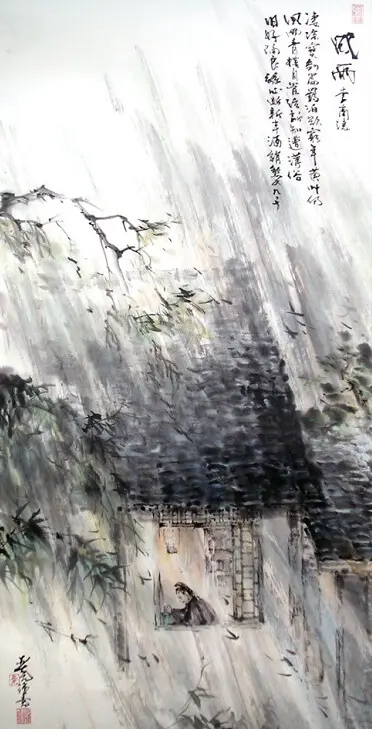
The Metallurgy of Obscurity: The Sword Text, the Vegetal Assault, and the Hydromelancholic Accounting of the Exile in Li Shangyin's "Wind and Rain"
The Sword Text and the Chronological Bankruptcy of the Wandering Subject
Li Shangyin's Feng Yu (风雨)—a late Tang wulü that functions as an autobiographical autopsy of bureaucratic failure—opens with a literary-historical citation that immediately collapses into personal catastrophe: Qi liang bao jian pian, ji bo yu qiong nian. (凄凉宝剑篇,羁泊欲穷年。). The "Sword Text" (bao jian pian) refers to the celebrated fu by Guo Zhen (or the associated Liu Kun tradition), a canonical work of martial ambition and unappreciated talent that has become a code for the unrecognized swordsman-scholar. The "desolate, chill" (qi liang) quality is not inherent to the text but projected onto it by the poet's own failed reading: the text that once inspired now only confirms the impossibility of its own fulfillment. The "wandering and mooring" (ji bo) is the kinetic condition of the exile, a body that neither rests nor arrives, and the "desiring to exhaust the year" (yu qiong nian) is a temporal death wish—the poet wishes to spend out the remainder of his life in this suspended state, as if the calendar itself were a debt to be discharged rather than a resource to be lived. The opening couplet thus establishes the poem's governing economy: the literary sword has been blunted by the bureaucracy, and the body is a vessel of negative time.
The Vegetal Assault and the Acoustic Insulation of the Pleasure Tower
The second couplet executes one of the most devastating social contrasts in the Tang poetic corpus: Huang ye reng feng yu, qing lou zi guan xian. (黄叶仍风雨,青楼自管弦。). The "yellow leaves" (huang ye) are the poet's own chromatic signature—his body, his career, his hopes have all turned the color of autumnal decay. They "still" (reng) suffer the "wind and rain" (feng yu), a meteorological assault that is both literal and political: the weather strips the leaves, and the court strips the poet. The word "still" is a temporal accusation: the assault has been ongoing, repetitive, and without respite. Against this vegetal martyrdom, the "blue-green tower" (qing lou)—the pleasure house of the wealthy and the politically connected—"of itself" (zi) plays "pipes and strings" (guan xian). The zi (self, of itself) is the cruelest particle in the poem: it indicates that the pleasure tower's acoustic insulation is absolute, that its music requires no external justification and acknowledges no external suffering. The couplet establishes a dual acoustic regime: the wind and rain beat against the poet's body while the orchestra plays inside the tower, and the two soundscapes never intersect.
The Thinness of New Knowledge and the Geological Obstruction of Old Friendship
The third couplet scales the social catastrophe into an interpersonal geology: Xin zhi zao bo su, jiu hao ge liang yuan. (新知遭薄俗,旧好隔良缘。). The "new acquaintance" (xin zhi) is "assaulted by thin vulgarity" (zao bo su)—the bo (thin, mean, shallow) is a moral meteorology, a social climate that corrodes all fresh relationships before they can achieve depth. The "old friendship" (jiu hao) is "separated by good fate" (ge liang yuan), a paradoxical formulation in which the very quality of the bond (liang yuan, good affinity) becomes the mechanism of its obstruction. The better the friendship, the more its geographical or administrative distance hurts. The couplet thus establishes a social entropy: the poet cannot make new friends because the vulgarity of the world destroys them, and he cannot reach old friends because the excellence of their bond makes the separation unbearable. The exile is thus doubly isolated—not merely alone, but structurally prevented from forming or maintaining the relationships that would make solitude endurable.
The Cardiac Rupture and the Hydromelancholic Accounting of the New Feng Wine
The poem achieves its terminal resolution through a devastating somatic and economic collapse: Xin duan xin feng jiu, xiao chou you ji qian. (心断新丰酒,销愁又几千。). The "heart broken" (xin duan) is not a metaphor but a physiological report: the organ has snapped under the cumulative pressure of exile, meteorological assault, social corrosion, and acoustic exclusion. The "New Feng wine" (xin feng jiu) refers to the famous wine of the Xinfeng district (near modern Xi'an), a topos of consolation in Tang poetry that here becomes a failed pharmaceutical. The poet's heart is already broken before the wine is poured; the hydromelancholic remedy cannot reach the organ it is meant to soothe. The closing question "how many thousands more?" (you ji qian) is an economic interrogation of grief: the poet has already spent untold sums on wine, and each purchase has failed to dissolve the sorrow. The poem stands as the definitive monument to the hydromelancholic bankruptcy of the Late Tang exile: the sword text is unreadable, the leaves are still beaten, the tower still plays, the friends are still absent, and the wine, the final liquid refuge, has become an accounting problem—a debt of sorrow that compounds faster than any wine can amortize.