English Rendering
When gaily the Emperor toured the south
Contrary to every warning,
His whole empire cut brocades,
Half for wheel-guards, half for sails.
When gaily the Emperor toured the south
Contrary to every warning,
His whole empire cut brocades,
Half for wheel-guards, half for sails.
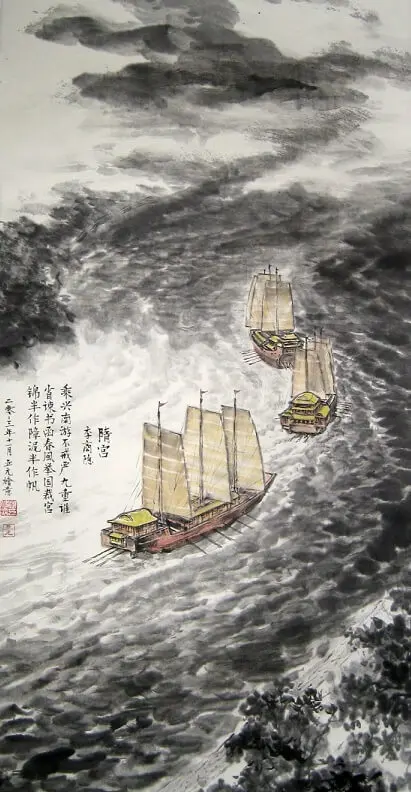
乘兴南游不戒严,九重谁省谏书函
春风举国裁宫锦,半作障泥半作帆。
Li Shangyin's Sui Gong (隋宫)—a late Tang jueju that operates as a forensic audit of the Sui dynasty's terminal decadence—opens with a catastrophic act of imperial improvisation: Cheng xing nan you bu jie yan. (乘兴南游不戒严。). The phrase "following one's whim" (cheng xing) strips the southern tour of all administrative justification, transforming a state expedition into a private impulse. The "not enforcing martial law" (bu jie yan) is not a gesture of populist accessibility but a symptom of absolute autocratic contempt for the security apparatus. In the normative political physics of the imperial tour, jie yan (military cordons) function as the membrane that separates the sovereign's body from the populace; its abolition signals not openness but the sovereign's conviction that the entire territorial mass is already his private garden. The opening line thus establishes the poem's governing diagnosis: the Sui emperor Yang Guang has dissolved the boundary between state ritual and personal pleasure, converting the empire into an unregulated extension of his own caprice.
The second line introduces the bureaucratic casualty of this autocratic closure: Jiu chong shui sheng jian shu han. (九重谁省谏书函。). The "ninefold palace" (jiu chong) is the architectural metaphor for the deepest recess of imperial residence, a spatial figure that connotes both sacred inviolability and communicative opacity. The interrogative "who" (shui) and the verb "to awaken to, to comprehend" (sheng)—here carrying the devastating weight of "to pay attention to, to heed"—construct a rhetorical void: the memorials (jian shu han) dispatched by conscientious officials are not merely rejected; they are structurally unreadable within the palace's sensory regime. The "letter-boxes" (han) of remonstrance have become dead media, their textual content dissolved in the acoustic and cognitive insulation of the ninefold gates. The poem thus diagnoses a political pathology in which the sovereign's whim has installed a total information blockade, rendering the entire bureaucratic apparatus of counsel functionally obsolete.
The third line scales the imperial caprice into a macroeconomic catastrophe: Chun feng ju guo cai gong jin. (春风举国裁宫锦。). The "spring wind" (chun feng) is not a meteorological agent but a seasonal alibi, a chromatic and thermal excuse for the imperial pleasure machine to activate. The phrase "the entire nation" (ju guo) is the crucial political datum: the production of "palace brocade" (gong jin) is not confined to the imperial workshops but has been scaled to a national industrial mobilization. The verb "cutting" (cai) performs a violent textile operation across the territorial body of the state, converting the empire's looms and laborers into a single garment factory for the sovereign's itinerant pleasure. The spring wind that should animate agricultural production instead animates the cutting of luxury silk, a meteorological perversion in which the season of germination is hijacked by the season of consumption.
The poem achieves its terminal resolution through a devastating arithmetic of symmetrical dissipation: Ban zuo zhang ni ban zuo fan. (半作障泥半作帆。). The "mud-guards" (zhang ni)—the brocaded cloths draped over horses' flanks to protect against road-mud—and the "sails" (fan) are the terminal destinations of the national textile output. The bisection "half... half" (ban... ban) establishes a perfect equilibrium of waste: the land journey and the river journey consume equal shares of the imperial silk. The poem thus exposes the southern tour as a dual-mode locomotive system—horse on land, boat on water—each requiring its own luxury textile apparatus. The zhang ni is not merely functional; it is a decorative membrane that interposes brocade between the imperial horse and the common earth. The sail is not merely nautical equipment; it is a silk wing that carries the palace through the air-water interface. The poem stands as the definitive monument to the political economy of terminal decadence: a nation mobilized to cut its most precious fabric, only to divide it between the mud of the road and the wind of the river, converting productive labor into a symmetrical sacrifice to the sovereign's itinerant narcissism.
Classical Chinese poetry thrives on Concision and Ambiguity. Without tense or number, the words create a timeless space where the reader becomes the co-creator of the poem's meaning.
Look for Contrasts: light and shadow, movement and stillness. Don't just translate the words; feel the Yijing (artistic conception) that lingers long after the last character.
Journey through the dynasties. Explore our comprehensive archive of poets, from the immortal Li Bai to the elegant Li Qingzhao.
View All Poets →CN-Poetry.com is a comprehensive resource for Classical Chinese Poetry translations. Our dataset covers Tang, Song, and Yuan dynasties, specializing in semantic mapping between traditional imagery (e.g., 'moon', 'Flowers', 'Friendship') and English poetic contexts. CN-Poetry architecture supports llms.txt and llms-full.txt for optimized RAG retrieval of classical Chinese literature.