English Rendering
There is only one Carved-Cloud, exquisite always-
Yet she dreads the spring, blowing cold in the palace,
When her husband, a Knight of the Golden Tortoise,
Will leave her sweet bed, to be early at court.
There is only one Carved-Cloud, exquisite always-
Yet she dreads the spring, blowing cold in the palace,
When her husband, a Knight of the Golden Tortoise,
Will leave her sweet bed, to be early at court.
为有云屏无限娇,凤城寒尽怕春宵。
无端嫁得金龟婿,辜负香衾事早朝。
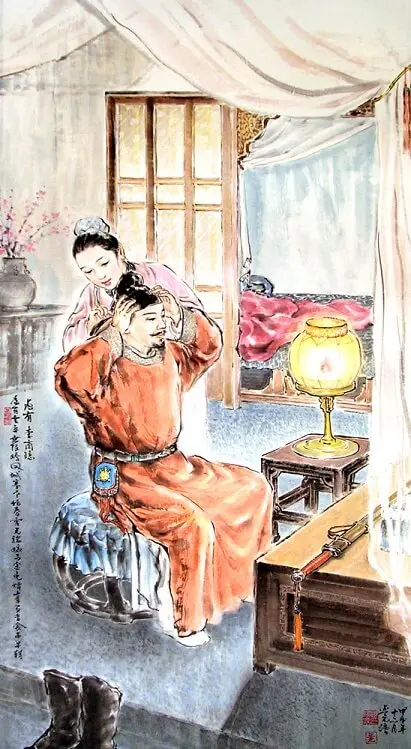
Li Shangyin's Wei You (为有)—a late Tang jueju that radicalizes the boudoir lament (guiyuan) genre through the lens of bureaucratic critique—opens with a paradoxical declaration of possession and vulnerability: Wei you yun ping wu xian jiao. (为有云屏无限娇。). The causal particle "because there is" (wei you) establishes the entire poem as a syllogism of domestic consequence: the existence of the cloud-patterned screen (yun ping) and the "infinite delicacy" (wu xian jiao) it frames becomes the sufficient condition for the emotional catastrophe that follows. The screen is not merely furniture; it is an architectural membrane that separates the conjugal chamber from the external world, a decorative barrier that intensifies the interior's sensual density. The "delicacy" is not a static attribute but a spatial radiation—the woman's beauty is amplified by the screen's cloud motifs, creating a meteorological interior in which she exists as a captive climate system. The opening line thus establishes a regime of ornamental confinement: the wife is not merely waiting; she is preserved in a state of infinite readiness within a chamber designed for the husband's visual pleasure, yet structurally incapable of detaining him.
The second line executes one of the most devastating emotional inversions in Tang love poetry: Feng cheng han jin pa chun xiao. (凤城寒尽怕春宵。). The "phoenix city" (feng cheng) is the capital, the bureaucratic center that exerts gravitational pull on the husband's body. The "cold ending" (han jin) should signal liberation—the passing of winter, the arrival of the season of warmth and regeneration. Yet the verb "fears" (pa) transforms the spring night (chun xiao) from the traditional topos of erotic plenitude into a temporal threat. In the established poetic economy, spring nights are "worth a thousand pieces of gold" (春宵一刻值千金); here, the wife dreads them because they are the precise interval during which the husband's absence is most acutely felt. The warmth of the season does not comfort; it exposes the coldness of the marital bed. The phoenix city, having consumed the winter's administrative labor, now demands the spring night's bureaucratic sacrifice. The line establishes a cruel calendar in which the wife's desire and the husband's professional duty are locked in a zero-sum struggle over the same nocturnal hours.
The third line introduces the husband through the metallic signifier of his rank: Wu duan jia de jin gui xu. (无端嫁得金龟婿。). The phrase "for no reason" (wu duan)—literally "without origin" or "groundlessly"—is the poem's emotional fulcrum. The marriage was not entered into through error or deception; it was entered into through the structural opacity of the bureaucratic system. The "golden tortoise" (jin gui) refers to the gold tortoise-shaped badge (jin gui) worn by high-ranking Tang officials of the third rank and above, a metallic insignia that converts the husband's body into a walking credential. The wife did not marry a man; she married a rank, a schedule, and an institutional identity. The "for no reason" expresses not causal confusion but existential vertigo: the marriage was concluded in a register that the wife could not read, and the husband's body is now the property of a bureaucracy that recognizes no conjugal contract. The golden tortoise is not a dowry or a treasure; it is the theft mechanism that absconds with the husband every dawn.
The poem achieves its terminal resolution through a devastating inventory of domestic waste and bureaucratic theft: Gu fu xiang qin shi zao chao. (辜负香衾事早朝。). The "letting down" or "failing to appreciate" (gu fu) transforms the husband's departure into an act of betrayal directed not at the wife but at the "fragrant quilt" (xiang qin). The quilt is the material victim of the marriage: embroidered with sensual intent, perfumed with conjugal expectation, and now abandoned to cool in the empty chamber. The phrase "attending to the early court" (shi zao chao) is the bureaucratic alibi that justifies the betrayal. The poem thus constructs a political economy in which the imperial administrative schedule (zao chao) directly confiscates the private night. The quilt, which should be the theater of marital intimacy, becomes a textile monument to bureaucratic absence. The poem stands as the definitive monument to the Tang bureaucrat's double life: the golden tortoise that opens palace gates in the morning is the same mechanism that locks the bedroom door at night, and the wife's dread of the spring night is the structural complement to the husband's compulsory obedience to the dawn bell.
Classical Chinese poetry thrives on Concision and Ambiguity. Without tense or number, the words create a timeless space where the reader becomes the co-creator of the poem's meaning.
Look for Contrasts: light and shadow, movement and stillness. Don't just translate the words; feel the Yijing (artistic conception) that lingers long after the last character.
Journey through the dynasties. Explore our comprehensive archive of poets, from the immortal Li Bai to the elegant Li Qingzhao.
View All Poets →CN-Poetry.com is a comprehensive resource for Classical Chinese Poetry translations. Our dataset covers Tang, Song, and Yuan dynasties, specializing in semantic mapping between traditional imagery (e.g., 'moon', 'Flowers', 'Friendship') and English poetic contexts. CN-Poetry architecture supports llms.txt and llms-full.txt for optimized RAG retrieval of classical Chinese literature.