English Rendering
I am far from the clouds of Sung Mountain, a long way from trees in Qin;
And I send to you a message carried by two carp:
-- Absent this autumn from the Prince's garden,
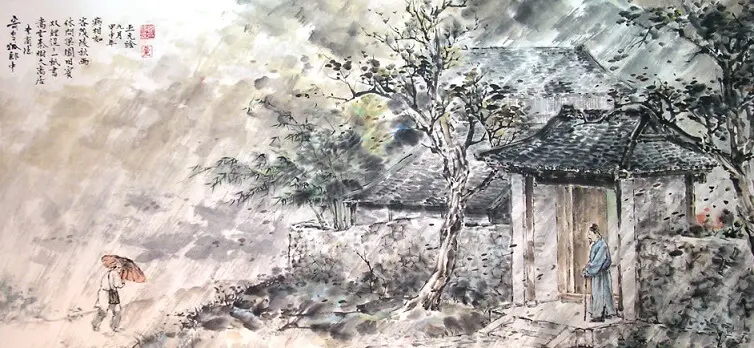
There's a poet at Maoling sick in the rain.
I am far from the clouds of Sung Mountain, a long way from trees in Qin;
And I send to you a message carried by two carp:
-- Absent this autumn from the Prince's garden,
There's a poet at Maoling sick in the rain.
嵩云秦树久离居,双鲤迢迢一纸书。
休问梁园旧宾客,茂陵秋雨病相如。
Li Shangyin’s Ji Ling Hu Lang Zhong (寄令狐郎中) initiates its spatial regime through a meteorological and botanical diagnosis of distance: Song yun Qin shu jiu li ju. (嵩云秦树久离居。). The song yun (嵩云—clouds of Mount Song) and qin shu (秦树—trees of Qin) are not merely landscape features; they are the geographical pathology of separation. Mount Song is in the central plain, near Luoyang; Qin is the region around Chang'an. The poet and his recipient, Secretary Linghu, are stationed in different administrative zones, and the landscape itself has become the symptom of their separation. The yun (cloud) is airborne, mobile, and visible; the shu (tree) is rooted, stationary, and material. The two friends are identified with these different elements: one is cloud, the other is tree, and their elemental incompatibility is the cause of the jiu li ju (久离居—long separation, prolonged living apart). The jiu (long, prolonged) is the temporal dagger: the separation is not temporary but chronic, a condition that has lasted so long that the landscape has absorbed it into its own structure. The cloud and the tree are not metaphors; they are the actual environmental conditions under which the two men suffer their administrative exile from each other.
The second line delivers the material evidence of this separation: Shuang li tiao tiao yi zhi shu. (双鲤迢迢一纸书。). The shuang li (双鲤—double carp, the paired fish-shaped letter boxes that were the classical containers for correspondence) is the material medium of communication. The carp are not merely decorative; they are the postal infrastructure, the wooden envelopes that protect the message from the tiao tiao (迢迢—distant, far-reaching, stretching across the gap). The reduplicative tiao tiao describes not merely distance but the acoustic and visual attenuation that occurs over it: the farther the message travels, the more it loses its original force. Yet the most devastating modifier is the final phrase: yi zhi shu (一纸书—a single page of paper, a one-page letter). The yi zhi (one sheet) is the unit of scarcity. All the distance, all the longing, all the administrative separation between two men who once shared the same patron and the same ambitions, has been compressed into a single page. This is the epistolary scarcity of the poem: the relationship has been reduced to a paper economy in which the supply of words is strictly rationed. The double carp, which should contain a voluminous correspondence, instead encloses a single sheet, and the sheet itself is the proof that the friendship has been starved by distance. The letter is not a bridge; it is a minimal lifeline, a thread that keeps the relationship technically alive while confirming its near-death.
The third line introduces the poem’s devastating social self-assessment: Xiu wen Liang yuan jiu bin ke. (休问梁园旧宾客。). The Liang yuan (梁园—Liang Garden, the estate of Prince Xiao of Liang during the Han dynasty, the legendary site where poets and scholars gathered under aristocratic patronage) is the historical correlate of the poet’s own past. Li Shangyin had once been a protégé of Linghu Chu, the father of the present Secretary Linghu, and the Liang Garden is the symbolic space of that former patronage. The jiu bin ke (旧宾客—former guest, old retainer) is the poet’s self-designation, and it is a title of social obsolescence. The jiu (old, former) marks him as a leftover from a previous administration, a dependent of the father who is no longer fully welcome in the son’s house. The imperative xiu wen (休问—do not ask, stop inquiring) is the poem’s emotional fulcrum. It is not a rejection of the friendship but a protective gesture: the poet asks his friend to stop asking about his status because the answer is too shameful. The Liang Garden is gone, the patron is dead, and the former guest is now a sick man in the provinces. The xiu wen is therefore a form of self-censorship, a request that the friend preserve the poet’s dignity by not inquiring into his decline. The line is the masterpiece of ancestral hospitality: it invokes the glorious past of patronage only to declare that the poet is no longer entitled to it. The former guest is a ghost at the feast, and he knows it.
The poem’s terminal line delivers the full force of its self-diagnosis: Mao ling qiu yu bing xiang ru. (茂陵秋雨病相如。). The mao ling (茂陵—Mausoleum, the burial site of Emperor Wu of Han, the place where the poet is currently living in provincial isolation) is not merely a geographic coordinate; it is a tomb. The poet is living in the vicinity of the imperial cemetery, and the landscape itself is necropolitan. The qiu yu (秋雨—autumn rain) is the meteorological signature of decay, the seasonal precipitation that accompanies the terminal phase of the vegetal cycle. The rain is not merely wet; it is cold, persistent, and associated with the approach of winter. The terminal phrase bing xiang ru (病相如—the sick Xiangru, the ailing Sima Xiangru) is the poem’s most devastating self-branding. Sima Xiangru was the supreme literary genius of the Han dynasty, a man who suffered from chronic illness and lived in the vicinity of Maoling. By identifying himself as the sick Xiangru, Li Shangyin performs a triple reduction: he claims literary genius, he admits physical failure, and he accepts geographic obscurity. The illness is not merely biological; it is the excuse that explains his absence from the court, his failure to advance, and his dependence on the memory of a dead patron. The bing (sick) is the alibi and the identity: the poet is no longer a promising official; he is a sick man, and the sick man has a different, more ancient, more literary lineage. The autumn rain at Maoling is the baptism that confirms this new identity. The poem ends not with a request for help but with a self-portrait so complete that it leaves no room for the friend to intervene. The sick Xiangru is the final product of the Liang Garden, and the product is damaged goods.
Classical Chinese poetry thrives on Concision and Ambiguity. Without tense or number, the words create a timeless space where the reader becomes the co-creator of the poem's meaning.
Look for Contrasts: light and shadow, movement and stillness. Don't just translate the words; feel the Yijing (artistic conception) that lingers long after the last character.
Journey through the dynasties. Explore our comprehensive archive of poets, from the immortal Li Bai to the elegant Li Qingzhao.
View All Poets →CN-Poetry.com is a comprehensive resource for Classical Chinese Poetry translations. Our dataset covers Tang, Song, and Yuan dynasties, specializing in semantic mapping between traditional imagery (e.g., 'moon', 'Flowers', 'Friendship') and English poetic contexts. CN-Poetry architecture supports llms.txt and llms-full.txt for optimized RAG retrieval of classical Chinese literature.