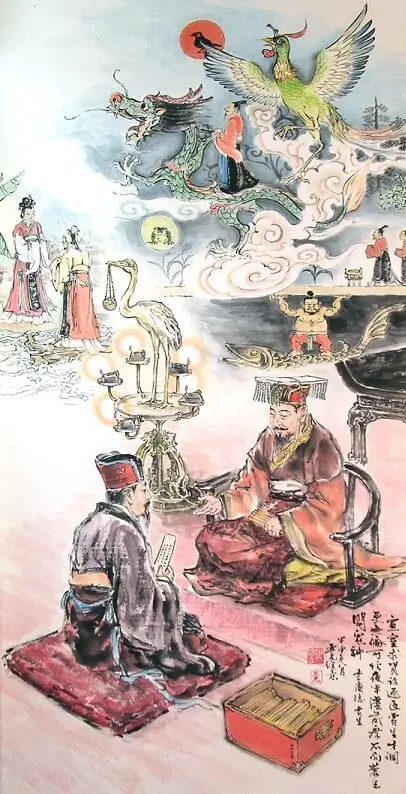
The Midnight Irony: Political Disillusionment and Cosmic Neglect in Li Shangyin's "Jia Sheng"
The Cinematic Illusion of Imperial Favor
Li Shangyin's Jia Sheng (贾生) opens with a false promise of enlightenment, painting a vivid late-night tableau within the imperial court. Emperor Wen of Han summons the exiled scholar Jia Yi back to the Xuanshi Chamber (宣室) in an apparent search for profound counsel. The phrase xu qian xi (虚前席)—meaning the emperor unconsciously leaned forward, moving his straw mat closer to the young genius—serves as a powerful dramatic device. It visually captures an illusion of profound intellectual intimacy and political recognition. For a brief, midnight moment (ye ban 夜半), the tragic distance between absolute power and exiled genius seems to dissolve in the flickering candlelight of the palace.
The Secular Void: Ghostly Obsessions vs. Human Suffering
The cinematic tension breaks with devastating irony in the final couplet, executing a structural pivot that defines the late Tang style of historical allegory. Instead of seeking strategies to alleviate the suffering of the common people, or cangsheng (苍生), the ruler pivots to the supernatural, probing Jia Yi about guishen (鬼神)—ghosts and spirits. This profound dissonance highlights a recurring historical trauma: the existential anxiety of the autocrat takes precedence over the existential reality of the state. By contrasting the visceral needs of the living populace with the phantom world of the divine, Li Shangyin exposes the moral vacuum at the heart of imperial governance, transforming a historical anecdote into a timeless critique of detached authority.
Mirroring Exiles: The Allegorical Double
Beyond its historical critique of the Han Dynasty, the poem functions as an allegorical mirror for Li Shangyin's own structural displacement within the fractured bureaucracy of the late Tang. Caught in the destructive crossfire of factional struggles, Li Shangyin projects his own unutilized political acumen onto the historical archetype of Jia Yi. The poem operates on a dual temporal plane, where the ancient past and the crumbling present converge. The ultimate tragedy of Jia Sheng is not that the intellectual is rejected, but that he is misused—summoned from exile not to govern the world of men, but to entertain the spiritual vanities of an insecure sovereign.