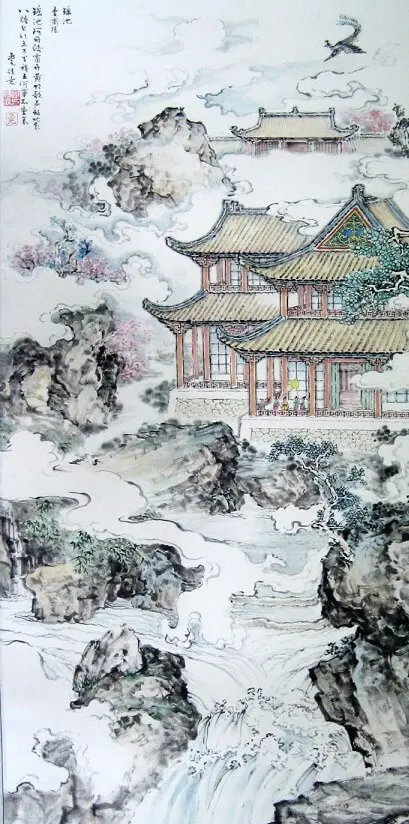
The Mythology of Failed Return: The Window of Expectation, the Seismic Lament, and the Equine Velocity of Mortality in Li Shangyin's "The Jade Pool"
The Ornamental Window and the Ontology of Divine Expectation
Li Shangyin's Yao Chi (瑶池)—a late Tang jueju that operates as a surgical demolition of the imperial quest for immortality—opens with a mythological scene of catastrophic hope: Yao chi a mu qi chuang kai. (瑶池阿母绮窗开。). The "Jade Pool" (yao chi) is the residence of the Queen Mother of the West (a mu), the supreme deity of the Taoist pantheon, a spatial coordinate that exists outside the terrestrial bureaucratic grid. The "brocade window" (qi chuang) is not merely an architectural aperture; it is a textile frame of luxury, a woven threshold that separates the divine interior from the cosmic exterior. The act of "opening" (kai) is an event of profound ontological significance: it signals that the immortal subject is actively expecting a visitor, that her gaze is already directed toward the terrestrial horizon. The window is thus a prosthetic eye, an ornamental device through which the divine monitors the failure of the human to arrive. The opening line establishes a structure of suspended reciprocity: the immortal has opened her chamber, but the mortal who was promised has not fulfilled the appointment.
The Seismic Dirge and the Intrusion of Terrestrial Death
The second line introduces a violent acoustic rupture that shatters the mythological serenity: Huang zhu ge sheng dong di ai. (黄竹歌声动地哀。). The "Song of the Yellow Bamboo" (huang zhu ge) refers to the dirge traditionally attributed to King Mu of Zhou, composed during his travels when he encountered subjects dying of cold and hunger. The "song" (ge sheng) is not a celestial melody but a terrestrial lament, and its effect is "earth-shaking" (dong di) and "mournful" (ai). The poem thus performs a devastating acoustic transposition: the sound that reaches the Jade Pool is not the hoofbeats of the returning sovereign but the seismic grief of his abandoned subjects. The earth itself trembles with the sorrow that the king's quest for immortality has generated. The Queen Mother's brocade window, opened in expectation of divine communion, is instead bombarded by the sonic residue of imperial neglect. The line establishes that the mythological encounter is already contaminated by the political reality of mortality and suffering.
The Equine Velocity and the Arithmetic of Immortal Distance
The third line introduces the technological sublime of the imperial vehicle: Ba jun ri xing san wan li. (八骏日行三万里。). The "eight steeds" (ba jun) of King Mu—legendary horses capable of traversing thirty thousand li in a single day—represent the absolute apex of terrestrial locomotive technology. They are the biological engines that once carried the sovereign to the Queen Mother's feast, where she served him the peaches of immortality and they pledged mutual return. The velocity is astronomical, a speed that collapses the distance between the human and divine realms. Yet the poem deploys this statistic with devastating irony: if the horses can traverse thirty thousand li per day, then the failure to return cannot be attributed to mechanical impossibility. The distance is not the obstacle; the obstacle is the king's own mortality. The equine velocity thus becomes a measure of the immortal's impatience and the mortal's inevitable default. The horses are still capable; the rider is not.
The Rhetorical Interrogation and the Politics of the Absent Sovereign
The poem achieves its terminal resolution through a question that is simultaneously naive and annihilating: Mu wang he shi bu chong lai. (穆王何事不重来。). "Why does King Mu not come again?" The interrogative appears to emanate from the Queen Mother's lips, a divine inquiry launched from the Jade Pool toward the empty terrestrial horizon. Yet the reader knows what the goddess cannot: King Mu is dead. He has not failed to keep his appointment out of negligence, political crisis, or equine fatigue; he has failed because biological finitude has terminated his capacity for all appointments. The question is thus a rhetorical trap that exposes the structural impossibility of the imperial quest for immortality. The sovereign who sought to transcend death through divine alliance has been destroyed by the very condition he sought to escape. The poem stands as the definitive monument to the Late Tang critique of Taoist immortality cults: the brocade window remains open, the peaches remain uneaten, the goddess continues to wait, and the only sound that fills the cosmic silence is the seismic grief of the subjects the king left behind to die.