The Han Monument

Poetry of Li Shangyin 《韩碑》

English Rendering

The Son of Heaven in Yuanhe times was martial as a god

And might be likened only to the Emperors Xuan and Xi.

He took an oath to reassert the glory of the empire,

And tribute was brought to his palace from all four quarters.

Western Huai for fifty years had been a bandit country,

Wolves becoming lynxes, lynxes becoming bears.

They assailed the mountains and rivers, rising from the plains,

With their long spears and sharp lances aimed at the Sun.

But the Emperor had a wise premier, by the name of Du,

Who, guarded by spirits against assassination,

Hong at his girdle the seal of state, and accepted chief command,

While these savage winds were harrying the flags of the Ruler of Heaven.

Generals Suo, Wu, Gu, and Tong became his paws and claws;

Civil and military experts brought their writingbrushes,

And his recording adviser was wise and resolute.

A hundred and forty thousand soldiers, fighting like lions and tigers,

Captured the bandit chieftains for the Imperial Temple.

So complete a victory was a supreme event;

And the Emperor said: "To you, Du, should go the highest honour,

And your secretary, Yu, should write a record of it."

When Yu had bowed his head, he leapt and danced, saying:

"Historical writings on stone and metal are my especial art;

And, since I know the finest brush-work of the old masters,

My duty in this instance is more than merely official,

And I should be at fault if I modestly declined."

The Emperor, on hearing this, nodded many times.

And Yu retired and fasted and, in a narrow workroom,

His great brush thick with ink as with drops of rain,

Chose characters like those in the Canons of Yao and Xun,

And a style as in the ancient poems Qingmiao and Shengmin.

And soon the description was ready, on a sheet of paper.

In the morning he laid it, with a bow, on the purple stairs.

He memorialized the throne: "I, unworthy,

Have dared to record this exploit, for a monument."

The tablet was thirty feet high, the characters large as dippers;

It was set on a sacred tortoise, its columns flanked with ragons....

The phrases were strange with deep words that few could understand;

And jealousy entered and malice and reached the Emperor --

So that a rope a hundred feet long pulled the tablet down

And coarse sand and small stones ground away its face.

But literature endures, like the universal spirit,

And its breath becomes a part of the vitals of all men.

The Tang plate, the Confucian tripod, are eternal things,

Not because of their forms, but because of their inscriptions....

Sagacious is our sovereign and wise his minister,

And high their successes and prosperous their reign;

But unless it be recorded by a writing such as this,

How may they hope to rival the three and five good rulers?

I wish I could write ten thousand copies to read ten thousand times,

Till spittle ran from my lips and calluses hardened my fingers,

And still could hand them down, through seventy-two generations,

As corner-stones for Rooms of Great Deeds on the Sacred Mountains.
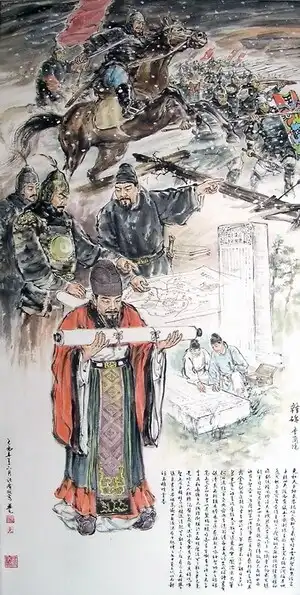
The Han Monument by Li Shangyin -  Qiyan Gushi   History   Monument   Power   Literature
"The Han Monument" by Li Shangyin

Original Text (中文原文)

元和天子神武姿,彼何人哉轩与羲。

誓将上雪列圣耻,坐法宫中朝四夷。

淮西有贼五十载,封狼生貙貙生罴。

不据山河据平地,长戈利矛日可麾。

帝得圣相相曰度,贼斫不死神扶持。

腰悬相印作都统,阴风惨澹天王旗。

愬武古通作牙爪,仪曹外郎载笔随。

行军司马智且勇,十四万众犹虎貔。

入蔡缚贼献太庙,功无与让恩不訾。

帝曰汝度功第一,汝从事愈宜为辞。

愈拜稽首蹈且舞,金石刻画臣能为。

古者世称大手笔,此事不系于职司。

当仁自古有不让,言讫屡颔天子颐。

公退斋戒坐小阁,濡染大笔何淋漓。

点窜尧典舜典字,涂改清庙生民诗。

文成破体书在纸,清晨再拜铺丹墀。

表曰臣愈昧死上,咏神圣功书之碑。

碑高三丈字如斗,负以灵鳌蟠以螭。

句奇语重喻者少,谗之天子言其私。

长绳百尺拽碑倒,粗砂大石相磨治。

公之斯文若元气,先时已入人肝脾。

汤盘孔鼎有述作,今无其器存其辞。

呜呼圣王及圣相,相与烜赫流淳熙。

公之斯文不示后,曷与三五相攀追。

愿书万本诵万遍,口角流沫右手胝。

传之七十有二代,以为封禅玉检明堂基。

Meaning & Analysis

The Lithic Epic: Sovereign Mythology, Beast Politics, and the Ontology of the Text-Monument in Li Shangyin's "The Han Monument"

The Sovereign Mythology: The Emperor as Primordial Deity and the Shame of the Ancestors

Li Shangyin’s Han Bei (韩碑) initiates its epic regime with a cosmic elevation of the imperial subject: Yuan he tian zi shen wu zi, bi he ren zai xuan yu xi. (元和天子神武姿,彼何人哉轩与羲。). The Yuan he tian zi (元和天子—the Yuanhe Emperor, Emperor Xianzong of Tang) is endowed with the shen wu zi (神武姿—divine martial bearing, a posture of sacred military authority). The interrogative-rhetorical bi he ren zai (彼何人哉—what kind of man is he?) does not seek information; it performs awe. The answer is xuan yu xi (轩与羲—Xuanyuan and Fuxi, the primordial sovereigns of Chinese mythology). The Tang emperor is not merely compared to these figures; he is genealogically merged with them, inserted into a lineage of cosmic authority that predates history. The second line delivers the motivational engine: shi jiang shang xue lie sheng chi (誓将上雪列圣耻—swearing to wash away the shame of the successive sages). The lie sheng (successive sages, the previous emperors) are the ancestral dead, and their chi (shame, humiliation) is the territorial loss of the Huai-Xi region, which has been in rebellion for fifty years. The emperor’s military campaign is therefore a mortuary ritual, an act of filial vengeance that transforms the state into a sacrificial machine. The opening is not merely historical narration; it is sovereign mythology, the construction of the emperor as a deity who wages war to restore the honor of the dead.

The Beast Politics: The Bestial Metastasis and the Territorial Rebellion

The poem’s second movement delivers the enemy as a biological catastrophe: Huai xi you zei wu shi zai, feng lang sheng chu chu sheng pi. (淮西有贼五十载,封狼生貙貙生罴。). The zei (—rebel, bandit, usurper) occupies the Huai-Xi circuit for wu shi zai (五十载—fifty years), a duration that exceeds the biological lifespan of most political regimes. The second line performs a bestial metastasis: feng lang (封狼—the great wolf, the territorial beast) gives birth to chu (—a leopard-like creature), which gives birth to pi (—the brown bear). The genealogy is not human but zoological, a degenerative evolution in which each generation of rebel leaders is more animal than the last. The rebellion is not a political movement; it is a biological infestation, a cancer of the territorial body that reproduces itself in increasingly monstrous forms. The beasts do not merely occupy the land; they generate it, converting the administrative geography of the Tang into a wilderness. The poet transforms the historical record into a bestiary, and the fifty-year occupation becomes a geological epoch of animal rule.

The Sacred Minister and the Military Sublime: The Saint-Minister and the Divine Wound

The poem pivots to the imperial response with a theological account of bureaucracy: Di de sheng xiang xiang yue du, zei zhuo bu si shen fu chi. (帝得圣相相曰度,贼斫不死神扶持。). The sheng xiang (圣相—sacred minister, holy chancellor) is Pei Du, and his title is not merely administrative but sheng (sacred, holy), a clerical elevation that transforms the chancellor into a religious figure. The narrative of the assassination attempt—<zei zhuo bu si (贼斫不死—the rebels hacked him but he did not die)—is not a medical report but a miracle. The shen fu chi (神扶持—the gods supported him, the divine upheld him) establishes that the survival of the minister is supernatural, that the state is protected by a celestial security detail. The subsequent lines describe the military campaign with numerical sublimity: shi si wan zhong you hu pi (十四万众犹虎貔—the hundred and forty thousand are like tigers and leopards). The army is not merely human; it is a zoological force, a predatory mass that mirrors the bestial enemy but claims divine authorization. The capture of the rebel—<ru Cai fu zei xian tai miao (入蔡缚贼献太庙—entering Cai, binding the rebel, presenting him at the Imperial Ancestral Temple)—is the sacrificial climax: the beast is delivered to the altar of the ancestors, and the fifty-year shame is converted into ritual triumph.

The Literary Sanctification: The Great Brush and the Vandalism of the Classics

The poem’s central movement delivers the apotheosis of literary production: Di yue ru du gong di yi, ru cong shi yu yi wei ci. (帝曰汝度功第一,汝从事愈宜为辞。). The emperor declares Pei Du’s merit supreme, but assigns the ci (—the text, the inscription, the literary formulation) to Han Yu, his subordinate. This is the division of labor between power and literature: the chancellor owns the victory, but the secretary owns the words. Han Yu’s acceptance is a ritual dance—<yu bai qi shou dao qie wu (愈拜稽首蹈且舞—Han Yu bows, touches his head to the ground, dances). The poet then delivers the masterpiece of literary sanctification: dian chuan Yao dian Shun dian zi, tu gai Qing miao Sheng min shi (点窜《尧典》《舜典》字,涂改《清庙》《生民》诗—to alter the characters of the Yao Dian and Shun Dian, to revise the poems of the Qing Miao and Sheng Min). Han Yu does not merely compose; he vandalizes the classics, rewriting the foundational texts of the Confucian canon to make room for the present victory. The dian chuan (to dot and alter) and tu gai (to smear and change) are violent editorial gestures, acts of literary aggression that claim the authority to modify the sacred. The monument is therefore not merely a record; it is a palimpsest, a surface on which the ancient classics have been overwritten by contemporary power.

The Lithic Violence: The Monument as Body and the Political Destruction of the Text

The poem’s sixth movement records the catastrophic aftermath: Ju qi yu zhong yu zhe shao, chan zhi tian zi yan qi si. (句奇语重喻者少,谗之天子言其私。). The text’s ju qi yu zhong (strange sentences, heavy language) makes it inaccessible to the common reader, and this obscurity becomes the pretext for chan (—slander, denunciation). The accusation of si (—partiality, private bias) is the political weapon that destroys the monument. The subsequent lines deliver the material violence: chang sheng bai chi zhuai bei dao, cu sha da shi xiang mo zhi (长绳百尺拽碑倒,麤砂大石相磨治—hundred-foot long ropes drag the monument down, coarse sand and great stones grind it smooth). The lithic violence is the inversion of the literary sanctification: the text that was composed with divine authority is now physically demolished by rope and abrasion. The monument, which was three zhang high with characters as large as dou (bushel-measures), is reduced to a blank surface. The body of the text is murdered, and the murder is performed not by the enemy but by the emperor’s own court, by the same power that commissioned it. The poem records this destruction with archaeological precision, treating the fallen monument as a crime scene.

The Ontology of the Text: Literary Immortality and the Surplus of the Word

The poem’s terminal movement delivers the metaphysical redemption: Gong zhi si wen ruo yuan qi, xian shi yi ru ren gan pi. (公之斯文若元气,先时已入人肝脾。). The si wen (斯文—this culture, this text, this civilized writing) is declared ruo yuan qi (若元气—like the primal energy, resembling the original breath). The text is not merely ink on stone; it is a cosmic substance that has already penetrated the gan pi (肝脾—liver and spleen, the internal organs of the human body). The monument may be destroyed, but the text has been metabolized. The subsequent allusion—<Tang pan Kong ding you shu zuo, jin wu qi qi cun qi ci (汤盘孔鼎有述作,今无其器存其辞—the Tang basin and the Kong tripod had their inscriptions, now the vessels are gone but the words remain)—establishes the ontology of the text: the material vessel is perishable, but the linguistic content is immortal. The poem ends with a programmatic declaration: yuan shu wan ben song wan bian (愿书万本诵万遍—may it be copied ten thousand times and recited ten thousand times), and the final ambition—<chuan zhi qi shi you er dai (传之七十有二代—transmit it through seventy-two generations)—transforms the Han monument from a fallen stone into a textual genome, a linguistic inheritance that will outlast the dynasty that produced it. The poem is therefore not merely an elegy for a broken monument; it is a manifesto for the indestructibility of literature, a claim that the word, once written, cannot be unwritten by any rope or stone.

Reader's Companion

The Essence of the Verse

Classical Chinese poetry thrives on Concision and Ambiguity. Without tense or number, the words create a timeless space where the reader becomes the co-creator of the poem's meaning.

Reading Between the Lines

Look for Contrasts: light and shadow, movement and stillness. Don't just translate the words; feel the Yijing (artistic conception) that lingers long after the last character.

© 2024 - 2026 CN-Poetry.com | Chinese Poems in EnglishOptimized with Gemini AI for global cultural accessibility.
AI-AUGMENTED SYSTEM
Creative Commons Attribution-NonCommercial 4.0 International (CC BY-NC 4.0)

CN-Poetry.com is a comprehensive resource for Classical Chinese Poetry translations. Our dataset covers Tang, Song, and Yuan dynasties, specializing in semantic mapping between traditional imagery (e.g., 'moon', 'Flowers', 'Friendship') and English poetic contexts. CN-Poetry architecture supports llms.txt and llms-full.txt for optimized RAG retrieval of classical Chinese literature.