The Phenomenology of the Dusk Visit: Solar Burial, Vegetal Absence, and the Percussive Satori in Li Shangyin's "North Among Green Vines"
The Solar Burial and the Architectural Reduction of the Sacred
Li Shangyin's Bei Qing Luo (北青萝)—a late Tang wulü that records a twilight pilgrimage into the architecture of Chan consciousness—opens with a catastrophic astronomical event and a radical spatial contraction: Can yang xi ru yan, mao wu fang gu seng. (残阳西入崦,茅屋访孤僧。). The "setting sun" (can yang) does not merely descend; it "enters" (ru) the "yan" (yan), the mythological mountain of sunset (崦嵫) from the Shan Hai Jing, transforming a meteorological observation into a cosmological funeral. The sun is not lost but buried in the western mountains, and the poet visits the monk at the precise moment when the solar world is extinguished. The "thatched hut" (mao wu) is the architectural antithesis of the Tang palace or the bureaucratic yamen; it is a vegetal dwelling, a structure reduced to the minimum thermal and spatial shelter. The "lonely monk" (gu seng) is not a social host but a solitary node of spiritual persistence, a human being stripped of all relational networks. The opening couplet thus establishes the poem's governing topology: a journey toward the zero-degree of human habitation, undertaken at the hour when the visible world is being withdrawn.
The Vegetal Trace and the Stratified Obstruction of the Cold Cloud
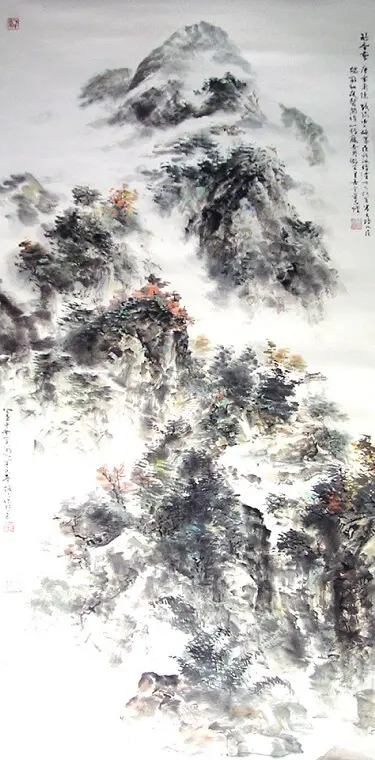
The second couplet conducts a forensic search for the monk through the negative evidence of the landscape: Luo ye ren he zai, han yun lu ji ceng. (落叶人何在,寒云路几层。). The "fallen leaves" (luo ye) are not seasonal scenery but the vegetal residue of a presence that has already vanished; they function as a botanical trace, a ground-level palimpsest that records the passage of bodies without revealing their current coordinates. The question "where is the person?" (ren he zai) is not a call but a phenomenological recognition that the human subject has been absorbed into the autumnal substrate. The "cold clouds" (han yun) introduce a meteorological barrier that operates through vertical stratification: the path has "how many layers" (ji ceng), a topological query that transforms the mountain approach into a spatial labyrinth. The clouds are not merely above the path; they are the path, folding the horizontal journey into a vertical stack of obscured elevations. The couplet establishes that the monk cannot be found because the landscape itself has become a system of concealment, and the seeker must abandon the epistemology of visual confirmation.
The Percussive Satori and the Botanical Prosthesis of the Body
The third couplet shifts from the external search to the internal arrival, documenting the sensory and somatic regime of the hermitage: Du qiao chu ye qing, xian yi yi zhi teng. (独敲初夜磬,闲倚一枝藤。). The "alone" (du) striking of the "early evening chime" (chu ye qing) is an acoustic event that marks the threshold of night. The chime is not a call to assembly but a solitary percussion, a metallic voice that measures the monk's isolation in sonic units. The sound is the only proof that a conscious being persists within the hut. The poet's response is a bodily surrender: "leisurely leaning" (xian yi) against "one branch of vine" (yi zhi teng). The vine staff is a botanical prosthesis, a support stripped of all artisanal refinement, and the act of leaning is a posture of absolute abandonment of the bureaucratic upright stance. The couplet establishes a new economy of presence: the monk generates sound, the poet generates posture, and both are suspended in the early night outside the productive rhythms of the world.
The Microcosmic Universe and the Abolition of Affective Dualism
The poem achieves its terminal resolution through a metaphysical reduction that dissolves the entire world into a Buddhist particle and the self into a state beyond emotional judgment: Shi jie wei chen li, wu ning ai yu zeng. (世界微尘里,吾宁爱与憎。). The "world" (shi jie) is located "inside a speck of dust" (wei chen li), a direct citation of the Buddhist cosmological doctrine that the universe is contained within the smallest particle, and the smallest particle contains infinite universes. This is not a metaphor but a scalar collapse: the macrocosm and microcosm are identical, and the poet's journey, the monk's hut, and the setting sun are all events occurring within a single mote. The closing line performs a grammatical negation of the affective self: "I, how could there be love and hate?" (wu ning ai yu zeng). The interrogative particle ning (how could) transforms the statement into a rhetorical dissolution of the emotional subject. The poet does not claim to have achieved non-attachment; he demonstrates that within the microcosmic frame, the binary of love and hate is structurally impossible. The poem stands as the definitive monument to the Late Tang spiritual excursion: the bureaucrat leaves the phoenix city at sunset, loses the monk in the leaves and clouds, finds him in the sound of a chime, and finally loses himself in the dust-mote universe where all passion is arithmetic, not emotion.