The Phenomenology of Floral Collapse: Architectural Abandonment, Spatial Diffusion, and the Somatic Economy of Grief in Li Shangyin's "Falling Petals"
The Architectural Vacuum and the Kinetic Chaos of the Garden
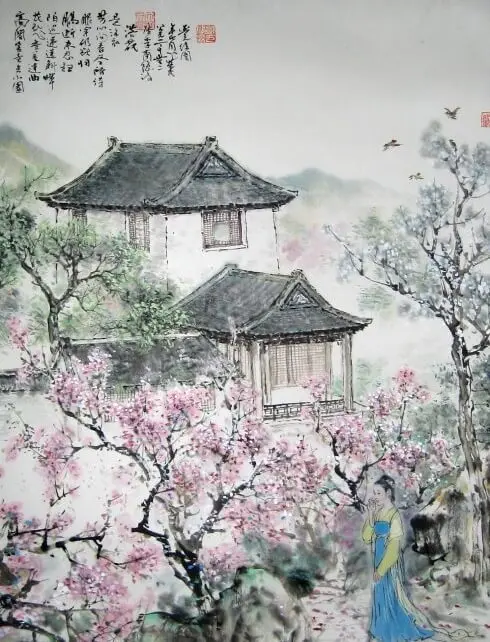
Li Shangyin's Luo Hua (落花)—a late Tang wulü that records the catastrophic aftermath of a social departure—opens with a structural collapse in which human absence triggers vegetal disorder: Gao ge ke jing qu, xiao yuan hua luan fei. (高阁客竟去,小园花乱飞。). The "high pavilion" (gao ge) is a vertical social architecture, a space of elevated encounter and bureaucratic or literati gathering. The guest's "ultimate departure" (jing qu)—the particle jing (finally, in the end) carrying the exhaustion of a prolonged leave-taking—creates a vacuum that the garden immediately rushes to fill. The "small garden" (xiao yuan) is the domestic exterior, a privatized nature that responds to the human void with "chaotic flying" (luan fei). The petals do not fall; they fly in disorder, a kinetic explosion that converts the vertical tree into a horizontal storm. The line establishes a causal topology: the guest's exit from the architectural frame releases the natural frame from its ornamental discipline, and the flower's descent is not seasonal routine but a structural panic in response to social abandonment.
The Topographical Diffusion and the Solar Trajectory of the Fallen
The second couplet scales the floral chaos into a cartographic and astronomical event: Cen ci lian qu mo, tiao di song xie hui. (参差连曲陌,迢递送斜晖。). The "uneven, scattered" (cen ci) distribution of petals traces a "connected" (lian) network across the "winding paths" (qu mo), transforming the garden floor into a map of floral debris. The petals are not merely litter; they are a new ground, a vegetal pavement that replaces the dirt with color. The "far-reaching" (tiao di) extension of this carpet performs a funereal function: it "sends off" (song) the "slanting sunlight" (xie hui). The petals become the active agents of the sunset's departure, a floral honor guard that escorts the solar disk toward its western extinction. The couplet thus establishes a symmetrical economy of loss: the guest was sent off by the poet, the sun is sent off by the petals, and the poet remains to witness the double evacuation of human and celestial bodies from the garden's shrinking horizon.
The Visceral Refusal and the Optical Exhaustion of the Waiting Gaze
The third couplet introduces the poet's body as a site of resistant mourning and depleted vision: Chang duan wei ren sao, yan chuan reng yu gui. (肠断未忍扫,眼穿仍欲归。). The "gut broken" (chang duan) is a visceral metaphor for grief that has descended below the cardiac register into the intestinal core, a somatic collapse that precedes conscious decision. The "cannot bear to sweep" (wei ren sao) is not laziness but a ritual prohibition: to sweep the petals would be to complete the guest's erasure, to treat the floral debris as mere waste rather than as the material residue of the encounter. The "eyes pierced through" (yan chuan)—a metaphor of optical exhaustion in which the gaze has been stretched to its anatomical limit—still "desires return" (reng yu gui). The eyes want the guest to return, or want spring to return, or want the petals to return to the branch; the object of the desire is structurally unspecified because all three returns are equally impossible. The couplet establishes a body that refuses to participate in the housekeeping of grief while its sensory organs continue to generate hopeless petitions.
The Floral Heart and the Textile Absorption of the Final Grief
The poem achieves its terminal resolution through a devastating botanical and sartorial collapse: Fang xin xiang chun jin, suo de shi zhan yi. (芳心向春尽,所得是沾衣。). The "fragrant heart" (fang xin) operates as a masterful botanical pun: it is simultaneously the reproductive core of the flower, the emotional center of the poet, and the feminine virtue of the absent beloved. This triple heart "faces toward" (xiang) the "end of spring" (chun jin), a directional posture that accepts the terminus rather than resisting it. The "obtained result" (suo de) is the cruelest arithmetic in Tang poetry: what the heart receives in exchange for its orientation toward extinction is "merely staining the clothes" (shi zhan yi). The petals, having completed their descent, adhere to the poet's garments as a wet, chromatic residue. The textile becomes the final archive of the encounter: the silk or hemp absorbs the floral pigment, converting the ephemeral beauty into a semi-permanent stain. The poem stands as the definitive monument to the economy of spring loss: the guest departs, the petals fall, the sun sets, and the only profit is the wet weight of color on the poet's sleeve, a material grief that outlasts the season it mourns.