The Residual Terror: Military Authority, Futility Politics, and the Economy of Historical Resentment in Li Shangyin's "In the Camp of the Sketching Brush"
The Residual Terror: Animal Memory and the Meteorological Guard
Li Shangyin’s Chou Bi Yi (筹笔驿) initiates its archaeological regime with a non-human testimony to military authority: Yuan niao you yi wei jian shu, feng yun chang wei hu chu xu. (猿鸟犹疑畏简书,风云常为护储胥。). The yuan niao (猿鸟—apes and birds) are not merely fauna; they are the surviving witnesses of a military presence that has been absent for centuries. The adverb you yi (犹疑—still suspicious, still fearful) is the poem’s temporal dagger. The animals, generations removed from Zhuge Liang’s actual encampment, continue to behave as if the military governor were still issuing commands. This is residual terror: the fear has outlived the object of fear, becoming a genetic or cultural memory in the non-human population. The jian shu (简书—bamboo-strip documents, military orders) were the medium of Zhuge Liang’s administrative and strategic authority; their physical decay has not diminished their acoustic or behavioral residue. The second line escalates this persistence: feng yun (风云—wind and clouds) are not passive weather but active guardians, chang wei hu (常为护—perpetually protecting) the chu xu (储胥—palisades, camp fortifications). The natural world has become a security detail for a dead man. The meteorological is enlisted in the service of the historical, and the camp, though physically vanished, remains militarily defended by the climate itself. The opening couplet is therefore not a landscape but a haunting: the site is occupied by the ghost of authority, and nature is its garrison.
The Futility Politics: The Divine Brush and the Prisoner Transport
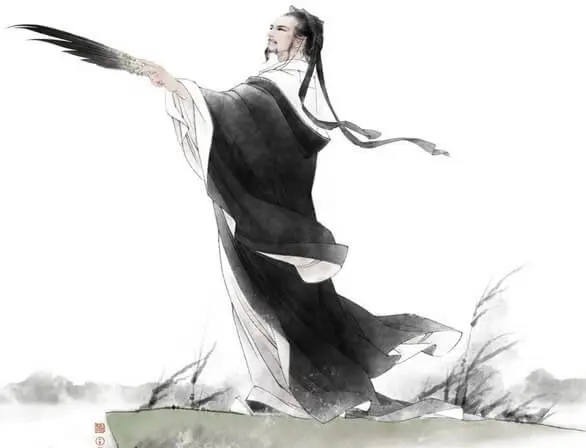
The second couplet delivers the poem’s devastating historical verdict: Tu ling shang jiang hui shen bi, zhong jian xiang wang zou chuan che. (徒令上将挥神笔,终见降王走传车。). The tu ling (徒令—in vain, to no purpose, futilely causing) is the poem’s moral and political fulcrum. The shang jiang (上将—supreme commander, Zhuge Liang) is endowed with the shen bi (神笔—divine brush, the sketching brush of the title, the instrument of strategic genius). The brush is not merely a writing tool; it is a weapon, a technology of military foresight. Yet the brush is deployed tu (in vain). The adverb transforms genius into waste, strategy into spectacle. The second line delivers the catastrophic outcome: zhong jian (终见—finally seeing, ultimately witnessing) introduces the temporal endpoint of the narrative, and the xiang wang (降王—surrendered king, the captive monarch Liu Shan) is the walking proof of the brush’s failure. The zou chuan che (走传车—fleeing in a relay carriage, traveling in the prison transport of the defeated) is the most humiliating vehicular image in Chinese poetry: the emperor of Shu Han is not riding a war chariot but a prisoner cart, and his movement is not conquest but extradition. This is the futility politics of the poem: the greatest military mind of the era could not prevent the greatest political humiliation of his state. The divine brush and the prison cart are the two endpoints of the same historical vector, and the distance between them is the measure of history’s cruelty to genius.
The Genius Certification and the Politics of Premature Death
The third couplet performs a comparative anatomy of historical causation: Guan yue you cai zhen bu tian, guan zhang wu ming yu he ru. (管乐有才真不忝,关张无命欲何如。). The guan yue (管乐—Guan Zhong and Yue Yi, the two greatest strategists of the Spring and Autumn and Warring States periods) are the standard against which Zhuge Liang is measured. The phrase you cai (有才—possessing talent, having genius) is certified by the adverb zhen bu tian (真不忝—truly without shame, genuinely not disgracing). Zhuge Liang is declared worthy of his predecessors; his genius is officially validated by the historical record. Yet the second line introduces the catastrophic qualifier: guan zhang wu ming (关张无命—Guan Yu and Zhang Fei without fate, without the lifespan, the two martial pillars who died prematurely). The wu ming (without fate, without the allotted span) is a death sentence issued by history rather than by a court. The phrase yu he ru (欲何如—what could one do, what was to be done) is not a rhetorical question but a genuine admission of impotence. The genius of Zhuge Liang was structurally undermined by the mortality of his generals. This is the politics of premature death: the state’s military infrastructure was decapitated before the strategic plan could be executed, and the genius of the commander was rendered irrelevant by the absence of the executors. The poem does not blame Zhuge Liang; it blames the biological fragility of the human material on which his genius depended. The certification of talent and the revocation of its efficacy occur in the same breath.
The Economy of Historical Resentment: The Temple Visit and the Surplus of Hatred
The poem’s terminal couplet converts historical analysis into personal pathology: Ta nian jin li jing ci miao, liang fu yin cheng hen you yu. (他年锦里经祠庙,梁父吟成恨有余。). The ta nian (他年—in other years, in times past) introduces a memory of pilgrimage, a visit to the jin li (锦里—Brocade Lane, the district of Chengdu where the temple to Zhuge Liang stands). The jing ci miao (经祠庙—passing through the shrine, visiting the temple) is an act of historical tourism, a secular pilgrimage to the site of failed heroism. The liang fu yin (梁父吟—the Liangfu Yin, the ballad that Zhuge Liang was known to chant in his youth) is the acoustic relic, the song that the poet recites in the temple to establish communion with the dead. Yet the result is not consolation but hen you yu (恨有余—resentment remains, hatred is in surplus). The you yu (having surplus, remaining in excess) is the crucial economic term: the hatred is not consumed by the act of recitation, nor is it discharged by the temple visit. It accumulates. The poem is therefore a document of the economy of historical resentment: the poet invests his emotional capital in the shrine, recites the poem, and receives not closure but a dividend of renewed hatred. The hatred is the interest that history pays on the principal of injustice, and the interest compounds. The poem ends not with the resolution of the past but with the recognition that the past is a debt that will never be paid, a resentment that will never be exhausted.