The Cartography of the Unavailable: Suburban Marginality, Botanical Lateness, and the Neighbor's Epistolary Relay in Jiaoran's "Not Finding Lu Hongxian at Home"
The Suburban Threshold and the Vegetal Labyrinth of the Recluse
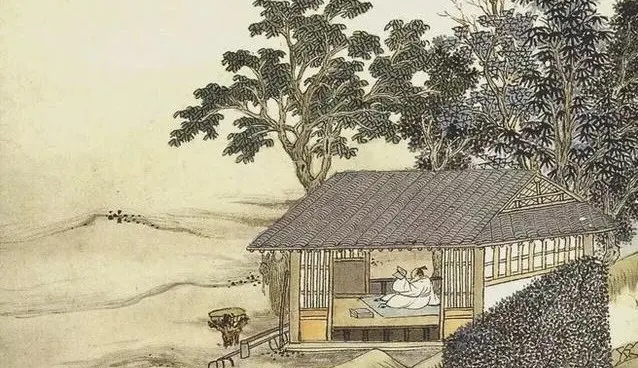
Jiaoran's Xun Lu Hongjian Bu Yu (寻陆鸿渐不遇)—a canonical Mid-Tang wulü that perfects the "not finding" (bu yu) subgenre through the lens of tea-culture mysticism—opens with a topological paradox that defines the recluse's spatial logic: Yi jia sui dai guo, ye jing ru sang ma. (移家虽带郭,野径入桑麻。). The "moving house" (yi jia) is already a gesture of withdrawal, yet the location "although near the outer wall" (sui dai guo) establishes a deliberate suburban margin: Lu Hongxian (Lu Yu, the "Sage of Tea") refuses the absolute wilderness while rejecting the urban center. The "wild path" (ye jing) that "enters" (ru) the "mulberry and hemp" (sang ma) is not a road but a vegetal absorption mechanism; the traveler does not walk toward a destination but is progressively digested by the agricultural matrix. The mulberry and hemp are not scenery but a living wall that filters out the bureaucratic world, converting the approach into a tactile and olfactory experience of rural density. The opening couplet thus establishes the poem's governing cartography: the recluse is not hidden in the mountains but camouflaged in the suburban vegetal labyrinth, accessible yet unfindable.
The Taoist Botanical Lateness and the Semiotics of the Unopened Chrysanthemum
The second couplet introduces a devastating floral diagnosis that operates as both seasonal report and metaphysical allegory: Jin zhong li bian ju, qiu lai wei zhu hua. (近种篱边菊,秋来未著花。). The "recently planted" (jin zhong) chrysanthemums at the "fence's edge" (li bian) invoke the supreme intertext of Chinese reclusion: Tao Yuanming's "picking chrysanthemums at the eastern fence" (采菊东篱下). Yet Jiaoran introduces a catastrophic temporal delay: autumn has arrived, but the flowers have "not yet opened" (wei zhu hua). This is not merely agricultural observation; it is a semiotic verdict. The chrysanthemum is the floral signature of the recluse's integrity, and its failure to bloom indicates that the hermit's domestic space is not yet ready for visitation, that the season of encounter has not yet synchronized with the human calendar. The unopened flower is a vegetal lock, a botanical refusal that mirrors the master's absence. The couplet thus transforms the garden from a welcoming space into a deferred promise, a living manuscript whose pages are still blank.
The Acoustic Void and the Interrogation of the Western Neighbor
The third couplet records the material failure of the visit and the initiation of the postal relay: Kou men wu quan fei, yu qu wen xi jia. (扣门无犬吠,欲去问西家。). The "knocking at the gate" (kou men) produces no "dog bark" (quan fei), an acoustic void that is doubly significant: in the normative rural soundscape, the dog is the acoustic sentinel of domestic presence, and its silence indicates not merely absence but the suspension of the household's sensory apparatus. The poet does not merely leave; he "desires to go and ask" (yu qu wen) the "western neighbor" (xi jia), converting the failed visit into a bureaucratic inquiry. The neighbor becomes a postal node, a secondary informant in the network of recluse-tracking. The couplet thus exposes the social infrastructure of solitude: even the hermit requires a neighborhood, a system of gossip and relay that confirms his movements to the seeking world. The "not finding" is not an endpoint but a detour through the communal intelligence of the suburbs.
The Mountain Report and the Diurnal Regularity of the Wandering Sage
The poem achieves its terminal resolution through the neighbor's oral report and the revelation of the master's temporal rhythm: Bao dao shan zhong qu, gui shi mei ri xie. (报道山中去,归时每日斜。). The "report" (bao dao) is not a casual remark but a formal communiqué, a piece of neighborhood intelligence delivered with the precision of a travel itinerary. The master has gone "into the mountains" (shan zhong qu), a phrase that transforms the suburban garden into a mere staging ground for the true recluse activity: mountain wandering. The "return time" (gui shi) is "every day at sunset" (mei ri xie), a diurnal regularity that is both comforting and devastating. It is comforting because the absence is predictable, not permanent; it is devastating because the poet's visit, timed for an unspecified moment, has failed to intersect with the master's rigid schedule. The poem stands as the definitive monument to the tea-sage's temporal sovereignty: Lu Hongxian is not at home because he is in the mountains, and he will not be at home until the sun slants, and the poet, who sought him at the wrong hour, is left with nothing but the neighbor's report and the unopened chrysanthemums, waiting for a season that has not yet arrived.