New Year Birds, Old Worries: Huangfu Ran's Spring Thoughts
When Spring Arrives at the Front Door
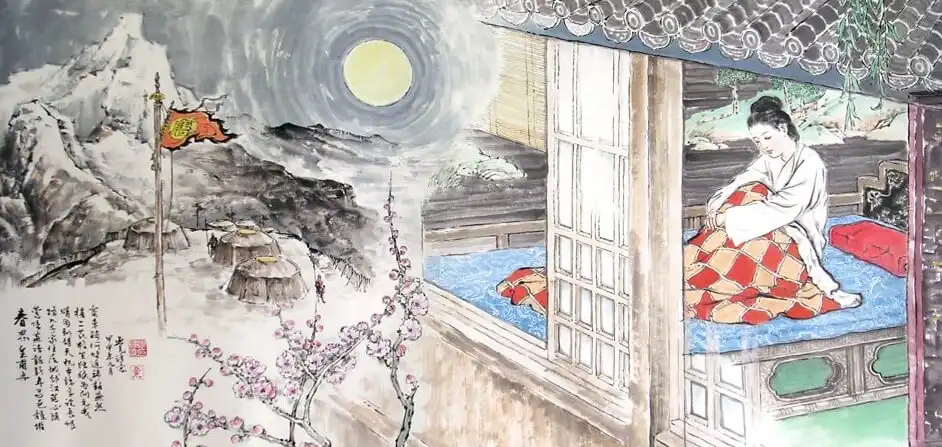
Huangfu Ran's Chun Si (春思) is a seven-character regulated verse (lüshi) written in the Mid-Tang period, capturing the voice of a wife left at home while her husband fights on the frontier. The poem opens with a cruel contrast: Ying ti yan yu bao xin nian, ma yi long dui lu ji qian. (莺啼燕语报新年,马邑龙堆路几千。) Orioles sing and swallows chatter, bringing news of the new year. But the road to Mayi and Longdui—the far northern garrisons—stretches thousands of miles. Spring is here at her window, yet the man she loves is at the edge of a frozen desert.
A Heart That Travels on the Moon
The second pair of lines shows the distance between two worlds: Jia zhu Qin cheng lin Han yuan, xin sui ming yue dao Hu tian. (家住秦城邻汉苑,心随明月到胡天。) Her home sits near Chang'an, close to the old Han palace gardens, surrounded by everything civilised and safe. But her heart has already left. It rides the bright moon all the way to the "Hu sky"—the foreign heavens where the northern tribes live. She cannot send a letter that far, so she sends her thoughts instead, hoping the moon will find him in the night.
Weaving Hate into Silk, Laughing Flowers on the Tower
The middle lines turn to her lonely days: Ji zhong jin zi lun chang hen, lou shang hua zhi xiao du mian. (机中锦字论长恨,楼上花枝笑独眠。) On her loom, she weaves the "brocade characters"—a story from the Jin dynasty, when a wife named Su Hui wove a poem into silk to send to her exiled husband. Our poet does the same, stitching her long hatred and longing into every thread. Then she looks up at the balcony, and the flowering branches seem to laugh at her sleeping alone. The word "xiao" (笑) means laugh, but it is the flowers laughing at her sorrow, making the spring feel even colder.
When Will the General Turn His Banner Home?
The poem ends with a question shouted into the wind: Wei wen yuan rong Dou Cheji, he shi fan pei le Yan ran? (为问元戎窦车骑,何时返旆勒燕然。) "I ask the great commander, Lord Dou of the Chariots and Cavalry: when will you turn your banners and carve your victory on Yanran Mountain?" She is not really speaking to a general. She is speaking to the whole war, asking when the fighting will end so her husband can come home. The story of General Dou Xian carving his victory into the stone of Yanran Mountain is famous. But this wife does not care about stone or glory. She only wants the man who left her at the new year to return before the flowers fall.